
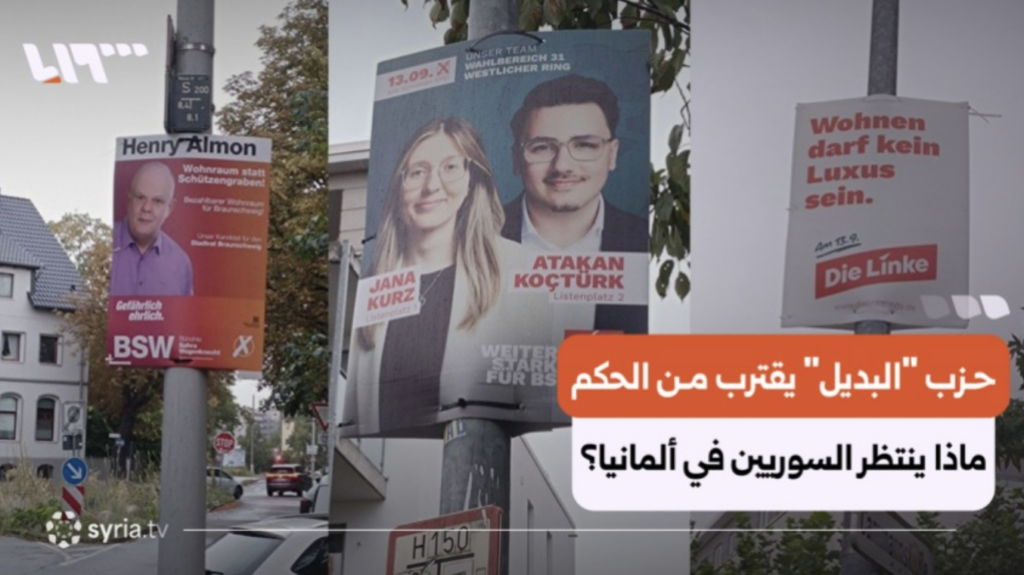
Rounds of parliamentary elections in Germany have once again dominated discussions among Syrian refugees, casting a shadow over their concerns due to the growing influence of the far-right Alternative for Germany (AfD) party and its rhetoric within state political corridors and the fabric of German society, as well as its continued push for the highest office in the country — despite its relatively short 13-year existence — alongside state-level parliamentary elections (Landtag).
Elections are scheduled to take place in the state of Saxony-Anhalt on September 6, while elections in Berlin and Mecklenburg-Vorpommern will be held on September 20. This follows elections in the state of Rhineland-Palatinate held on March 22.
The AfD is expected to achieve a historic victory in Saxony-Anhalt, winning its first parliamentary majority and potentially forming a government on its own — a prospect that has stirred anxiety among refugees over the possibility of worsening racism in the relatively small eastern German state, prompting many to consider leaving.
Merkel’s Return
Mounting concern over the AfD’s rising popularity and its approach toward the pinnacle of power became clearly evident with the return of former German Chancellor Angela Merkel to the public eye. She made a surprise appearance on Sunday at an event in the capital, Berlin, following a long absence from the political scene, warning of the far-right party’s growing influence and stating that it had come to dominate political discussions in the country and succeeded in imposing its themes on public discourse.
This appearance comes a week before the Saxony-Anhalt elections, which polls confirm are all but decided in favor of the AfD, at the expense of the ruling Christian Democratic Union (CDU), the party to which Merkel belongs.
The former chancellor called on citizens to “defend democracy,” noting that political debate had increasingly come to revolve around the issues raised by the AfD, and warning that this phenomenon was no longer confined to eastern Germany but had spread to western states as well.
At the same time, Merkel said the vast majority of citizens would not vote for the AfD, but that the situation required “defending democratic values and principles firmly and clearly.”
AfD Gains, Ruling Party’s Popularity Declines
A recent opinion poll showed the AfD leading strongly with 42 percent, compared with 22 percent for the conservative CDU, led by current German Chancellor Friedrich Merz — a notable political shift reflecting changing public sentiment in Germany and growing dissatisfaction with the political situation and the performance of the current federal government.
Looking back to May, a poll conducted by the INSA institute found that a majority of Germans supported holding early parliamentary elections. Support for early elections was highest among AfD supporters, while a large number of supporters of the left-wing BSW alliance and the Free Democratic Party (FDP) also backed the idea of new elections.
CDU/CSU supporters were the only group in which opposition to early elections prevailed, according to the poll results. The poll also showed rising criticism of Chancellor Merz and the federal government’s performance, amid ongoing debate over the economy, migration, energy, and the rising cost of living.
AfD Threatens Refugees
The AfD, known for its hardline stance on refugees and migration issues, has shown strong confidence about reaching power — not only at the state level but at the federal level as well, including the chancellorship. This was evident in statements by AfD leader Alice Weidel during an interview broadcast by German television channel ZDF last week.
During the interview, Weidel adopted a harsher tone on migration, criticizing European asylum policy and saying Germany suffered from high levels of illegal immigration and “no longer enjoys legal certainty.” She also called for increased deportations and reduced naturalization of foreigners, saying that all Syrians in Germany — numbering around 1.3 million — should “be returned to their homeland.”
From the Euro to “Selective” Racism
“When the AfD was founded in 2013, its goals were related to taking Germany out of the eurozone and opposing bailouts for economically weak European countries at the time, such as Spain and Greece. This had no bearing on foreigners in Germany at the time,” explained Syrian-German academic Wasim Al-Matar.
Mr. Matar told Syria TV: “After the waves of asylum seekers, which happened to coincide with the AfD’s founding, the party’s base expanded and its goals shifted, using vague, elastic slogans such as preserving German customs and values — a slogan that managed to draw in racists and opponents of foreigners and other religions to join the party’s ranks. It has now become the largest known racist bloc, and has surpassed the 5 percent electoral threshold.”
Mr. Matar noted that Arabs and Afghans in general are among the groups most targeted by the AfD, given that they are Muslims — a group the party views as among those most capable of changing Germany’s general appearance, from dress and head coverings to entirely different customs and traditions.