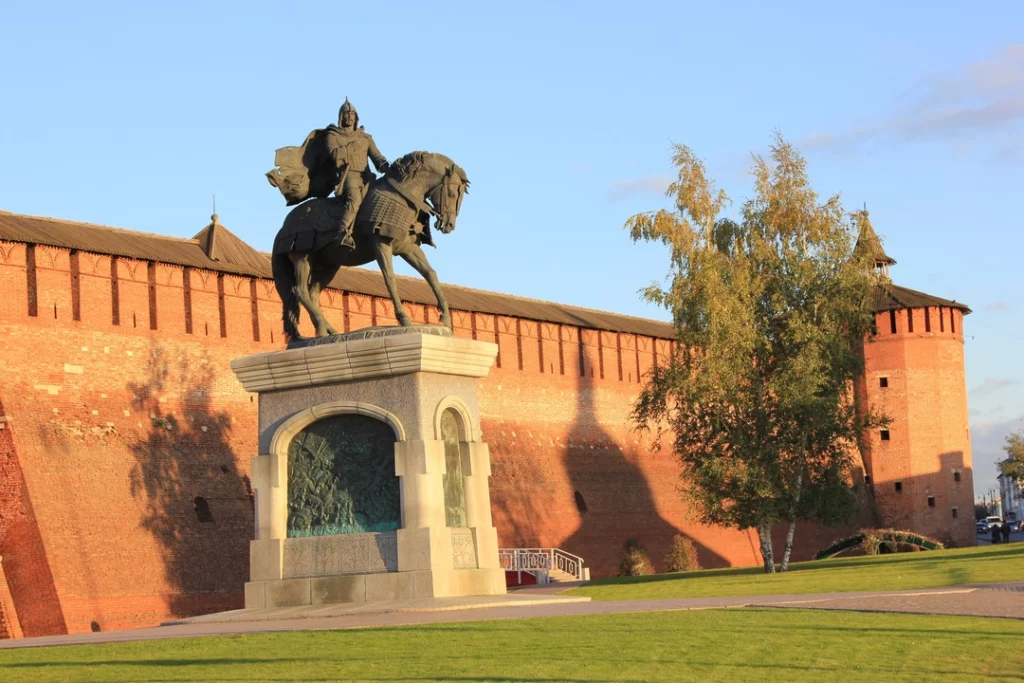
The Russian authorities announced the “wonderful acquisition” of the relics of Dmitry Donskoy and sent them to the front. Modern propaganda paints Dmitry as a holy fighter against the coalition of the “West” and the defender of Orthodoxy. This is already a new iteration of an alternative story around this historical figure, which began to become myths two hundred years after the death of the prince. During his life and in the next few centuries after his death, Dmitry was neither Donskoy nor holy (he was with the church in deep conflict), but the fighter against the West called him and completely ridiculous: no single West then simply did not exist, and everyone fought with everyone.
In July 2026, a long-known burial of Dmitry Donsky was opened in the Kremlin’s Arkhangelsk Cathedral, after which the prince’s remains began to be honored as relics. In a few weeks, Vladimir Putin called their acquisition miraculous, and in the State Duma proposed to send particles to the Russian military in Ukraine.
Moreover, the Russian authorities decided to use the prince in a modern context: the propagandists of “Russia-1” presented Mamay and the Golden Horde, with which the then Moscow prince fought as a “proxy of the West”. So the image of Donsky became another example, as in ideological interests the real historical character (another vivid example – Alexander Nevsky) turns into something completely unlike him.
In fact, the medieval prince was an extremely controversial character, fought with the Slavic neighbors, oppressed the Orthodox Metropolitan, and the West was very conditional – if one is considered Pagan at that time Lithuania, which itself fought with the Catholic-Tevtonian.
However, all this did not prevent the fact that the tradition of sending icons and relics to the military in the places of hostilities — from the Russian operation in Syria to the war against Ukraine — was again in demand.
What kind of man and ruler was Dmitry Moscow
The traditional image of Dmitry Donsky is built around several major achievements. After the death of his father in 1359, the nine-year-old Dmitry was at the head of the Moscow principality and initially relied on Metropolitan Alexia and boyarism.
Under him, Moscow significantly increased: in 1367, a white-stone Kremlin was built, which withstood the campaigns of the Lithuanian prince Olgerd. In the 1370s, Dmitry came into conflict with Mamay, defeated the Horde army on Vozhe in 1378, and two years later — on the Kulikov field. Although in 1382 Tohtamysh burned Moscow and the payment of tribute was resumed, to the death of Dmitry in 1389 the Moscow principality was considerably strengthened, and the great princedom of Vladimir he handed over to his son Vasily as a hereditary possession, without seeking a separate sanction of the Horde.
An important part of the later image of the prince was his connection with Serge of Radonezh and the story of the blessing before the Battle of Kulikovo, although the details of this episode appear mainly in the late sources. At the same time, the real rule of Dmitry contained many episodes that are poorly placed in the image of an impeccable Orthodox sovereign.
The real rule of Dmitry contained many episodes that are badly laid in the image of a perfect Orthodox sovereignOne of the most famous occurred in 1368. Tver remained the main rival of Moscow in North-Eastern Russia, and its Prince Mikhail Alexandrovitch relied on the union with Lithuania. Dmitry and Metropolitan Alexy invited Mikhail to Moscow to deal with the dispute about inheritance and guaranteed his safety with a cross-kissing – a religious oath. Nevertheless, Michael and his boyar were arrested, and some of the disputed possessions were selected.
A few years later, Moscow received the hands of the son of Michael, fifteen-year-old Ivan, who was held hostage in Orda. He was bought, but instead of liberation concluded in Moscow and used for pressure on the father. As a result, Mikhail renounced the claims to the great princess and paid for the son a large ransom.
The policy of Dmitry and in relation to his own subjects and neighboring Russian lands was tough. In 1371, in order to obtain a label in the Horde, he had to raise huge funds. The chronicle noted the “hardship given to the great people” after his return, and sources speak of the ruin of firm possessions.
In 1375, during the new war with Tver, the Moscow army burned posad, churches and surrounding villages.
After the invasion of Tokhtamysh in 1382, Dmitry sent an army already against Ryazan, the prince of which was accused of helping the Khan. The chronicler wrote that the Ryazan land was ravaged and burned “the emptiness of the Tatar rati.” Thus, the prince, who entered history primarily as a defender of Russia from the Horde, himself consistently used the usual methods of war for his time: the destruction of the land, coercion and seizure of property.
It is particularly difficult to reconcile with the latest faithful prince his conflict with Metropolitan Cyprian. The Russian Church was then subject to the Patriarchate of Constantinople, who, after the death of Metropolitan Alexy, considered Cyprian the legitimate head of the metropolis. Dmitry, however, refused to accept him and tried to put on the Metropolitan the department of his close Mitya.
When Cyprian went to Moscow in 1378, he was detained, humiliated and expelled. The Metropolitan himself wrote about beatings, robbery and hunger. In response, he excommunicated and cursed those involved. In 1380, Dmitry was forced to reconcile with Cyprian, but after the ruin of Moscow, Tohtamysh again expelled him. The Metropolitan finally returned to the capital after the death of the prince.
Critics and statements about Mamai as a “proxy of the united West” and the fact that Dmitry Donskoy united Russia in the face of a united West are not standing. In 14th-century Europe, there simply did not exist what could be called a “one West.” England and France fought the Hundred Years War. From 1378 the Roman Catholic Church itself was split between the Roman and Avignon popes. The Italian states constantly fought with each other.
In 14th-century Europe, there simply did not exist what could be called a “one West”Yes, Dmitry Donskoy has repeatedly fought with Lithuania, which was geographically in the west of Moscow. But also Lithuania itself, in which both Orthodox and Gentiles and Catholics lived at that time, quite successfully fought with the even more Western Teutonic Order. In this case, it was helped by Western Catholic Poland.
As for the “cohesion of Russian lands around Moscow”, here Prince Dmitry really achieved a lot. In the thirty years of his reign, the territory of the Moscow principality grew several times, and the great princedom of Vladimir actually took hold of the Moscow dynasty.
In the struggle for superiority in North-Eastern Russia, Dmitry achieved a decisive margin over Tver: after the defeat of 1375, Prince Mikhail Tverskaya refused to claim the Vladimir table and could no longer act as a political center equal to Moscow. Moscow under Dmitri became able to gather around itself wide coalitions of other Russian princes – first for a campaign on Tver, and then against Mamay in 1380.
At the same time, the capital itself was strengthened: in 1367, the white-stone Kremlin was built, which became a symbol of the new political weight of Moscow. By the end of the reign, Dmitry managed to extend his influence to remote principalities, including the Novgorod Republic.
But it is important to understand that all this was not an abstract “collection of Russia”, but above all a consistent strengthening of its own state – the Moscow principality. And it was achieved quite conventional for the Middle Ages by means: wars, coercion, hostage-taking and the ruin of rivals – literally iron and blood.
All this does not turn Dmitry into an exceptional villain: cruelty, internecine wars and treaty violations were part of the political reality of the 14th century. But these episodes make him a far more complex historical figure than the ideal Orthodox warrior ruler.
In addition, the question arises: how did the prince, who entered into direct conflict with the head of the Russian Church, who allowed violence against him and even received the church curse, after six centuries was added to the league of blessed saints?
As Dmitry became Donskoy and was canonized
The memory of Dmitri Ivanovich was gradually developing. Initially it remained only in the family circle of the Moscow princes. The contemporaries knew him before the great prince Dmitry Ivanovich of Moscow and Vladimir, and the nickname of Donskoy was fixed only in the 16th century, when the Kulikovskaya battle began to be rethought as the beginning of Moscow’s struggle with the Horde. At the same time, the victory on the battlefield in the Battle of Kulikovo is associated with other names: according to the established statement, the battle was struck by an ambush regiment, which was previously hidden in the oak tree; it is usually associated with Prince Vladimir Andreevich Serpukhov and the voivodeship Dmitry Bobrok-Volynsky.
This image of Dmitry Donsky was especially active in Ivan the Terrible: his own campaign to Kazan in 1552 he symbolically associated with the Kulikovo victory, and Dmitry became a historical predecessor of the expanding Moscow state.
In the Russian Empire, Donskoy finally entered the national pantheon. Interest in it was particularly heightened during the Napoleonic wars, and in the 19th century there were monuments, paintings and literary works that established his image as a defender of the country and the great commander.
After the revolution of 1917, the religious component disappeared, but since the late 1930s Donskoy was again in demand in the Soviet military-patriotic tradition. In a speech at the parade on November 7, 1941, Stalin named him among the “great ancestors”, and during the war there was a tank column “Dmitry Donskoy”, collected, as it was announced, on the donations of the faithful of the Russian Orthodox Church.
The next important frontier of memory of Dmitri Donskoy was the 600 anniversary of the Kulikovskaya battle. The anniversary was widely celebrated by the state in 1980. At the same time, he became the reason for the return of the religious reading of the figure of the prince.
At the same time, the popular biography of the prince in the series of ZZL under the authorship of the writer Yuriy Lochica was published. In it, Dmitry was portrayed almost as an ideal Orthodox ruler, and complex episodes of his biography were smoothed.
Therefore, the canonization of Donskoy at the 1988 Local Cathedral, in the year of the millennium of Russia, became the end of a long process rather than an unexpected decision. Then the ROC chose for the first major series of canonizations in Soviet times mainly historically and politically safe figures.
The list, in particular, included Andrey Rublöv, Maxim Grek, Paisiy Velichkovsky, Ambrose Optinsky and Feofan Zavoknik. They were medieval heroes, monks, theologians and ascetics, whose glorification allowed the church to restore its own historical tradition, not yet raising the most conflicting topic for the Soviet power – persecution of the church after 1917.
It is significant that Tikhon (Bellavin), the first patriarch of Moscow and all Russia after the restoration of the Patriarchate in Russia in 1917, was canonized only a year later and cautiously as a saint. The first new martyrs appeared in the official calendar of the ROC after the collapse of the USSR.
In this sense, Dmitry Donskoy was especially convenient: the Soviet state itself made him a historical hero, so his transformation from a “great ancestor” into an Orthodox saint practically did not require a revision of the Soviet version of history.
Orthodox shrines in war
The use of Orthodox shrines in war has a long tradition in Russian history. In the Russian Empire, regimental and miraculous icons accompanied the troops, before them served as prayer services, they were blessed by the parts sent to the front.
In 1812, the Smolensk Icon of the Mother of God was under the active army, before it prayed on the eve of the Borodino battle. A special fate was the icon-relic “The Appearance of the Mother of God to the Venerable Serge”, written in the XVI century on the boards from the coffin of Serge of Radonezh: it was sent to the troops in 1812, during the Crimean and Russian-Turkish wars, the Russian-Japanese war and the Supreme Commander-in-Chief’s bet in 1914.
This practice became particularly noticeable during the Russian-Japanese War. According to the memoirs of the contemporaries, General Kuropatkin on the way to Manchuria constantly gave icons, and one memoir wrote писалabout his wagon, taken by icons. The general himself considered the Orthodox faith and religiosity one of the advantages of the Russian army over the Japanese. Against this background, there was a famous sharpness attributed to General Mikhail Dragomirov: “So much gained Kuropatkin images that he does not know how to win.”
After a break in the times of the USSR, such practices began to return together with the rapprochement of the state, army and ROC. This is well seen in the example of the Russian operation in Syria. In 2016, at the airbase Hmamim sanctified the chapel of George the Victorious and handed over there an icon with a particle of his relics. In 2018, Patriarch Kirill sent to the temples of Russian bases in Hmamim and Tartus the icon of Seraphim of Sarovsky, and the servicemen – icons of the Resurrection of Christ. He concluded his address with the words: “I bless you with your labors.”
After the beginning of Russia’s full-scale war against Ukraine, the sacred component became even more noticeable. On March 13, 2022, Kirill handed over to the head of the RosGuard Viktor Zolotova the Augustian Icon of the Mother of God – an image that arose from the military legend of the First World. Zolotov publicly stated that the icon will “protect the Russian army and accelerate our victory.”
In 2024, the Spas TV channel organized a procession along the line of combat contact with the relics of Dimitri Solunsky, Alexander Nevsky and George the Victorious. The shrines were delivered to the military units and to the temples located at the frontline.
In July 2026, there was also a story about the loss of a particle of the relics of Alexander Nevsky during transportation in the occupied territory of the Donetsk region: it was reported that the car accompanying the shrine was hit by a drone and the soldiers who were in it were killed. However, there was no independent confirmation of this story, and Novaya Gazeta Europe indicated that the message could have been unreliable.
Prince Dmitry Donskoy is a figure characteristic of the late Middle Ages. He was cruel, sometimes treacherous, not afraid of even the church curse and successfully achieved his goals, not always taking into account the price. Over the centuries that followed, this controversial figure was consistently reworked into a hero of imperial, Soviet, and then church historical memory.
Today it is not so much the real ruler of the 14th century that is in demand as the image of the winner and defender of the state. Its inclusion in the current military ritual shows how the Russian authorities are seeking additional symbolic resources to justify protracted aggression. Modern warfare is placed in a series of former “fateful” battles, and military and political failures are given a higher meaning. And so, the Russians must be filled with a sense of historical and spiritual continuity.
In addition, in a situation of growing economic crisis and the highest uncertainty in the history of Russia in the last twenty years, citizens want a miracle. And this desire the Kremlin, among other things, is trying to satisfy the “acquisition of powers.”