
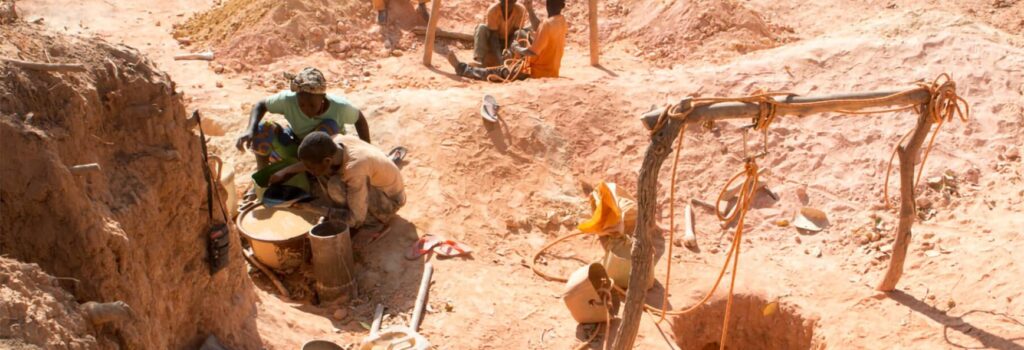
Senegal faces no immediate threat from JNIM, but the group’s entrenchment in bordering Mali gives it access to cross-border communities, trade, and gold mining.
Executive summary
The expansion of the al-Qaeda-affiliated Jama’at Nusrat al-Islam wal-Muslimin (JNIM) in western Mali has increased security and economic pressure on neighboring Senegal. JNIM has expanded its operations along the Senegalese border but has refrained from launching attacks within the country. Instead, the group has sought to discourage closer military cooperation between the Senegalese and Malian militaries. JNIM has also disrupted the main trade and transport route between the two countries through its ongoing fuel and transport embargo announced in September 2025. This is particularly significant for Senegal because Mali is its largest export market, accounting for more than 20% of Senegalese exports.
Eastern Senegal’s mining sector is particularly exposed because of its proximity to western Mali and the highly integrated gold-mining economy across the Senegal-Mali border. There is currently no evidence that JNIM controls artisanal mining on the Senegalese side, although the group taxes local communities in western Mali and may also collect revenue from artisanal mining sites. As JNIM becomes more entrenched along the border, it could increasingly benefit from the cross-border mining economy and use existing networks to establish a presence within Senegal.
JNIM pressures Senegal without opening a new front
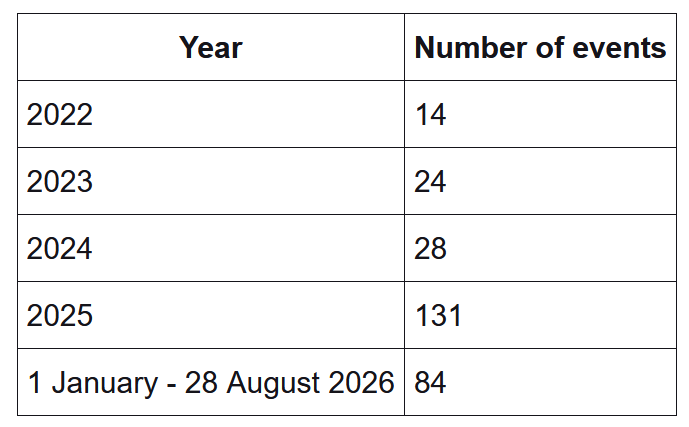
JNIM activity in Mali’s Kayes region dates back to at least 2017 but began to intensify gradually from 2022 and reached its highest recorded level in 2025 (see table below). The group’s coordinated offensive on 1 July 2025 marked the culmination of its westward expansion when it attacked several targets across Kayes, including Malian security forces at police and customs posts in Diboli, a border town on the border with Senegal. However, JNIM has refrained from launching attacks inside Senegal and has instead sought to deter the Senegalese state from becoming more involved in the conflict in Mali. Between December 2024 and January 2025, JNIM sought to open negotiations with Senegal to discourage closer military cooperation and joint patrols with Malian forces, although Senegal did not pursue the talks. In an audio statement made on 24 April 2025, a senior JNIM figure criticized the media coverage of Senegalese-Malian joint patrols and publicly threatened Senegal and other countries for supporting governments fighting the group.
Events involving JNIM in Mali’s Kayes region
JNIM’s growing presence along the border adds a coercive element to its efforts to exert military pressure on Senegal while avoiding direct confrontation. Through attempted negotiations and threats, JNIM has sought to discourage closer Senegalese military cooperation with Mali without opening a new front.
Yet, JNIM has also increased economic pressure on Senegal. In September 2025, the group imposed a fuel and transport embargo on the Malian cities of Kayes and Nioro, severely disrupting the Dakar-Kayes-Bamako transport route. JNIM later extended the embargo to the main transport routes connecting Bamako with Dakar, Abidjan, and Conakry. This embargo is still ongoing even though the group has not been able to enforce it effectively. It has had significant ramifications for Senegal, as Mali is its largest export market. It accounts for more than 20% of Senegal’s exports, worth over $1.3 billion.
Cross-border gold mining provides potential entry points for JNIM
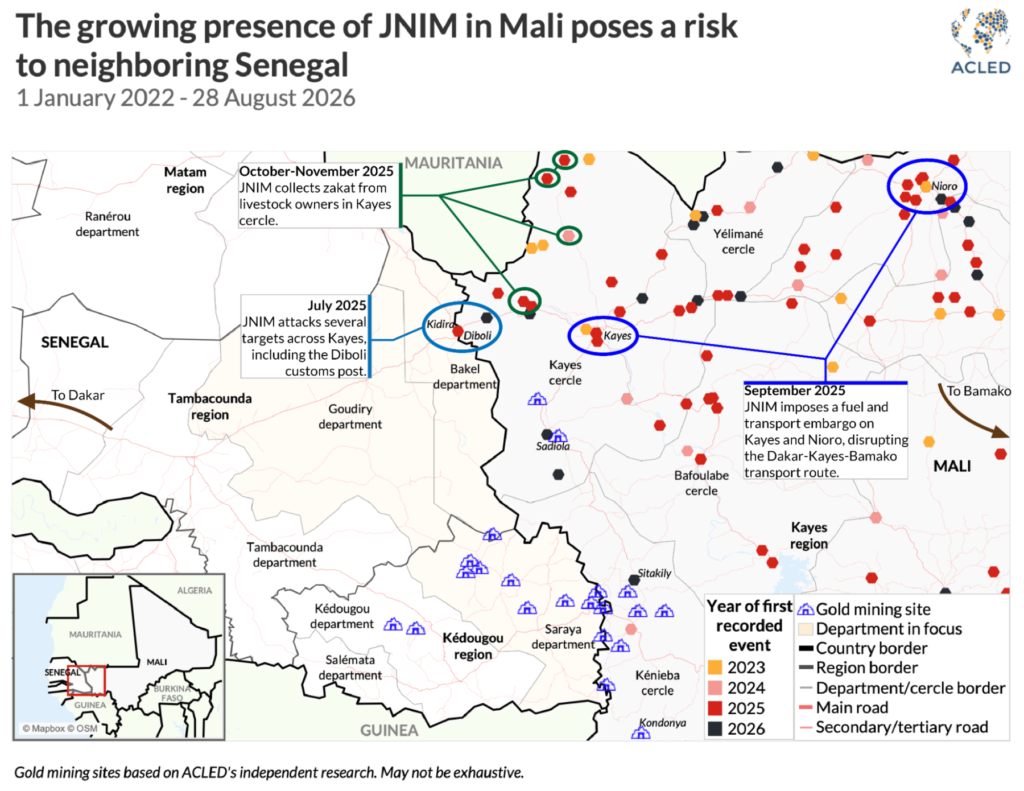
The departments of Bakel and Goudiry in Senegal’s Tambacounda region and Saraya in the Kedougou region are particularly vulnerable to JNIM’s growing presence in neighboring Mali (see map below). Bakel shares a long border with Mali, much of it along the Faleme river, while Saraya lies within Senegal’s main gold-mining area.
Poor infrastructure, limited mobile coverage, and numerous informal crossings used by communities on both sides make it difficult for Senegalese security forces to monitor parts of the border. Gold mining adds another layer to this. The gold-mining economy is closely connected across the Senegal-Mali border, and workers, traders, buyers, and gold regularly move between the two countries. However, the scale and informal nature of these cross-border movements make it difficult to distinguish routine cross-border activity from potential militant movements.
In this context, JNIM’s growing presence on the Malian side of the border has become increasingly important. In October and November 2025, JNIM militants collected zakat (alms or taxes) from livestock owners in at least four communes of Kayes cercle, including areas close to Bakel and in the wider Senegal-Mali-Mauritania border area (see map above). JNIM has also carried out attacks on mining operations elsewhere in Mali to pressure companies into entering into protection agreements and to extract revenue. The group may also have collected revenue directly from artisanal mining sites in western Mali, though this remains unconfirmed.
As JNIM becomes more entrenched in western Mali, the likelihood that the cross-border gold-mining economy could provide entry points for the group to establish networks within Senegal is low in the next six months, but could increase over time. The risk is particularly relevant where informal mining, trade, and cross-border movement overlap with limited state presence.
Outlook: JNIM’s focus remains on Mali despite increased access in eastern Senegal
Over the next 12-24 months, JNIM is unlikely to prioritize opening a new front in Senegal. The group remains committed to its campaign in Mali, where it continues to contest state control and maintain pressure on Bamako. A new front would risk overreach with little to gain, as demonstrated by JNIM’s earlier experience in Ivory Coast and, to a lesser extent, in Togo, where the group has failed to sustain its violent campaigns. Senegal, therefore, faces no immediate threat of JNIM spillover, although the group’s presence along the border, its ability to disrupt trade, and its opposition to Senegalese military cooperation with Mali will continue to create security and economic risks.
Longer-term risks are concentrated in eastern Senegal, especially in the Bakel, Goudiry, and Saraya departments (see map above). JNIM’s entrenchment in western Mali gives the group greater access to cross-border communities, trade, and the gold-mining economy. These connections could provide entry points for recruitment, financing, logistics, and local networks in Senegal. Such precursor activities would suggest the emergence of an infiltration phase rather than an immediate shift to violence. A change in JNIM’s priorities or its relationship with the Senegalese state would substantially alter Senegal’s risk profile.
Key factors that could alter Senegal’s risk profile
Senegalese military cooperation with Mali: More direct Senegalese involvement in operations against JNIM would increase the risk of JNIM retaliating. Increased joint patrols, cross-border operations, or other military support to Malian forces would be important indicators of a possible change in JNIM’s approach toward Senegal.
JNIM’s entrenchment along the Senegalese border: Continued entrenchment in western Mali would increase JNIM’s access to communities and networks spanning the border. Recruitment, preaching, financing, or the establishment of more permanent support networks in Bakel, Goudiry, and Saraya departments would indicate a growing presence inside Senegal.
Artisanal mining and cross-border trade: Increased JNIM involvement in artisanal mining, gold trading, taxation, or protection agreements in western Mali would increase its access to networks extending into eastern Senegal. Further disruption to the Dakar-Kayes-Bamako transport route would increase the economic impact on Senegal, particularly in its trade and mining sectors.