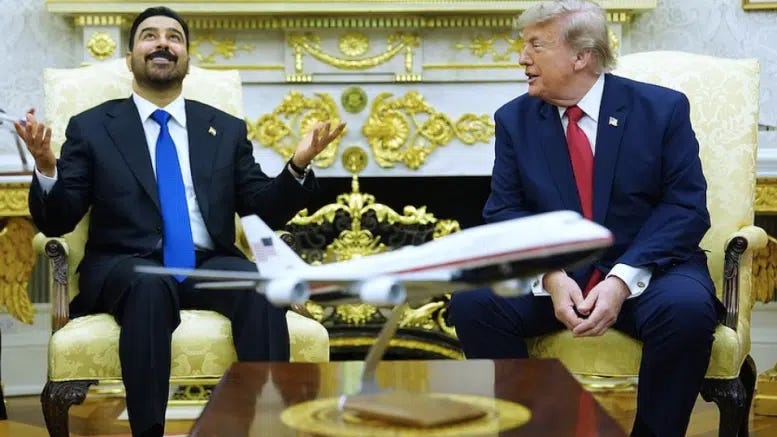
First, there was the Technocrat-in-Chief meeting on July 14 with an up-and-coming, newly selected Technocrat Prime Minister from Iraq, Ali Falih Kadhim al-Zaidi. Secondly, the multi-billion-dollar deals flowed like the Euphrates River.
Why does this matter? Because we have fought two bloody wars in and over Iraq, and right now we are still pounding Iran, a country that is closely allied with Iraq. Iraq and Iran share a border, a religion, and a long, tangled history. You cannot talk about one without the other.
Trump has now turned the tables. Instead of treating Iraq as a problem to manage, he is embracing it as a partner to build. And the man he is embracing is al-Zaidi, who has been installed as a “technocrat” to reform Iraq’s economy and its trade relationships. Al-Zaidi was not elected. He said so himself, on television, more or less. He was chosen by a committee of Iraq’s political parties, the Coordination Framework, in a meeting that reportedly took twenty-five minutes.
Reports say Trump was not directly involved in picking him. But Trump forced the outcome by eliminating the other leading contender. Nouri al-Maliki wanted the job, and Trump made it clear that American support for Iraq would be cut off if al-Maliki got it. Al-Maliki withdrew. Al-Zaidi was in.
That was not an election, but rather a selection, with a single veto power sitting in Washington.
He is only forty years old. He has never held political office before in his life. He is an oligarch businessman, chairman of Al-Janoob Islamic Bank, an institution that Iraq’s own central bank banned from dollar transactions back in 2024 because of money laundering concerns tied to Iran. He was never charged with anything. But the file exists, and Washington knows it, which means Washington has leverage over him whenever it wants to use it.
Members of the Atlantic Council have already started calling him the “Trump of the Mideast.” (Before I did this research, I called him “mini-me” on national TV) A businessman with no political background, an outsider who talks like a builder instead of a politician. Sound familiar? It should. It is the exact same packaging Trump himself has always used, and it works the same way in Baghdad as it does in Washington. The label lets you brand someone as independent even when the machinery that produced them is anything but.
Since taking office in May, al-Zaidi has run a public anti-corruption campaign, complete with raids and arrests of former officials. He has pledged to bring every armed militia in Iraq under state control by September 30, the same date the remaining American troops are supposed to leave. He has appointed a new central bank governor whose specialty is anti-money laundering. Every move fits the same pattern: clean up the money, cut the militias off from it, and open the country to American- and Gulf-aligned capital.
I wrote back on June 18 that the goal in Iran was never containment. It was economic reintegration. The men who built that framework, Steve Witkoff and Jared Kushner, were not fighting a war so much as writing a development contract. Iran sits on top of the map that matters, the corridor between the Gulf, the Mediterranean, and the trade routes running east into India and north into Russia. You do not spend that kind of military effort just to leave the ground empty when it is over. You spend it, and then you rebuild the ground on your own terms.
Iraq is the same playbook, running a few steps ahead. And that is exactly what should catch your attention, because Iraq is smaller, weaker, and far more dependent on Washington than Iran will ever be. If you want to see what “reintegration” actually looks like in practice, in real signed documents instead of grand strategy, look at Iraq first. It is the pilot program.
So what did al-Zaidi actually get in Washington? A bonanza, actually.
A pipeline deal. Iraqi officials confirmed an agreement between Iraq, the American firm Chevron, TI Capital, and Qatar’s UCC to build a pipeline from Basra in the south to Haditha in the west. The stated reason is to move Iraqi oil around the Strait of Hormuz, which closed during the Iran war and cost Iraq badly.
Oil company deals to rebuild and expand production. Iraq signed a development deal for the Hamrin oil field with a US company just days before the visit. Chevron is negotiating for the West Qurna-2 and Nasiriyah fields. Iraq wants to push production up to 4.3 million barrels a day.
The release of frozen funds. This is the part almost nobody outside the financial press picked up on, and it deserves more attention than it got. Iraq’s oil money does not sit in Baghdad. It sits in an account at the Federal Reserve Bank of New York. When Iraq needs cash for its own domestic economy, the money gets physically flown over on cargo planes. In April, the Trump administration blocked one of those shipments, close to $500 million, and froze parts of security cooperation with Iraq at the same time. The stated reason was pressure on Baghdad to cut Iran-backed militias off from access to dollars. The shipments only resumed at the end of June, right before al-Zaidi’s trip, after Iraq agreed to new dollar controls designed to keep the money out of Iranian hands. Read that again. Iraq’s own oil money, held in an American bank, was withheld from Iraq’s own government until Iraq agreed to new financial rules written with an eye toward Iran. That is not aid. That is leverage, dressed up as generosity, released right on schedule to make the Washington visit look like a triumph.
Assistance with the Development Road, the highway and rail corridor meant to connect Basra to Turkey and on into Europe, a project Iraq is openly pitching as competition for the Suez Canal.
A proposed Energy and Development Fund, reportedly worth $400 billion over thirty years, built around a thirty-year industrial master plan that gives top priority to American corporations, and structured, according to al-Zaidi’s own announcement in late June, to operate outside OPEC’s production limits entirely. Think about that for a second. Iraq is a founding member of OPEC. And its new prime minister is now floating a financial structure explicitly designed to sidestep the cartel’s own quotas, backed by hundreds of billions in American-linked capital.
He also confirmed a program to hand out one million serviced residential land plots to Iraqi citizens, and he made a point of saying he has no ambition to run for future office or build a political party of his own, which he framed as freedom to make hard decisions without worrying about reelection. An unelected Technocrat leader boasting that he answers to no voters is not usually something you’d expect a country to celebrate.
That is a staggering list of concessions and commitments for a first foreign visit. It reads less like a courtesy call between two heads of government and more like the signing of a franchise agreement.
Here is the piece that ties this whole story back to my June article, and it is the piece that most analysts have missed entirely.
Iran’s Supreme Leader Ali Khamenei was killed in a joint US-Israeli strike in late February 2026, at the opening of the war. His funeral was held in stages across Iran and Iraq in late June and early July, just days before al-Zaidi’s trip to Washington. Al-Zaidi personally took part in the funeral procession in the Iraqi holy city of Najaf. He honored the man Trump had ordered killed. Then, within the same week, he flew to Washington and sat across from Trump in the Oval Office, all smiles, talk of “tremendous chemistry” between two businessmen who had never held office before landing at the top.
Two American officials told reporters that Iranian officials had actually pressured al-Zaidi’s team not to make Washington his first trip abroad as prime minister. He went anyway. US officials are reading that as proof he is serious about an “Iraq first” tilt toward America and away from Tehran.
Maybe. Or maybe it proves something else. Al-Zaidi is a devout Shia Muslim with existing relationships inside Iran’s religious and political networks, the same networks that produced the very bank he used to chair. He can honor Khamenei one week and shake Trump’s hand the next because he does not have to choose sides in the way most Iraqi politicians before him did. He is not a radical Islamist. He is not a militia commander. He is not tied organically to the Shia parties that grew up after 2003, which were attached to Tehran. He is a banker, and bankers do not pick sides. They pick whichever side is paying, and right now both sides are paying.
That is precisely why he is such a useful template for what comes next in Iran itself. A leader trusted enough in Shia religious circles to walk in a mourning procession for the Ayatollah, and trusted enough in Washington to be called a “fantastic champion” by Trump, is a leader who can carry money and infrastructure deals across a line that used to be a wall. Iraq is not just getting reintegrated on its own. Iraq is being built into the doorway Iran walks through next.
Ask yourself what containment ever looked like in either country. It looked like troops, sanctions, and standoffs. What we are watching now looks nothing like that. It looks like pipelines, funds, land grants, and central bank governors trained in anti-money laundering. It looks like a thirty-year industrial master plan and a $400 billion fund that steps outside OPEC’s own rules. Nobody fired a shot to get any of that. It was negotiated, signed, and announced with smiles and handshakes.
I said in June that the Iran war was never about containment. It was about opening ground for a development contract – economic reintegration. Iraq confirms it. The corridors, the funds, and the men installed to run them all point in the same direction. Whether you call it reintegration or something else, it is not containment, and it never was. Watch September 30. Watch whether those militias actually disarm and watch whether the American troop withdrawal proceeds on schedule right alongside it. Watch whether that $400 billion fund gets a charter, and watch what currency and what rails it settles in when it does.
Iraq is the rehearsal. The main show is still in Tehran.