
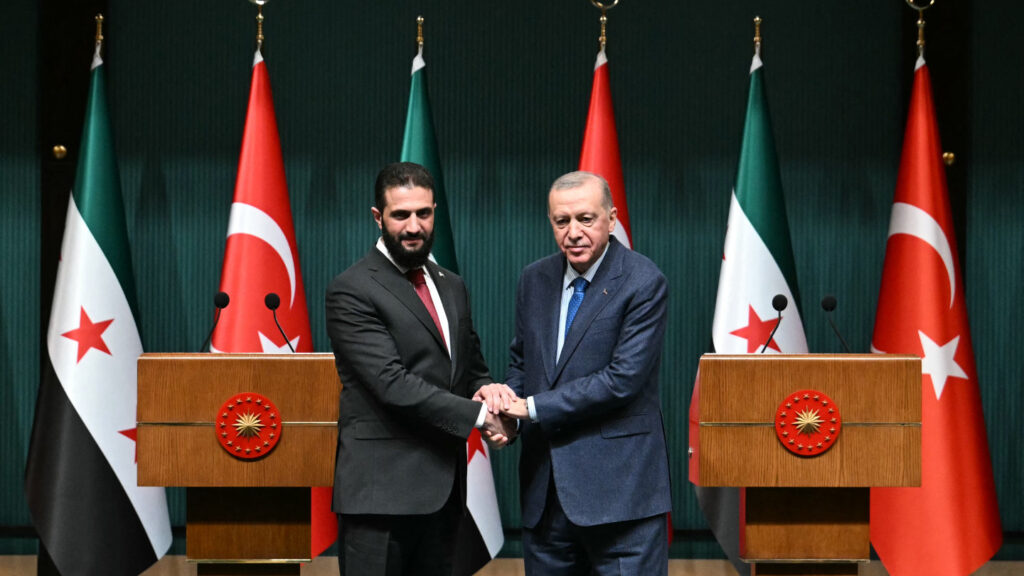
In another sign of how swiftly relations have improved, Turkish President Recep Tayyip Erdogan will soon visit Syria, Turkish Foreign Minister Hakan Fidan said on 14 September after a two-day visit.
This year marks the 80th anniversary of the two neighbours establishing diplomatic relations in 1946, the same year Syria became independent.
A brief look at the history of Turkey-Syria relations suggests that the present moment may mark the closest the two countries have ever been.
Disquieting developments
Syria and Lebanon were under French mandate from the collapse of the Ottoman Empire until the aftermath of the Second World War, when both countries became independent. Turkey immediately established diplomatic relations. At the time, it was viewed as “a Turkish step towards a closer union with the Arab world”.
From those early years of relations, the two neighbours joined rival alliances and forged close ties with the two superpowers. Turkey joined the NATO alliance in 1952. After Turkey concluded a mutual defence treaty with Iraq, then under the pro-Western monarchy, Syria in 1955 recalled its envoy to Turkey for consultations.
Tensions reached an unprecedented high point in 1957 when regional fears spread of a communist takeover in Damascus following the appointment of leftist officers to the Syrian Army in August. Ankara deployed thousands of troops along its border. Damascus charged that Turkey massed its troops in a “manner which presages imminent attack”.
The crisis reached a breaking point by that October, with Damascus additionally charging that Turkish soldiers fired at Syrian border residents and Turkish warplanes flew over Syrian territory.
It even risked drawing in the superpowers, with the US warning the Soviet Union that it would honour its commitments to Turkey’s defence and Moscow declaring it would “inevitably” intervene if Turkey went to war. Soviet leader Nikita Khrushchev wasn’t so subtle when he remarked that “if war breaks out, we are near Turkey and you are not”.
The crisis showed signs of thaw and ultimately ended that month. In early October 1957, Syria’s new minister to Turkey clarified that Syria only feared an attack by Israel, adding: “I hope Turkish-Syrian relations become better for both of our countries have close ties in language, history and custom.”
Khrushchev seized the opportunity presented by Turkey’s National Day on 29 October to “unexpectedly” show up at the Turkish Embassy in Moscow and toast “peace,” crediting Soviet diplomacy with “cooling off” Turkey.
Syria entered into a brief political union with Gamal Abdel Nasser’s Egypt, then known as the United Arab Republic, in 1958. In January of that year, Turkey again warned its southern neighbour of communist infiltration, arguing that such danger “has introduced in our region disquieting developments”.
Damascus seceded from the UAR in 1961 following a coup. Nasser broke off diplomatic relations with Turkey for recognising the new provisional government in Damascus on the day it was formed, citing a “hostile attitude” toward the UAR.
Any hopes for warmer relations between Ankara and Damascus were short-lived. The 1963 coup brought the Ba’ath Party to power, and Syria entered a closer, lasting relationship with Moscow, which became its leading arms supplier for the rest of the Cold War.
Still, the neighbours avoided another crisis like 1957 until the end of the century.
Insurgency, territorial disputes, and water-sharing
The rule of the Assads in Syria began in 1970 when Hafez al-Assad seized power in yet another coup, invariably justifying his family’s long and brutal reign by citing the endless coups that preceded them.
Assad’s first decade in power coincided with Turkey beginning its damming of the Tigris and Euphrates rivers, both of which originate in Turkey and flow downstream to Syria and Iraq. Ankara’s move would create recurring tensions in the relationship over the decades to come.
Another dispute Assad would raise was over Turkey’s Hatay Province. During the French Mandate over Syria, it was known as the Sanjak of Alexandretta. France supported its transfer to Turkish sovereignty in 1939, hoping to convince Ankara to join the Allies against Nazi Germany. It didn’t work. Alexandretta became Hatay.
The Hatay and water-sharing disputes persisted for years. Assad would host the Kurdistan Workers’ Party group, well-known by its Kurdish PKK acronym, and its leader Abdullah Öcalan for years after it launched its armed rebellion against Turkey in 1984. While the two sides signed a border security agreement in 1985, relations between them were strained in this period by Syria’s support of the PKK and the Armenian Secret Army for the Liberation of Armenia.
In 1989, two Syrian MiG-21 fighter jets flew 12 miles into Turkish airspace and shot down a civilian Turkish plane, killing all five people aboard. Syria offered condolences and ordered an inquiry.
By 1990, Turkey’s massive Ataturk Dam on the Euphrates neared completion, again raising objections downstream, with Syria fearing it could lose 40 percent of water it could hitherto rely upon.
Turkey’s state minister said his country had “no international obligations” to provide other countries with water but added that Ankara would do its “best not to harm our neighbours”.
In 1992, Turkey promised to honour past water-sharing agreements. Turkish Foreign Minister Hikmet Cetin said Ankara would respect a 1987 pact on water-sharing under which Turkey would allow at least 500 cubic meters of Euphrates water a second into Syria. The two signed an accord committing to reach a “final solution” on Euphrates water allocation by the end of 1993.
From brink to thaw
Exactly forty-one years after the end of the 1957 crisis, 10,000 Turkish troops amassed along the Turkish-Syrian border in October 1998. Turkey’s military threatened “economic, political and military sanctions” on Damascus. Ankara finally had enough of Syria providing its PKK arch-enemy sanctuary.
“I am not only warning Syria, I am warning the world – this cannot continue,” declared Turkish President Suleyman Demirel. In addition to expelling the PKK, Turkey demanded that Syria drop territorial claims to Hatay.
The crisis lasted less than a month. On 20 October, they signed the Adana Agreement, under which Syria would end its support of the PKK. Damascus expelled Ocalan, who Turkey captured the following year, and restricted the group’s activities on its soil.
Hafez Al-Assad passed away in 2000. Under his son and successor Bashar, Turkey-Syria relations experienced a notable thaw.
Bashar Al-Assad became the first Syrian head of state to visit Turkey in 2004, declaring that his visit coincided “with a period when Syrian-Turkish relations are reaching a peak”.
The following year, Turkish President Ahmet Necdet Sezer visited Syria for two days. In April 2008, Erdogan flew to Damascus, where he discussed the possibility of direct Syria-Israel talks with Assad. The following August, they would meet again when Assad visited the Turkish resort of Bodrum, where he was also vacationing that month.
In 2009, Turkey and Syria reached a deal allowing their citizens to travel to each other’s countries without visas. As Turkey-Israel relations sharply deteriorated following the deadly May 2010 Israeli raid on the Mavi Marmara flotilla, Turkey-Syria ties briefly blossomed as tens of thousands of Syrians visited Turkey’s southeastern Gaziantep monthly.
In a far cry from the 1957 and 1998 crises, Turkey and Syria even held joint military exercises along their shared border in 2009 and 2010.
Little could anyone at the time know that the lowest point in relations was just around the corner.
Lowest point
Assad would ultimately initiate the worst of the regional crackdowns that followed the 2011 Arab Spring uprisings, killing and torturing what were initially peaceful civil demonstrators.
Turkey sought to preserve relations and urge restraint. By August, Turkish Foreign Minister Ahmet Davutoglu went to Damascus to deliver Erdogan’s message that Ankara had “run out of patience” with the Assad regime’s unrelenting violence, which at that point had killed more than 2,000 people. Assad remained unmoved.
The war grew increasingly violent with larger numbers of Syrian refugees pouring over the border into Turkey. The Syrian refugee population peaked at up to 3.7 million over the next decade, more than any other country hosting refugees from that bloody conflict, which eventually left more than 500,000 dead.
Turkey closed its embassy in Damascus in March 2012, hosted the anti-Assad opposition, and banned all Syrian flights from its airspace. Aleppo University even withdrew an honorary doctorate in international relations it had awarded Erdogan in 2009. In December 2015, both states cancelled their 2009 visa agreement.
Syria shot down a Turkish RF-4E reconnaissance jet after it briefly violated its airspace on 22 June 2012, killing both crew members.
Turkey would later intervene directly in Syria in August 2016 with its cross-border Euphrates Shield operation that targeted both the Islamic State and the Kurdish YPG. Ankara avoided fighting Assad’s forces, who were ferociously bombarding east Aleppo with Russian support at the time.
Instead, Turkey remained largely focused on combating the Kurdish forces in a series of cross-border incursions that followed in 2018 and 2019. At the same time, it established an on-the-ground military presence in Syria’s northwestern Idlib province, where the Islamist armed opposition Hayat Tahrir al-Sham (HTS) had come to control and govern.
The deadliest clash ever between Turkey and Syria occurred in Idlib in early 2020. After an airstrike killed at least 33 Turkish soldiers, Turkey launched Operation Spring Shield, devastating Assad’s forces with heavy air, artillery, and drone strikes.
New leader, new thaw
After the deadly February 2023 earthquake, which affected both sides of the Turkey-Syria border, regional states offered the Assad regime a second chance in return for reforms and ending the Captagon drug trade. Syria was readmitted into the Arab League but made little tangible effort to implement any reforms or even basic policy changes.
By June 2024, Erdogan offered to restore diplomatic relations for the first time in over a decade. In reference to the 2008 vacation, the Turkish leader said, “In the same way that we kept our relations with Syria alive in the past – we had these meetings with Mr Assad that included family meetings – we cannot say that it will not happen again”.
It did not. Not under Assad anyway. In his final days, the Syrian leader was detached from any semblance of reality, reportedly spending a lot of his time playing Candy Crush on his phone.
By December, a victorious HTS burst out of Idlib, swiftly captured Aleppo and marched on Damascus. Assad fled into exile in Moscow. HTS leader Ahmed al-Sharaa has succeeded Assad as interim president, ending a half-century of that family’s rule.
Sharaa quickly forged close relations with Turkey, making his first visit in February 2025. Turkey reopened its embassy in Damascus mere days after the transitional government seized power, and Turkish Airlines resumed flights to Damascus for the first time in 13 years.
Turkey even seems poised to replace Moscow’s traditional role as Syria’s main military client. However, Sharaa has shown signs that he wants to diversify Syria’s relations to avoid over-reliance on any one country.
The new leadership in Damascus has heralded a new era in Turkey-Syria relations, which may prove much more resilient and long-lasting than past thaws.