
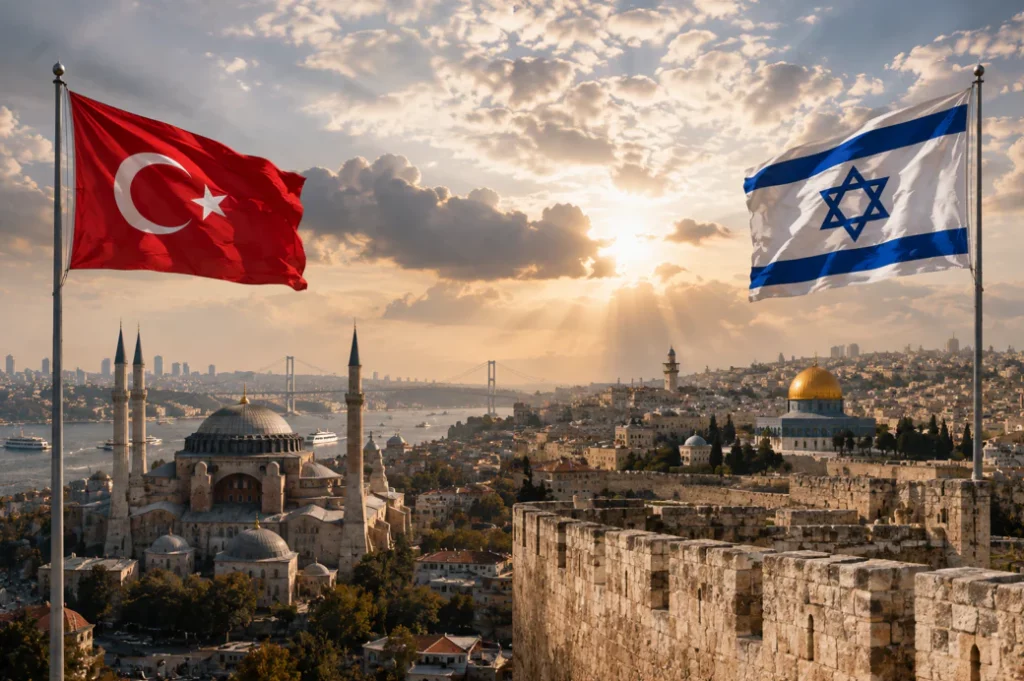
Israel’s strategy in the Middle East is changing: the country is shifting from a targeted response to threats to a systemic containment of all regional players capable of challenging it. After Iran, Turkey has come into focus.
For years, Israel’s wars were presented as responses to threats. But as Gaza, Lebanon, Syria, and Iran have demonstrated, the pattern increasingly looks broader: eliminate or contain any regional power capable of challenging Israel’s freedom of action. Now Turkey is entering the equation. As Israeli strikes move closer to the Turkish border and Jerusalem warns Ankara against expanding its role in Syria, is a new conflict in sight?
Once allies, Turkey and Israel are now emerging as rival powers whose regional ambitions are becoming increasingly difficult to reconcile. From Syria to the Eastern Mediterranean, their strategic theatres are overlapping while military signalling is becoming more explicit. After Iran, is Ankara becoming Israel’s next major regional adversary?
The central question is whether Israel and Turkey can contain their rivalry before the security dilemma becomes self-fulfilling
The answer is not yet a war. But the relationship is increasingly being shaped by what international relations theory calls a security dilemma: measures taken by one actor to increase its security are interpreted by another as preparations for aggression, prompting countermeasures that make both sides less secure.
In this theoretical framework, Turkey’s efforts to increase its security, such as strengthening its military presence in Syria, developing autonomous defence capabilities, and building new security partnerships, as the Mecca Defence Agreement, may be interpreted by Israel as threatening, prompting Israeli countermeasures that, in turn, reinforce Ankara’s perception that it needs greater security.
The danger is particularly acute because Turkey is not Iran. It is a NATO member, a major regional power, and an increasingly autonomous military-industrial actor. It also occupies a geopolitical position connecting Europe, the Middle East, the Black Sea, the Caucasus, and Central Asia.
The emerging confrontation is therefore about more than Gaza or rhetoric between Recep Tayyip Erdoğan and Benjamin Netanyahu. It concerns the future structure of power in the Middle East.
Syria has become the fault line
For nearly three decades, Turkey and Israel maintained an unusually close strategic relationship. Both were non-Arab regional powers aligned with Washington, and both benefited from a regional order in which their strategic interests could coexist.
That order has now largely disappeared.
The fall of Bashar al-Assad transformed Syria from a buffer between competing powers into an arena for competing projects of regional order. Ankara sees Syria as central to its national security and its wider regional strategy. Israel, meanwhile, has sought to prevent the consolidation of military capabilities in Syria that could threaten its freedom of action.
The resulting collision became concrete on August 18, when Israel struck the Abu al-Duhur airbase in northwestern Syria, approximately 70 kilometres from the Turkish border. Israel said it acted because of concerns over a possible Turkish military deployment and the transfer of advanced capabilities to the area. Ankara rejected the justification and condemned the attack as a violation of Syrian sovereignty.
The significance lies not simply in the target but in its geography. Israeli military action has moved closer to a zone in which Turkey has direct strategic interests.
This is where the rivalry becomes structural, according to Turkish analyst Barin Kayaoglu.
Israel increasingly appears determined to preserve freedom of action across its northern frontiers; therefore, a weak Syria fits Israeli interests. Turkey, on the contrary, wants a stronger Syrian state capable of controlling its territory and developing its own defence capacity, with Ankara playing a central supporting role. The two visions are difficult to reconcile.
The Israeli warning has also become unusually direct. Defence Minister Israel Katz told Erdoğan that Turkey should not put itself in the position Iran had occupied, while declaring that “Jerusalem is not Constantinople.”
The historical reference is deliberate. Constantinople, the Byzantine capital, was conquered by the Ottoman Empire in 1453. Katz’s message was therefore more than rhetoric: Israel would not accept the idea that Turkey could reproduce an Ottoman sphere of influence in the Levant or exercise a privileged role over Jerusalem. It was simultaneously a rejection of Ankara’s neo-Ottoman geopolitical imagination and a declaration that modern Israel regards Jerusalem as permanently outside any Turkish sphere of influence.
The message to Erdoğan was obvious: the regional order is not returning to the Ottoman past.
Ankara’s answer: deterrence through networks
Turkey’s response has so far been notably cautious. Ankara has condemned Israeli actions and defended its interests in Syria, but it has also sought US-mediated mechanisms to prevent an accidental military confrontation. Turkey can no longer count on the U.S. ambassador to Ankara, Tom Barrack, as an intermediary, who was sacked because of his comments, such as “the occupied Syrian Golan” or when he called the recent attack on the Syrian air-base “an unnecessary escalation that does not advance regional stability,” which has drawn fierce criticism in Israel, including from Defense Minister Israel Katz, who has publicly reprimanded Barrack for challenging Israeli policy in Syria.
Turkey is simultaneously accelerating military autonomy and building diplomatic alternatives. Its defence industry, from drones and missiles to the KAAN fighter programme, is intended to reduce dependence on foreign suppliers and eventually provide Ankara with greater freedom of action.
But the most consequential hedge may not be technological. It may be institutional.
On August 7, Turkey, Saudi Arabia, and Pakistan signed the Mecca Defense Agreement. By August 31, the agreement had already moved from political declaration towards institutionalisation, with a Strategic Political and Defense Committee involving foreign and defence ministers and military chiefs, alongside a permanent secretariat in Saudi Arabia and a Pakistani secretary-general for the first three years.
That speed matters.
The pact should not necessarily be interpreted as an “Islamic NATO.” Its deeper significance may lie in the creation of a security network connecting states that do not intend to abandon relations with Washington, Beijing, or Moscow but increasingly resist exclusive dependence on any one of them.
For Turkey, this creates a different kind of strategic power: the power of the indispensable node, as put forward by Professor Silverio Allocca.
Saudi Arabia contributes financial, energy, and religious weight. Pakistan brings military depth, strategic experience, nuclear deterrence and links to China. Turkey brings military-industrial capacity, geography, and connections across NATO, the Middle East, Central Asia, and the wider Muslim world.
This is hedging as geopolitical strategy: not choosing one camp, but increasing the number of relationships that make one’s isolation more difficult.
The next test: escalation or a new balance of power?
The central question is whether Israel and Turkey can contain their rivalry before the security dilemma becomes self-fulfilling.
Israel has already demonstrated that it is prepared to use military force to establish red lines in Syria. Turkey, meanwhile, has strong incentives to remain in Syria and deepen its relationship with Damascus. Neither side, therefore, has an obvious reason to retreat.
The United States faces an especially difficult dilemma. Washington has strategic relationships with both countries and has an interest in preventing an Israeli-Turkish confrontation. Yet it must also manage Israel’s freedom of action and Turkey’s growing strategic autonomy.
The NATO question is even more complicated. Turkey is protected by the alliance, but Article 5 is not an automatic declaration of war in every circumstance; collective defence requires political determination by allies. A direct Turkish-Israeli confrontation would therefore create an extraordinary dilemma for Washington and NATO: would the alliance be drawn into a conflict between two US partners?
Israel, for its part, may calculate that American diplomatic and military support would remain available if confrontation escalated. But assuming that Washington would automatically accept a war on Israel’s terms would be risky. Israel also counts on European NATO members. Ankara is well aware of it.
This is why the Mecca Agreement matters beyond its three founding members.
If it remains a limited deterrence arrangement, its effect will be modest. If it develops into a broader network involving additional Muslim-majority states, defence cooperation, interoperability, technology production, and political coordination, the regional balance could change substantially. The possibility of Iranian or Bangladeshi participation would further complicate the strategic equation.
The emerging contest is therefore not simply Israel versus Turkey. It is a struggle over who will shape the security architecture that follows the old Middle Eastern order.
Israel appears determined to prevent the emergence of a regional peer capable of constraining its freedom of action. Turkey, for its part, is unlikely to accept a subordinate position in the post-Assad Middle East. The Mecca Defence Agreement makes the balance favourable to Ankara.
Turkey’s answer is unlikely to be an immediate confrontation. It is more likely to be hedging, deterrence, military autonomy, and network-building.
That may prove more consequential than a conventional alliance.
Because the decisive question in the emerging multipolar Middle East may no longer be who commands the region.
It may be that they become indispensable to everyone else.