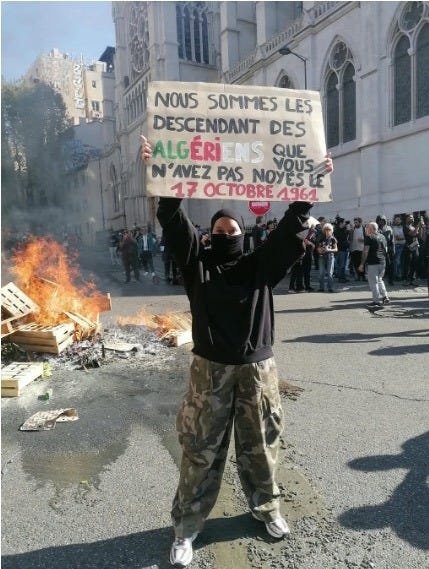
Should inheriting the drowning of Algerians on 17 October 1961 mean inheriting the obligation to answer for it?A few days ago, during the ongoing demonstrations in France, an image circulated of a young protester holding a placard. It read: “We are the descendants of the Algerians you did not drown on 17 October 1961.”
Some of you will know what happened on that date. Thousands of Algerians took to the streets of Paris to protest a curfew imposed specifically upon them. The police responded with extraordinary violence. People were beaten, detained and killed. Some were thrown into the Seine. For decades, the extent of that violence remained obscured in France’s public account of itself, despite the efforts of survivors, families and historians to establish what had happened. The death toll remains disputed, and the struggle to recover this history has been a long one, as documented in the French National Audiovisual Institute’s historical account of 17 October 1961.
Sixty-five years later, someone from a younger generation is invoking that history. What interests me is the wording of the placard, particularly its insistence upon descent. It does not ask us simply to remember those who were killed. It speaks of those who survived, and of people who now claim a relationship to that survival. The opening words, nous sommes, establish a collective identity, although what binds that collective together is not self-evident. Descent may be familial, but it can also become a political affiliation, acquired through shared experience, education or the decision to identify with a history that others would prefer to regard as concluded.
Then there is vous, “you.” The accusation addresses an earlier violence as though the relationship between those who inflicted it and those who inherited its consequences remains open. The police officers responsible for the killings in 1961 are not those confronting demonstrators today. France has changed, legally and politically, in ways that matter. Yet the question of what responsibility survives such changes cannot be settled by the passage of time alone.
The photograph has circulated on social media, including this Facebook page, and was reproduced in an 18 October article by M. Aït Amara in Algérie Patriotique. Its original photographer and date remain unverified. The photograph appeared in an 18 October article by M. Aït Amara in Algérie Patriotique. Aït Amara describes the demonstrator as someone who “ne commémore pas, elle accuse” — who does not commemorate, but accuses. I find something persuasive in that distinction, though I hesitate over the larger political meaning he assigns to the image. The protester’s face is concealed. Wooden pallets burn nearby. It is tempting to make someone in such a photograph speak for an entire generation, particularly when the words correspond closely to an argument one has been trying to develop. I am conscious of that temptation here.
In Form as History, I was concerned with the possibility that institutions could become increasingly accomplished at documenting human suffering while the obligation to respond to it grew uncertain. We can preserve testimony, assemble archives, commemorate atrocities and recover people once excluded from the historical record. Much of this work has been indispensable. Yet recognition does not necessarily alter the conditions under which institutions govern human lives. A person can remain visible to an administrative system without being treated as someone to whom an answer is owed.
The Algerians of Paris in 1961 were conspicuously visible to the authorities. The curfew targeted those classified in administrative language as Français musulmans algériens, French Algerian Muslims. As documented in the National Museum of the History of Immigration’s account of contemporary records, they were identified and subjected to restrictions through an apparatus whose precision offered little protection from arbitrary treatment. Their presence was registered as a matter of official concern, while their security and dignity could be disregarded.
I used the distinction between address and abandonment in Form as History, to examine how institutions may continue to classify, administer and regulate human life even as the requirement to justify their actions diminishes. The problem extends beyond the failure to remember an injustice. It concerns the ordinary arrangements through which institutions can continue functioning without having to respond adequately to those whose lives they organise.
The photograph has made me consider another difficulty. A historical claim can be renewed by those who inherit it without necessarily restoring the relationship of answerability that has been lost. The demonstrator addresses the present through a remembered injury, but there is no assurance that those being addressed will recognise an obligation to respond. Nor does the claim itself tell us what an adequate response would require.
On 17 October 2026, the Élysée issued a statement acknowledging the bloody repression carried out under police prefect Maurice Papon and recognising the work of historians, teachers, associations and families in preserving its memory. Such recognition was hard won, and it matters. Yet I can understand why those who inherit this history might remain dissatisfied even with an official commemoration undertaken seriously. Their concern may have less to do with what France now says about 1961 than with how that knowledge bears upon the country in which they live.
The current student protests offer an uneasy setting for these questions. In an earlier report , I examined the movement’s emergence in the lycées of Créteil and the working-class suburbs around Paris. The first blockades in September concerned missing teachers, overcrowded classrooms and deteriorating buildings. Students wanted teachers appointed to vacant posts, repairs carried out and some assurance that the republican promise of equal education extended to the neighbourhoods in which they lived. The demonstrations spread, bringing pupils into contact with university students, teachers, parents and trade unions. Police intervention, injuries and arrests altered the character of the movement, while public attention increasingly followed the burning bins and confrontations with riot police.
What struck me in the earlier reporting was how differently the state could appear to the same pupil. A missing mathematics teacher might remain unreplaced for weeks, while police officers could be deployed outside the lycée in considerable numbers. The responsibilities belong to different institutions and administrative authorities, of course. But for the student experiencing both, the distinction may offer little reassurance. The state appears strangely absent where education is concerned and emphatically present when public order is at issue. I find this more revealing than the familiar argument that institutions are simply failing. They remain capable of acting, although their capacity to respond seems unevenly distributed.
The placards registered something of that frustration. One declared, “We burn trash, you burn our future,” photographed in Paris by Reuters photographer Abdul Saboor. Others borrowed from May 1968, including the famous promise of a beach beneath the paving stones. This time the declaration was “Under our text books, anger.” The reference did not make these schoolchildren heirs to the politics of 1968 in any straightforward sense. They had begun with rather different complaints, but an older vocabulary of dissent had become available for expressing them.
Then came the strange invocation of “Bismillah, c’est les ténèbres.” As Simon Ormiston reported in Euronews on 19 October, screenshots circulated of Snapchat messages from an account calling itself “Mamadou,” apparently seeking access to groups organising school blockades. Students suspected an undercover police officer attempting to impersonate one of them, although that allegation remains unverified. The messages combined Arabic expressions, Algerian flags and an awkward familiarity with street slang. Students recognised the caricature and made a joke of it.
The ease with which that joke travelled belongs partly to a French popular culture already shaped by immigration. Rap and hip-hop have brought the languages and musical inheritances of immigrant communities into the country’s mainstream. The Algerian singer Soolking’s Planète Rap performance of Guérilla, and the later circulation of Liberté during Algeria’s 2019 Hirak, offer one example. I would not presume that his music supplies the soundtrack to these French students. What interests me is how familiar such cultural expressions have become in a society that remains deeply divided over the political claims of the communities associated with them.
None of this establishes a common historical consciousness among the protesters. The young people laughing at the Snapchat messages may have little in common with the person holding the Algerian placard. Nor should we assume that a shared language of dissent necessarily produces agreement about representation, political demands or the institutions through which those demands might be addressed.
The disagreements are visible even in the responses to the photograph. Among readers commenting beneath Aït Amara’s article, some welcomed the placard as an affirmation of Algerian historical identity. Others questioned the wisdom of invoking colonial memory amid contemporary French unrest. Such responses tell us little about the demonstrator’s intentions, but they caution against imagining inheritance as a settled possession passed intact between generations. Families remember differently. Some transmit stories, others silence. People also acquire historical attachments through education, religious and communal institutions, political movements and experiences for which family genealogy provides no simple explanation.
I return, then, to the question that the photograph has made difficult for me: when we inherit a history, do we inherit only its memory, or do we also inherit an obligation to those whom that history has left unanswered?
I do not think the placard resolves the problem of abandonment. Its public visibility cannot oblige the state to respond, any more than the recognition of 1961 guarantees a different relationship between institutions and those who encounter them today. But it has made me reconsider something in Form as History. The forms through which history persists are not necessarily exhausted by the purposes for which they were preserved. A later generation may take a date, a document or an acknowledged injury and address the present through it, sometimes in ways that unsettle the institutions responsible for its commemoration.
Whether that renewed address acquires any consequence remains uncertain. The students outside the French schools still need their teachers and resources; the history invoked by the placard carries demands that are less easily specified. I would not want to collapse those different claims into one account of French political life. Yet I find myself wondering how much of what we call historical recognition consists of knowing that an injustice occurred, and how much involves remaining answerable to people who continue to ask what that knowledge should mean for them.