
The United States and Europe risk squandering the best opportunity since 2022 to alter Russia’s trajectory toward a longer and larger war. Ukraine currently has the best chance of seizing the strategic initiative against Russia since December 2022, while simultaneously facing the greatest risk to its momentum. Russia’s ballistic missile and jet-powered drone campaign against Ukraine, alongside its growing kinetic attacks against NATO states, aims to drive Ukraine and its allies into a reactive stance and distract them from seizing a hard-won opportunity to hold the strategic initiative against Russia. The Kremlin’s offer to supply diesel to global markets is a cognitive warfare effort that similarly aims to disrupt the momentum of the effective pressure campaign against Russia’s energy sector. The Kremlin, unlike the United States and Ukraine’s other partners, recognizes that Russia is critically vulnerable to initiative, momentum, and sustained pressure.[1] The Kremlin is vigilant about Ukraine and its partners holding the initiative and seeks to deter and disrupt it at all costs.[2] The United States and Europe can either deny the Kremlin’s strategy or risk a greater war with greater escalation risks.
Ukraine has regained the operational initiative on most key battlefield directions and has been contesting Russia’s strategic initiative since late 2025. Ukraine has slowed Russian battlefield advances to a footpace in 2026 and has grown the already staggering human cost of the Russian advance.[3] Ukraine has retaken significant territory from Russia in 2026, and at the theater level has nearly zeroed out Russian gains for the year. ISW has observed evidence to assess that Russian forces have only made a net gain of about 100 square kilometers thus far in 2026 thanks to Ukrainian counteroffensives, which have liberated at least 1,046 square kilometers, for example. The daily Russian net rate of advance in 2026 is so far less than a square kilometer per day — literal footpace. Russia’s summer offensive has failed.[4] Russia’s fall offensive is likely to fail as well. Russian President Vladimir Putin has failed to accomplish any of his stated war aims in Ukraine to date. Putin did not force the Ukrainian government to capitulate, nor did he destroy the Ukrainian military. Russia is nowhere close to taking the rest of the Donetsk region, including the Fortress Belt – one of Putin’s stated war aims.[5] Ukraine has forced the Kremlin to confront dilemmas inside of Russia that would have been unthinkable not long ago. Ukraine’s deep strike campaign has triggered fuel shortages in Russia, degrading at least 30 percent of its refining capacity, and forced Moscow to choose which infrastructure to protect with air defense assets.[6] Ukrainian advances and strikes are challenging Putin’s promises of Russia’s economic stability, security, and greatness.[7]
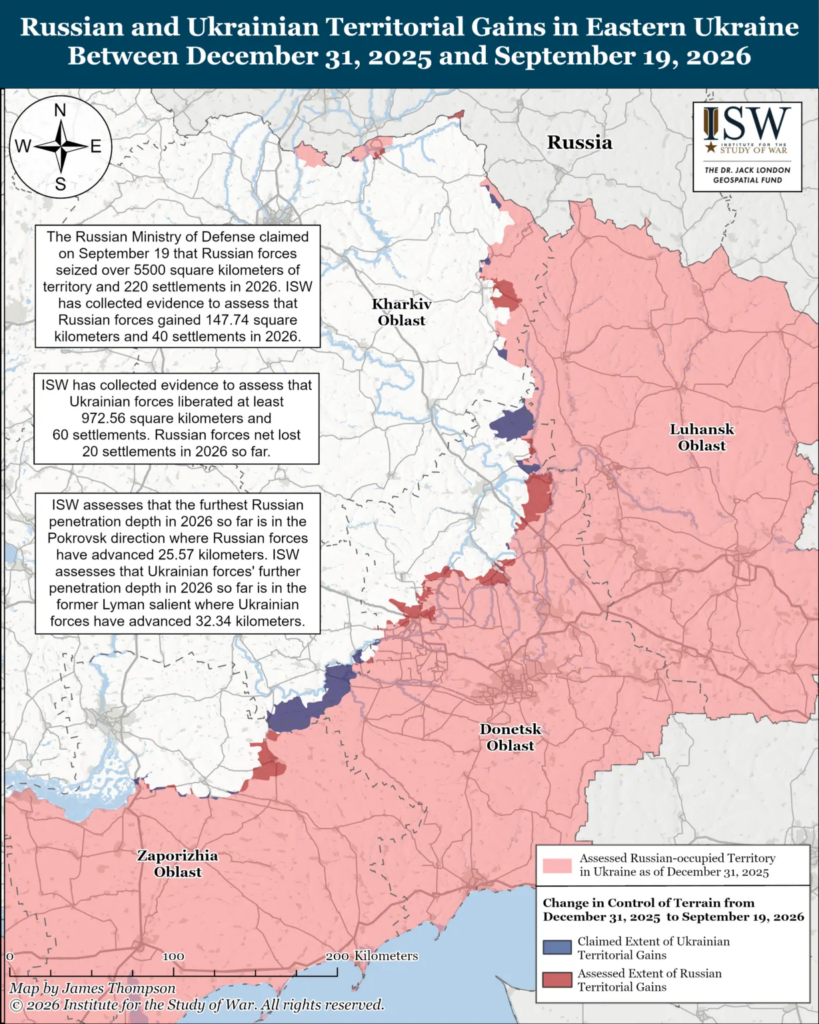
Ukraine’s 2026 battlefield progress is not transient or accidental — it is a result of Ukraine’s maturing warfighting capabilities and military transformation that occurred over 2025 and 2026.[8] Ukraine has significantly grown its intermediate-range and deep-strike campaigns, expanded military production, matured operational art concepts, and is increasingly focused on the long-term warfighting strategy.[9] Ukraine is working on its ballistic missile program, which, if successful, will put key Russian defense industrial and military infrastructure at even greater risk.[10]
The design of Russia’s 2026 strategic bombing campaign against Ukraine, coupled with its intensifying attacks against other European states, seeks to in part overshadow Ukraine’s hard-won gains and force Ukraine and its partners into a reactive posture. Russia has surged its strategic bombing of Ukraine each fall and winter since 2022 — efforts that have failed to break Ukraine’s will or capability to fight.[11] The design of Russia’s 2026 strategic bombing campaign seeks to inflict maximum terror and civilian harm by exploiting the gap in Ukraine’s ability to counter jet-powered drones and ballistic missiles. First, the Kremlin aims to make major Ukrainian cities unlivable through sustained daytime and nighttime strikes on civilian infrastructure, such as post distribution centers or bridges.[12] Second, the Kremlin is targeting major cities to drive distrust in Ukraine’s authorities and drive a wedge between the frontline and the rear.[13] Third, Russia likely seeks to impose resourcing dilemmas on Ukraine, forcing Ukrainian forces to balance the use of mid- and long-range systems to suppress targets enabling Russia’s strategic bombing campaign and using those systems in support of Ukraine’s frontline requirements. Fourth, Russia is attempting to isolate Ukraine from European support by increasingly targeting logistics and transportation in and out of Ukraine. Russia’s growing attacks against NATO states, which include drone and missile incursions, sabotage, arson, and assassinations, seek to force the alliance into a reactive stance and drive false dilemmas for the resurging European defense industry between supporting Ukraine and preparing for a potential Russian escalation.[14] These attacks also support Putin’s long-standing aim of neutralizing NATO as an effective alliance.
Russia’s cognitive warfare effort aims to disrupt the success of Ukraine and its partners’ sustained pressure against Russia’s critical war capability — its energy sector. Russia’s energy sector is vital to the Kremlin’s ability to fund the war.[15] Ukraine’s sustained strikes and Western economic pressure on Russia’s energy sector have been driving severe fuel shortages in Russia, in turn forcing Putin to make hard choices. The Kremlin, for example, started to buy refined fuel from India, thereby sustaining additional costs.[16] The Russian Ministry of Finance announced its intent to increase its purchase of foreign currency and gold between October 7 and November 6, 2026 amid declining energy export revenues.[17] It is precisely because the pressure strategy is working that the Kremlin seeks to disrupt it — including by offering to export insignificant quantities of diesel to the global markets in exchange for sanctions relief.[18]
Ukraine’s partners must learn what is arguably the most important lesson from this war – recognizing (and denying) the Kremlin’s strategy of disrupting Ukraine’s and its partners’ initiative. Russia has undermined Ukraine’s and Western initiative in the past by manipulating Western decision-making. The Kremlin invoked nuclear blackmail during Ukraine’s counteroffensive in Kharkiv Oblast and in Kherson in Fall 2022.[19] The Kremlin’s cognitive warfare effort at the time negatively shaped Ukraine’s allies’ decision about supplying Ukraine with military equipment and prevented Ukrainian forces from imposing additional defeats on Russian forces, disrupting Ukraine’s momentum and prolonging the war.[20]
Russia seeks to keep Ukraine and its allies in a reactive stance, focused on discussing tactics rather than developing a strategy. Russia is trying to create new dilemmas to force Ukraine and its allies to respond to exigent threats and crises, for example jet-powered drones or offers of cooperation — like the Kremlin’s energy deal — to undermine Ukraine and the West’s proactive and sustained campaigns.
Ukraine’s allies must prevent Russia from once again disrupting Ukraine’s battlefield momentum and help Ukraine seize and hold the strategic initiative against Russia — as Russia’s strategic bombing campaign against Ukraine becomes more brutal alongside Russia’s kinetic attacks against Europe. Most immediately, Ukraine’s partners must help accelerate the scaling of countermeasures to Russian jet-powered drones, recognizing that this capability makes Russia’s 2026 strategic bombing campaign particularly dangerous due to the systems’ effectiveness against dynamic targets, including those deep in Ukraine’s rear.[21]
Ukraine’s partners must proactively resource Ukraine’s battlefield momentum. Momentum requires resourcing and planning. The European Union’s release of its loan to Ukraine should avoid repeating the incrementalism patterns in delivery of Western military aid that allowed Russia to prolong the war in the first place.[22] European funding needs to support Ukraine’s military leadership’s ability to plan simultaneous and successive operations well into the next year in order to sustain and grow the effects of Ukraine’s 2026 progress in its ground war.
The United States and Europe must proactively resource Ukraine’s deep strike campaign against Russia’s defense industrial and energy sectors by increasing sanctions on Russia’s energy sector and helping accelerate the growth of Ukraine’s deep strike capability.
Europe must finally develop measures to deter Russia from conducting attacks against its territory. For example, Europe must prioritize denying Russia the ability to conduct sabotage operations or drone incursions. Russia feels comfortable accepting higher risks associated with such attacks, largely because it does not perceive European or NATO response as a meaningful deterrent.[23] NATO and Europe must therefore consider deterrents for emergent risks that are short of a traditional ground attack to regain the initiative against Russia.