
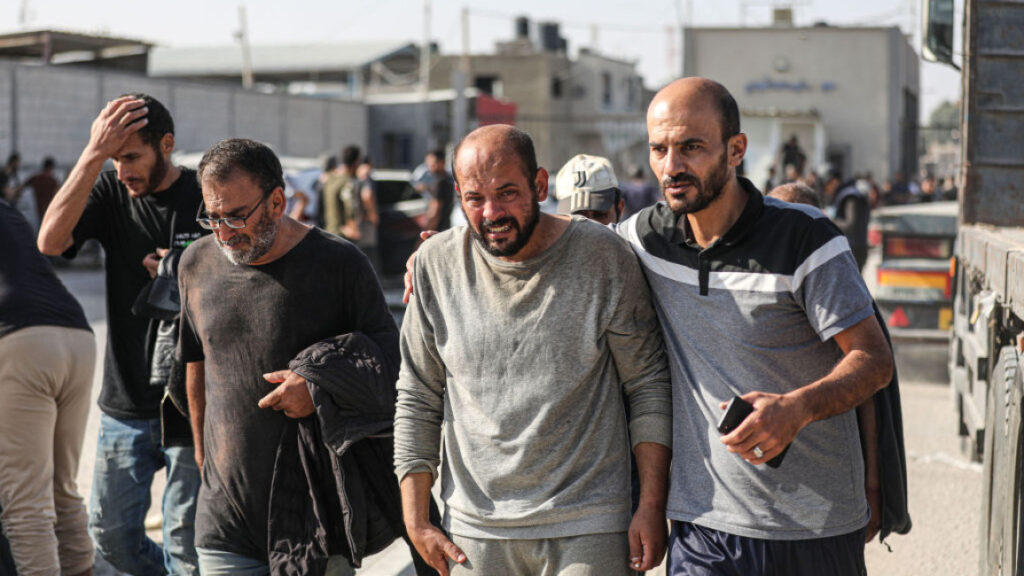
Thousands of Palestinian workers were detained and tortured in 2023, yet questions about their fate remain unanswered, writes Hossam el-Hamalawy.
Three years after Israel began its genocide in Gaza, the fate of Palestinian workers detained after 7 October remains unclear, though their odyssey of humiliation, torture, and, on occasion, murder is beyond doubt and is mostly documented by their Israeli tormentors on social media and aired live by the far-right Minister of National Security Itamar Ben-Gvir.
Gazans who had crossed the Green Line desperate to earn a living, mostly in blue-collar jobs, were stripped of their permits, rounded up, and held without contact with lawyers or families. Their treatment should push one to wonder what international trade unions did when fellow workers in this part of the world were imprisoned and abused.
Israel closed the crossings and revoked Gazan workers’ permits, turning people previously authorised to work into supposed illegal residents. Thousands were detained in Israel and the occupied West Bank. On 3 November 2023, more than 3,000 were released into Gaza, where bombardment continued. Release offered no guarantee of safety.
Workers described, in testimonies published by Human Rights Watch in January 2024, beatings, electric shocks, humiliation, and deprivation of food and water. The rights watchdog also independently documented mass detention without contact with the outside world.
International allies
Warnings of the ongoing abuse were already coming out earlier. On 11 October 2023, the Palestinian Democracy and Workers’ Rights Centre denounced violence against Gazan workers. On 25 October, it demanded their immediate release and appealed to the international labour movement. The workers’ predicament was already being placed before their supposed international allies.
Their case cuts through the claim that Palestine is somehow outside a union’s remit. These Gazan workers had employers, wages, and families dependent on their earnings. Stripped of work permits, thrown in torture dungeons for weeks, should have triggered a global public outcry among trade unionists and industrial organisers everywhere.
Calling the subsequent response universal silence would be inaccurate. The International Trade Union Confederation’s 2024 Global Rights Index described thousands of workers held in illegal detention, denied basic rights and legal representation. It recorded reports of abuse and degrading conditions, alongside two deaths in custody. The world’s principal union confederation had publicly acknowledged the violations.
Australia’s Union Aid Abroad–APHEDA published Palestinian union allegations of torture deaths in January 2024. In March 2025, the International Labour Network of Solidarity and Struggle endorsed reports from the Arab Workers Union in Nazareth concerning disappeared Gazan workers, torture and deaths in detention. These were clear acts of solidarity, but circulating allegations is only the beginning.
On 27 September 2024, nine global unions filed a complaint with the International Labour Organisation detailing the draconian working conditions of more than 200,000 Palestinian workers in Israel. The nine organisations condemned “widespread wage theft due to the suspension of work permits and the unilateral termination of their contracts.”
Signatories included the ITUC, IndustriALL, Education International, Public Services International, UNI, and the international federations representing transport, construction, food workers and journalists. The OECD’s Trade Union Advisory Committee also joined. Its stated legal focus was wage protection; however, not accountability for torture.
The demands of Palestinian unions
While such a solidarity move is worth applauding, it still exposes a long-running problem of “economism” that has long marred the trade union movement.
What resources went toward locating missing workers, supporting survivors, securing independent investigations and pursuing those responsible? A complaint about stolen wages surely matters enormously to impoverished families. It cannot substitute for a “political” campaign against imprisonment, torture, military occupation and genocide.
Palestinian unions had also identified what their counterparts could do. Their 16 October 2023 appeal asked workers to refuse to manufacture or transport weapons for Israel, challenge complicit companies and pressure governments to stop military trade. This was an action plan for international unions. Were the latter ready to organise around those demands and protect members prepared to act?
The wider response to Gaza shows that stronger positions were possible. The World Federation of Trade Unions was calling for an end to genocide by October 2023. IndustriALL’s executive committee explicitly condemned the continuing genocide in May 2024 and urged affiliates to support boycott, divestment, and sanctions.
Education International’s 2024 congress demanded an end to arms transfers to Israel. These were formal positions of international organisations, not merely statements by dissident branches.
Other unions organised material support. In November 2023, the International Transport Workers’ Federation created a Palestine Solidarity Fund. Public Services International established its Gaza fund in March 2024. By August 2025, European Union federations were demanding sanctions, suspension of the EU–Israel Association Agreement, and an end to economic relations with Israeli settlements.
Influential national unions in several countries also took a firm position in solidarity with the Palestinians, sometimes aligning with their governments’ stated positions and sometimes opposing them.
South Africa’s teachers’ union SADTU explicitly condemned genocide in 2023. Ireland’s ICTU demanded economic sanctions, while Britain’s TUC called for ending arms licenses and suspending the trade agreement. Canada’s CUPE described the assault as genocide and supported Palestinian workers’ rights organising.
In July 2024, seven US unions demanded an immediate halt to military aid: UAW, UE, SEIU, the postal workers’ APWU, flight attendants’ AFA, painters’ IUPAT and National Education Association. Their demand confronted the material support sustaining Israel’s assault, even if a letter alone could not stop it.
Disrupting the deadly occupation machine
Workplace action offered another, certainly more effective, route. A trade union representing workers in 11 major Indian ports refused to handle weapons shipments for Israel. France’s CGT endorsed workers at Fos and Roissy who refused to facilitate arms deliveries. Such examples show where unions’ distinctive power lies: in their capacity to interrupt production and transport.
Italian unions took action to another level by organising a general strike explicitly in solidarity with Gaza. On 22 September 2025, USB and other grassroots unions organised a nationwide stoppage against the genocide, disrupting transport, schools and ports.
Following Israel’s interception of the Global Sumud Flotilla, CGIL and USB called another general strike on 3 October. According to CGIL, the stoppage disrupted major services, and more than two million people rallied across over 100 cities.
Such organising efforts developed across borders. Italy’s USB, Greece’s ENEDEP, the Basque union LAB, Turkey’s Liman-İş and Morocco’s ODT called a joint ports action for 6 February 2026, demanding an end to arms shipments feeding the genocide and a trade embargo on Israel. Their initiative connected solidarity with opposition to militarisation and the erosion of dockworkers’ conditions.
But other union leaders shamefully obstructed solidarity. In October 2023, the AFL-CIO intervened against a ceasefire resolution adopted by Washington state’s Thurston-Lewis-Mason labour council. The federation eventually, under pressure, called for a negotiated ceasefire on 8 February 2024.
Germany’s DGB declared solidarity with Israel after the Hamas attacks. Its position cannot fairly be reduced to unconditional approval of everything Israel subsequently did: a July 2025 resolution demanded an end to attacks on civilians and supported a ceasefire. Yet the same resolution sharply defended Histadrut against criticism within international union bodies.
The Histadrut, for its part, is hardly an ordinary “trade union.” It has been the backbone of the settler colonisation of Palestine from the start, and a major instrument of segregation and discrimination against Arab workers. The international labour movement should isolate, boycott, and deplatform it.
Union members everywhere need to hold their own leaders accountable for these decisions. Those who blocked solidarity or defended Israel’s actions should face a challenge from below, with their record on Gaza brought into branch meetings, congress debates, and leadership elections. Members can demand disclosure of their unions’ ties to Histadrut and organise to sever them.
The fight is far from over. Missing workers must be accounted for, survivors supported, stolen wages recovered, and those responsible for torture and deaths held accountable. These demands belong alongside the struggle to end the occupation and dismantle the structures that leave Palestinian workers dependent on those who dispossess and exploit them.
The strikes and port actions point toward what comes next: sustained organising to stop arms shipments, challenge complicit employers, and defend workers who face retaliation for taking action. Every solidarity resolution needs an organising plan behind it. Palestinian workers deserve a labour movement prepared to use its power, and a rank and file ready to act when its leaders refuse.