
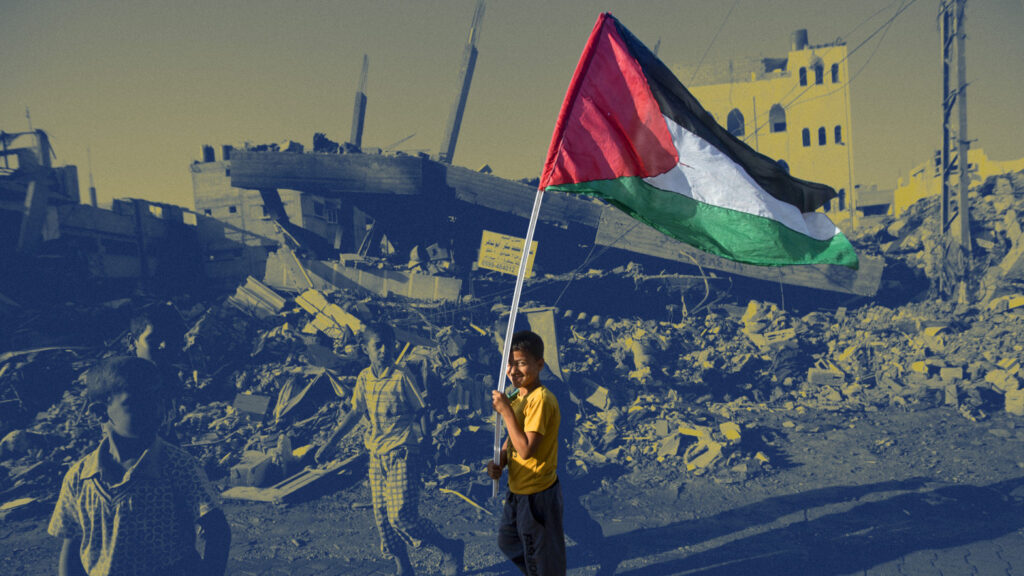
Khan Younis, Gaza Strip – A year after a US-brokered ceasefire halted Israel’s full-scale war on Gaza, the Palestinian technocrats appointed to govern the territory remain in Cairo, waiting for Israel to allow them to enter.
Palestinian analysts say the delay is a symptom of a deeper problem over Gaza’s future, with those chosen to govern the territory still unable to enter, while Israel continues to control the conditions for its governance and reconstruction.
The National Committee for the Administration of Gaza, chaired by Ali Shaath, a civil engineer and former deputy minister in the Palestinian Authority (PA), was formed in January under UN Security Council Resolution 2803.
It was endorsed by US President Donald Trump’s 20-point plan and authorised a Trump-led Board of Peace to oversee Gaza’s transition until the end of 2027.
Hamas dissolved its governing body in July to make way for the committee, but Israel has still kept it out. Israeli forces, which were to hold 53 per cent of Gaza behind the so-called yellow line under the ceasefire’s first phase, now control around two-thirds of the territory.
Mohammed Daraghmeh Abu Allan, a researcher on Israeli affairs, argues that Israel has framed its demands, from disarmament to the destruction of the last Hamas tunnel, “in terms that can never be shown to be met,” allowing it to hold a long-term buffer zone and defend Israeli communities from inside Gaza.
“Israel’s acceptance of the Gaza administration committee is conditional on guaranteeing the Israeli military’s freedom of action across the entire Gaza Strip, including assassinations and thwarting any immediate threat,” he told The New Arab.
“These are the very reasons Israel uses to reject any real solution in Gaza.”
A Palestinian committee kept out
Israeli Prime Minister Benjamin Netanyahu rejected Trump’s plan in August, saying Israel would not withdraw until Hamas was fully disarmed.
Abu Allan sees Hamas’s decision as an attempt to strip Israel of its main argument for keeping the committee out. On the other side, Israeli Foreign Minister Gideon Sa’ar dismissed it as a ploy to copy Hezbollah’s arrangement in Lebanon.
Meanwhile, the Board of Peace said it would judge Hamas by its actions, insisting on “one authority, one law, and one weapon”.
Writer and political analyst Iyad al-Qarra expects the status quo, with Israel holding 70 per cent of the Strip and the committee stuck outside it, to last at least until the end of the year and until the shape of Israel’s next government is clear.
“Hamas deserves credit for stepping back from government, but Shaath’s committee has done very little. They’ve spent months talking without actually getting anything done,” he told The New Arab.
Abu Allan is harsher still, describing the Board of Peace as “aligned with Israel’s goals,” given its failure to take practical steps in Gaza since the ceasefire and its silence over what he calls Israeli crimes, assassinations, and the siege.
The committee, he says, is “nothing more than an amorphous body with no real existence, which is why Israel may accept dealing with them as governing bodies in Gaza”.
The Palestinian Authority’s road back?
Saeed Abu Rahma, a researcher on conflict affairs, argues that the end goal should be a unified Palestinian political system with Gaza inside it, on the road to statehood, rather than a separate entity called the Gaza administration.
“It is hard to imagine rebuilding the Palestinian political system without [the PA], and equally hard to imagine Gaza without any link to the Authority, whether direct or indirect,” he explained.
Ramallah’s position rests on the same premise, according to Munther al-Hayek, a Fatah spokesman and member of the movement’s Revolutionary Council, who tells The New Arab that the PA accepted the Board of Peace and its committee “reluctantly,” given the scale of the catastrophe, for the sake of ending the genocide.
“The best solution from the start was for Hamas and the occupation to allow the [Palestinian] Authority to take up its responsibilities in Gaza, but that did not happen,” he adds
“Now, we have few alternatives other than accepting that the national committee that emerged from the Board of Peace handles the recovery phase, provided that the Palestinian Authority takes over the entire reconstruction file according to the plans already prepared.”
Al-Hayek sees elections as the way to reunite Gaza and the West Bank under the Authority’s legal jurisdiction. PA President Mahmoud Abbas has set legislative elections for 28 November, the first since 2006, when a Hamas victory triggered the split that ended with the movement taking over Gaza in 2007.
Israel holds its own general election on 27 October, and the Palestinian Center for Policy and Survey Research has warned that the month between the two votes leaves almost no time for a new Israeli government to set its policy, making a postponement close to inevitable.
Al-Hayek still hopes any new government will be less damaging than Netanyahu’s, whose far-right ministers, Itamar Ben-Gvir and Bezalel Smotrich, he says, have left Palestinians with nothing.
Abu Allan, however, expects no such change, arguing that Israel will not accept the PA’s return to Gaza because it would join the West Bank and Gaza in a single entity that could become the nucleus of a Palestinian state, and that only Washington could shift that position.
“Neither Hamas, nor the Authority, nor the Palestinians as a whole, nor even the Arab and Islamic states, nor even the European Union has the tools to confront Israel in its drive to keep Gaza outside any Palestinian governance or administration,” he says.
Al-Qarra also rejects the idea that Hamas has lost its base, arguing that Fatah has suffered as much in the West Bank, where Israel has expanded settlements and checkpoints and stepped up killings.
“Gaza’s future,” Abu Allan says, “will depend less on who is in charge and more on the deal between the different parties over who governs, who pays for reconstruction, who provides security, and who ultimately gets to make the political decisions.”
A political and security vacuum
For human rights activist Hussein Hammad, the absence of the PA, or of any unified and internationally accepted government, leaves Palestinians to face the war machine and collapse alone, a view widely shared among Gaza’s elite and public alike.
“This administrative vacuum obstructs the organisation of relief operations, prevents strategic recovery plans from being drawn up, and turns the Strip into a chaotic environment where needs collide with scarce resources,” he says.
The situation in Gaza is dire; an estimated 1.98 million people, 94 per cent of Gaza’s population, need shelter and basic household assistance, according to a Shelter Cluster survey led by the Norwegian Refugee Council, while the global hunger monitor IPC says more than 1.2 million people face acute hunger.
He also warns against sidelining UNRWA, the UN agency for Palestinian refugees, which he says is “the only logistical backbone” capable of distributing aid on the scale of the disaster. Already hit by Israeli bans on its operations, the agency laid off 600 staff and cut Gaza salaries by 20 percent in January to cover a $220 million shortfall.
The organisations filling the gap, from the World Food Programme and UNICEF to Arab institutions and local charities, lack UNRWA’s staff, databases, and premises, Hammad says, and in his experience in the field they cover less than 10 per cent of actual needs.
Reconstruction has barely begun, with the Board of Peace unveiling a $2.45 billion plan in September to start rebuilding, a fraction of the $71.4 billion in needs over the next decade estimated by the EU and UN in April.
Abu Allan says there will be no reconstruction without disarmament, a position he says Israel and the Board of Peace share, and that Israel wants Gaza to remain “a place that drives life out” to advance a displacement project now back on Israeli campaign platforms.
Defence Minister Israel Katz said in September there was “no real solution for Gaza in the end without this migration,” and analysts have warned that Israel’s exit rules at the Rafah crossing are designed to ensure that more Palestinians leave than return.
Even Fatah, which has staked its return on the transition, expects it to drag on, with al-Hayek predicting that the Board of Peace’s mandate, due to end in 2027, will be extended because nearly a year has passed without anything being done.
He also rules out any real improvement without an immediate and comprehensive end to the war, warning that after three years every coping mechanism, among residents and relief institutions alike, has been exhausted. A lasting administration, he argues, “can only spring from Palestinians’ own free will”.
“Whoever ends up running Gaza cannot be a body imposed by tanks or by international resolutions detached from reality,” he says.