
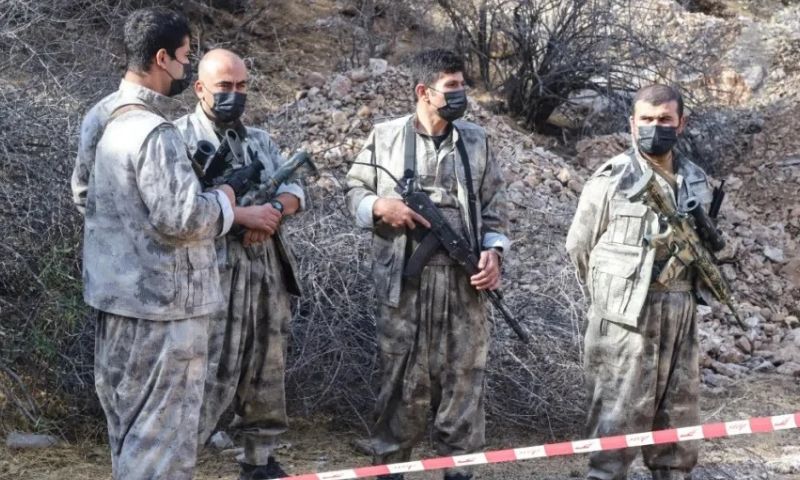
The dissolved Kurdistan Workers Party (PKK) announced on Thursday, October 8, the withdrawal of all its armed forces from inside Turkish territory and areas near the border, saying that the move “completes the necessary requirements to end the armed struggle against Turkey and move to political action.”
The party leadership said in a statement that the withdrawal process took place a few days ago, and included all the party forces inside Turkish territory, in addition to the evacuation of four tunnels and defensive positions in the Metina area, west of the Zab region in the Kurdistan region of Iraq, “despite being away from the Turkish border and not being considered a source of threat to Turkey.”
The statement added that the party “withdrawal of all its armed forces located within the borders of Turkey and in areas near the Turkish border,” considering that this means the implementation of all the requirements associated with ending the armed struggle and the adoption of a strategy based on “democratic political struggle.”
The move comes in the context of a path that began in Turkey over the past year, after the leader of the party, Abdullah Ocalan, imprisoned in Turkey, on February 27, 2025, called for the dissolution of the party, the laying of arms and ending the decades-old armed conflict. The “Kurdish workers” announced in May 2025 that it had dissolved itself and ended its armed activity in response to the call of Öcalan.
The party’s leadership confirmed in its new statement that the Turkish state can no longer, according to its assessment, talk about the existence of an “armed threat” issued by it, noting that it has taken what it described as exceptional steps to end the conflict.
On the other hand, the statement linked the continuation of the peace process to the steps that will be taken by the Turkish government, especially with regard to the situation of Öcalan, as he considered that the lack of recognition of the importance of the steps implemented by the party, foremost of which is ending its armed presence, means the continuation of the policy of “denial and erasure” towards the Kurdish issue, as he put it.
The party called on the Turkish government to take steps “without delay” to push what it called the “peace process and the democratic community,” considering that dealing with Öcalan and providing it with working and living conditions is the main indicator of Ankara’s seriousness in continuing the process.
A path that began with the invitation of Ocalan
The withdrawal announcement came after a series of steps that began with Ocalan’s call in February 2025 for the dissolution of the Kurdistan Workers’ Party (PKK) and the laying of arms, in a shift from the armed path that the party has followed since its establishment.
Ocalan’s call for his party included an appeal to end armed activity and dissolve the party, at a time when Turkey was witnessing a political movement led by the leader of the Nationalist Movement Party, Dawlat Bahceli, an ally of Turkish President Recep Tayyip Erdogan, to push Öcalan to issue a position in this direction.
In later stages, the leaders of the “Kurdish Workers” set conditions for holding the party’s conference and taking the decision to dissolve it and lay down arms, as Executive Committee member Murad Karanin said that giving up weapons requires holding a conference, and that inviting Ocalan alone through a letter or registration is not enough to make the decision.
On May 12, 2025, the party has already declared itself dissolved and disarmed, saying in a statement that the decision is aimed at reaching a democratic solution and a long-term peace.
This coincided with a legal and political path within Turkey to provide a framework for disarmament and reintegration of a number of former party elements, and Turkish legislation regulating aspects of the process, including some legal guarantees for combatants who give up weapons, with the exception of those who committed serious crimes, was passed in 2026.
What does that mean for Syria?
The withdrawal announcement raises a question about the reflection of the end of the armed path of the “Kurdish workers” on northeastern Syria, given the political, intellectual and organizational relationship that Turkey is talking about between the party and the Kurdish forces active in Syria, led by the dissolved Syrian Democratic Forces (SDF).
During the call for the dissolution of the Workers’ Party, the former SDF commander and adviser to the Syrian presidency, Mazloum Abdi, stressed that Öcalan’s message was addressed to the PKK and not to the SDF, but at the same time he welcomed the call and considered ending the war in Turkey and opening a peaceful political path a positive development.
In March 2025, Abdi said that his forces were not directly concerned with the letter because they were addressed to the “workers,” while the SDF had entered a separate path of dialogue with Damascus, at the time, with the aim of integrating its forces into the institutions of the Syrian state, after signing an agreement between Syrian President Ahmed al-Sharaa and Mazloum Abdi on March 10, 2025.
On the other hand, Turkey considered that the invitation of Öcalan should not be limited to the party in Turkey and Iraq, and called on the branches and organizations associated with it in Syria and Iraq to lay down arms as well. In March 2025, the spokesman of the ruling Justice and Development Party (AKP), Omar Chlik, called on the organizations of the two countries to respond to the disarmament process.
The sensitivity of the relationship between the SDF and the workers goes back to the years of war against the Islamic State in Syria. Mazloum Abdi said earlier that a number of leaders and elements of the “workers” appeared alongside the “SDF” during the battles against the organization, but denied that the “SDF” branch of the party, and said that the role of these ended with the end of that stage.
In parallel, the year 2026 witnessed additional steps on the Syrian side, where the northeastern regions of Syria witnessed field changes represented by the control of the Syrian army over the provinces of Raqqa and Deir ez-Zor, in addition to the southern and eastern countryside and a section of the western countryside of the province of Hasaka, while the “SDF” retreated to the cities of the province such as Hasaka and Qamishli.
These changes have created a state of division in administration and control, while the Syrian government and the SDF agreed on January 29 to start integrating the military, security and service institutions in the governorate within the government ministerial structures, which began gradually in February.
On August 25, Mazloum Abdi announced the dissolution of the Syrian Democratic Forces (SDF) and all its formations, while President Ahmed al-Sharaa issued two days later, on August 27, a decree appointing Abdi as an adviser to the presidency.
Multiple tracks
The new declaration of the Kurdistan Workers’ Party (PKK) comes at a stage where three tracks are intersecting: the organization’s termination of its armed activity against Turkey, the attempt to consolidate the political track related to the Kurdish issue inside Turkey, the ongoing changes in northeast Syria and the arrangements for the integration of institutions in the region within the structures of the Syrian state.
In its latest statement, the “Kurdish workers” kept its focus on the Turkish side of the process, as it linked its completion to Ankara’s steps towards Öcalan and the political track, while the reflection of the party’s end of its armed activity on the Kurdish forces in Syria remains linked to separate tracks, foremost of which are the integration arrangements within the institutions of the Syrian state and the relationship between Damascus and Ankara and the Kurdish file in Syria.