
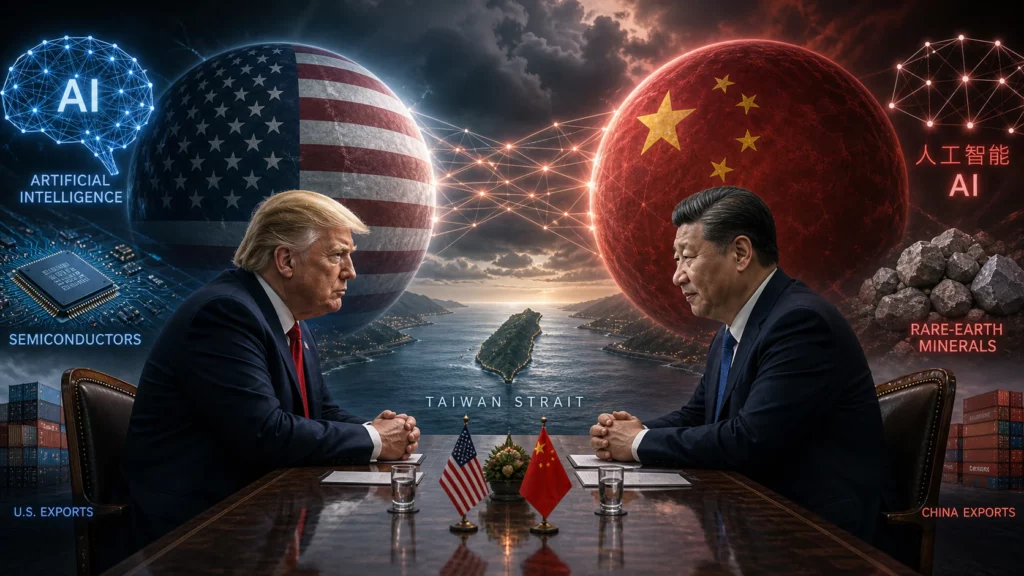
The Trump-Xi summit did not mark a US-China rapprochement, but it demonstrates that sustained diplomacy and strategic guardrails are essential to prevent intensifying competition from becoming direct conflict.
The recent summit between Chinese President Xi Jinping and US President Donald Trump in Washington has demonstrated a significant paradox in contemporary international politics: the two superpowers remain strategic competitors, yet neither side could afford to let their rivalry spiral into confrontation. The Trump administration welcomed Chinese President Xi Jinping, on his first state visit to Washington in more than a decade, with significant diplomatic warmth, but the substantive disagreements over diverse issues separating the two powers remain largely intact.
During this summit, both sides extended their trade truce until January 10, while divisive issues such as Taiwan, technological restrictions, artificial intelligence, rare earth minerals, and the Iran war remained on the agenda, with no considerable progress in any of these domains. Therefore, the summit should not be interpreted as the beginning of a US-China rapprochement. Its actual significance lies in the attempt to contain the risks of an increasingly consequential direct confrontation between the two sides. Considering the volatile global situation, the question is whether the two superpowers can prevent their competition from becoming a conflict.
From Trade War to Strategic Rivalry
Although issues like Taiwan, technological competition, AI governance, and other underlying sources of US-China rivalry persist, the significance of high-level diplomatic engagement cannot be denied, as sustained diplomacy has become more relevant and necessary in an era of geopolitical tensions and instability
Over the years, the Sino-US competition has moved far beyond trade deficits and tariffs. Economic rivalry has been intermingled with technological competition, national security, and geopolitical influence. Rare earth minerals, artificial intelligence, advanced technologies, and semiconductors have become strategic assets for both sides. However, Taiwan remains the most serious flashpoint with the potential to trigger a direct confrontation between the two powers, as reflected in the recent Xi-Trump summit.
Although trade was one of the key elements of bilateral discussion, the broader agenda also included Taiwan, technological advancement, AI, and the US-Iran war. Indeed, the meeting was heavy on symbolism; no clear breakthroughs on major disputes have been reported, and it failed to produce solutions or even provide a framework to resolve the contentious issues. Therefore, the extension of the trade agreement between the two sides must be considered as a breathing space rather than a permanent settlement of mutual rivalry between the US and China. This agreement defers confrontation over rare earth supplies, technological restrictions, and tariffs. However, the underlying disagreement between the two sides remains intact. Nonetheless, the summit’s significance lies in preventing individual disputes from reinforcing one another and producing a broader strategic crisis.
Taiwan and the Risk of Strategic Escalation
Among the agenda of the discussion between the two leaders, Taiwan presents the greatest potential for a military confrontation between China and the United States. Issues like trade, tariffs, commerce, and technological restrictions could be resolved or settled through bargaining. However, a military conflict over the Taiwan issue could be catastrophic not only for the two countries but for the whole world.
According to international media, President Xi urged Trump to oppose Taiwan’s independence, while US arms sales to Taiwan remained a highly sensitive topic during this summit. Trump had previously placed a roughly $14 billion arms package for Taiwan in abeyance, describing it as a negotiating instrument. At that time, he also discussed US arms sales to Taiwan with the Chinese President, a move the US analysts viewed with great skepticism. The danger of a potential conflict over the Taiwan issue does not simply lie in the disagreement between the two superpowers but in the possibility of a miscalculation.
Any military activity around the Taiwan Strait by either side could lead to a direct conflict and could have detrimental implications for the whole world. This makes sustained communication and confidence-building measures between the two sides indispensable. If the two governments maintain direct channels during periods of tension, they have a greater opportunity to prevent a political disagreement from becoming a military confrontation.
From Personal Diplomacy to Strategic Guardrails
Indeed, President Xi and Trump’s personal diplomacy can facilitate communication, but this alone cannot stabilize a relationship of this magnitude. The durability of bilateral relations between the two countries significantly depends on whether the two leaders maintain a cordial relationship. The recent summit provides an opportunity to develop an institutional framework to manage bilateral competition. The two sides need to hold regular high-level meetings, military-to-military communication, diplomatic hotlines, and structured discussions on technology to establish boundaries around strategic competition.
AI offers the two countries an incentive for mutual cooperation. Technology is simultaneously an economic opportunity, a national-security capability, and a potential source of new risks. Before the summit, CSIS argued that the two nations had an opportunity to establish common approaches to AI safety, including incident-reporting channels, shared definitions, and baseline safety practices.
However, artificial intelligence also exposes the difficulties of sustaining cooperation. Beijing and Washington are not only competing over technological capabilities but also over who will shape the rules governing AI internationally. China has already moved to establish the World Artificial Intelligence Cooperation, while Washington is advancing its own international initiatives. The parallel efforts point to an emerging contest between the two powers over technological standards, institutional influence, and the future governance of AI. This very logic also applies to critical minerals and trade. Agreements that reduce immediate tensions can enable further negotiations, but an underlying framework is mandatory for predictable rules and mechanisms to address future disputes.
Conclusion
President Xi’s reference to the Thucydides Trap, a concept that describes the danger that rivalry between an established power and a rising power can generate conflict, underscored the summit’s broader strategic significance. He maintained that such a trap or situation can be avoided. Overall, the summit demonstrated why continued engagement between the two sides remains significant. Although issues like Taiwan, technological competition, AI governance, and other underlying sources of US-China rivalry persist, the significance of high-level diplomatic engagement cannot be denied, as sustained diplomacy has become more relevant and necessary in an era of geopolitical tensions and instability. Competition between the world’s two major powers may be unavoidable, but conflict is not. However, avoiding a conflict will require sustained, cautious, and pragmatic diplomacy.