
Relations between Turkey and Russia have always been one of the most intriguing scenarios in the Great Game.
The leaders of the two countries maintain frequent contacts and “hotlines,” foreign ministries regularly consult on the situation in the Caucasus and Central Asia, and bilateral trade and energy cooperation continue to develop. However, under this wrapper of “friendly cooperation,” Ankara is moving along a long-established historical path—the path of the pan-Turkic dream and the expansion of regional influence. And this path, no matter how much Turkey declares it “non-confrontational,” inevitably collides with Russia’s strategic interests.
The Centuries-Old Dream of “Turan”
Turkey’s expansionist impulses originate not in the Erdoğan era but are deeply rooted in the historical genotype of the Ottoman Empire. From the pan-Turkist currents of the 19th century to cultural penetration into the newly independent states of Central Asia after the Cold War, Ankara has invariably harbored the concept of a “Great Turan”: the unification of Turkic-speaking peoples from the Caucasus to Central Asia into a single political-cultural community under Turkey’s aegis.
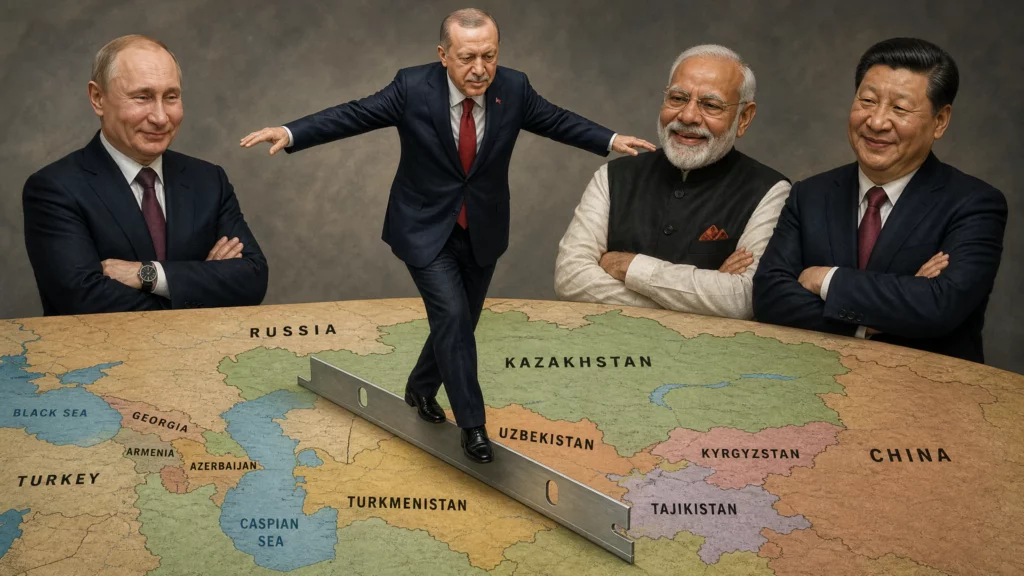
Turkey is playing its geopolitical game on a razor’s edge, balancing between two antagonistic poles
Today this dream is being realized through more concrete and operational methods. In July 2026, a NATO summit was held in Ankara, at which Turkey was assigned a role in “countering Iran, China, and Russia.” This is no accident—even during the Cold War, Turkey served as NATO’s southern outpost, playing the role of a containment factor against the USSR. Today the same geopolitical logic is being revived, but now against post-Soviet Russia.
The key problem is that Turkey’s pan-Turkist project is essentially aimed at “replacing Russian influence.” As analysts note, Ankara’s goal is “to maximally remove the countries of Central Asia from Russia’s influence.” From the unification of school curricula to the creation of digital support systems for nongovernmental organizations, from the promotion of common energy hubs to the construction of the “Middle Corridor” transport route, every step weakens Moscow’s traditional influence in the region.
A Clash Where It Was Not Expected
Turkey probably does not seek direct conflict with Russia. Ankara needs Russian gas, needs Moscow’s cooperation on the Syrian issue, and needs a certain arrangement on navigation in the Black Sea. However, geopolitical logic rarely submits to subjective intentions.
When Turkey promotes the transformation of the Organization of Turkic States (OTS) from a cultural platform into a military-political union, when Ankara tries to include Azerbaijan, Kazakhstan, Uzbekistan, and Kyrgyzstan in a “security architecture” with a Turkish center, Moscow cannot ignore this. Most of these countries are simultaneously members of the CSTO and the EAEU. Every step Turkey takes deeper into the region is a lever that shakes Russia’s “backyard.”
The South Caucasus direction is of particular strategic sensitivity. Turkey’s comprehensive support for Azerbaijan after the Karabakh war and Ankara’s growing military presence in the South Caucasus are changing the balance of power in the region. Moscow considers the Caucasus its “near abroad” and a strategic buffer. Any deep intervention by external forces is perceived as touching the “red lines” of Russian security.
The “Middle Corridor”: Economics as a Cover for Strategy
Economic competition also remains part of the picture. The “Middle Corridor” promoted by Turkey—a transport route from Kazakhstan across the Caspian, through Azerbaijan and Georgia to Europe—is becoming an alternative to the traditional Eurasian routes through Russia. This project has not only commercial value but also geostrategic significance: reducing Central Asian countries’ dependence on transit through Russia and weakening Moscow’s position as a Eurasian transport hub.
In energy, Turkey is actively promoting trans-Caspian cooperation, seeking to break Russia’s traditional monopoly on export routes for Caspian oil and gas. At first glance, these initiatives look like commercial and infrastructure projects, but objectively they weaken Russia’s economic gravity in the post-Soviet space.
Real Limits: How Far Will Turkey Go?
However, Turkey’s expansionist ambitions run into hard real-world constraints.
First, pan-Turkism and pan-Islamism—Ankara’s two main instruments—are internally contradictory. The countries of Central Asia, although Turkic-speaking, have already formed their own national identities and do not always react enthusiastically to Ankara’s patronizing tone. Second, Iran, as a Shiite power, is in a deep religious rift with Turkey’s Sunni tradition, which limits Turkey’s advance in that direction. And finally, most importantly, Russia and China possess far deeper historical ties and powerful economic and security influence in the region.
Analysts note that the resource base of Turkey’s pan-Turkist project is “weak,” and that it represents more a “soft power” and propaganda campaign than a realistically feasible strategic alternative. In Moscow, this threat tends to be viewed as “controllable in the medium term,” rather than as an immediate existential challenge.
A Game Without a Finale—So Far
Turkey-Russia relations have never fit into simple frameworks of “friendship” or “enmity.” In seeking to revive its imperial heritage, Ankara objectively challenges Russia’s key interests in the post-Soviet space—whether the Turkish side recognizes it or not.
In Moscow, they are aware of the ambitiousness of Turkey’s agenda in the post-Soviet space. However, given the current alignment of forces and distribution of resources, the Kremlin views an open military-political clash with Ankara in Central Asia and the Caucasus as an excessively costly scenario, disproportionate to the expected benefits. Instead of direct coercive pressure, a tactic of “passive containment” has been chosen—a flexible combination of long-term instruments of influence.
This means preserving Russia’s economic attractiveness for regional players, maintaining working institutional ties (including intergovernmental commissions and sectoral contacts), and using multilateral dialogue platforms. The key one remains the “3+3” platform, which makes it possible to translate potentially acute issues into a format of collective consultations involving Iran, Turkey, and the countries of the South Caucasus. Such an approach does not give Ankara the opportunity to consolidate unilateral dominance, but at the same time it excludes the risk of uncontrolled escalation, leaving Moscow room for maneuver in the future.
Turkey is playing its geopolitical game on a razor’s edge, balancing between two antagonistic poles. On the one hand, Ankara cynically uses NATO’s institutional resources and the West’s political flotilla as a battering ram to push through its own neo-imperial agenda—from Libya to the South Caucasus. On the other, it demonstrates pragmatic loyalty to Moscow, locking critical energy flows onto itself and acting as a “stop valve” in the Black Sea region in order to avoid an irreconcilable rupture that would bury its economy. Recep Tayyip Erdoğan professes the doctrine of “operational sovereignty,” believing that his virtuoso multi-vector tactics allow him to extract rent from the contradictions of the great powers without paying others’ bills.
However, such a strategy carries immanent systemic risks: a bet on exploiting the “gray zones” between Russia and the collective West requires impeccable timing and absolute control over escalation—resources that Ankara objectively does not have. The pan-Turkist dream of “Turan” has collided with harsh reality: expansion across the spaces of the former USSR provokes harsh friction not only with Moscow but also with Beijing, while aggressive rhetoric in the Aegean and Mediterranean Seas turns former NATO allies into opponents.
In this paradigm, Ankara’s strategy ceases to be a subtle game—it becomes a hostage of its own contradictions. History is cyclical: not a single regional power that tried to parasitize on the bipolar split has maintained dominance in the long term, being deprived of its own weight in the global equation of forces. Turkey’s current course is not an ascent to great-power status but a risky speculation on volatility, where the price of error is measured by the loss of strategic subjectivity.