Nablus, occupied West Bank – At Joseph’s Tomb in Nablus, Israeli military vehicles enter the city ahead of groups of Jewish settlers. Roads are closed within minutes. Movement in the surrounding neighbourhoods comes to a halt.
Palestinian residents retreat into their homes as tear gas drifts into nearby streets and buildings. The visits usually last only a few hours. But the military operation around them can disrupt daily life across the area, clearing streets and restricting movement to allow settlers to reach the site.
The scale of the deployment is striking: soldiers, armoured vehicles, road closures and movement restrictions are mobilised to facilitate a temporary settler presence in the heart of a Palestinian city.
That makes the visits more than religious pilgrimages. They are also demonstrations of who can move through Nablus, who is required to stay inside, and which authority can impose those restrictions.
Joseph’s Tomb is, however, a special case. Although it lies inside Nablus, in Area A, the Oslo Accords established particular arrangements governing access to the site. Military-backed visits therefore do not represent the sudden extension of Israeli control over the Palestinian Authority-controlled city.
But the exception is politically significant precisely because it exposes the gap between jurisdiction on paper and power on the ground. The Palestinian Authority remains formally responsible for Nablus, yet when a visit is authorised, Israel can deploy troops, close roads and secure a route for settlers. Israeli military power ultimately determines who can enter and who can move.
“Turning religious and heritage sites into instruments of political conflict is a dangerous development, as it conflates the sacred with the settlement project and transforms collective memory into a means of generating violence and forcibly reshaping the geography,” Dr Mona Abu Hamdiya, a researcher in heritage and archaeology, told The New Arab.
When an exception becomes the norm
The closures eventually end, but their effects are less easily erased.
Families plan around incursions. Work is disrupted. Relatives can be separated. Streets that are normally open become inaccessible. Residents learn that, for several hours, the ordinary rules governing their city can be suspended.
Repetition matters. An event that is officially exceptional can, through repeated incursions, become part of the landscape of Palestinian life.
Joseph’s Tomb therefore offers a lens through which to view a wider transformation underway across the occupied West Bank. The question is not simply whether Israeli sovereignty has formally changed, but whether the space available to Palestinians is being progressively narrowed while Israeli access, settlements and infrastructure become harder to reverse.
The figures suggest this is no longer a marginal phenomenon.
According to the UN’s Office for the Coordination of Humanitarian Affairs (OCHA), more than 1,300 settler attacks resulting in Palestinian casualties or property damage were recorded across the West Bank in the first seven months of 2026, an average of more than six a day.
More than 2,300 Palestinians had been displaced by settler attacks and related access restrictions since the beginning of the year.
By late August, OCHA had recorded 23 Palestinians killed and more than 1,040 injured in settler attacks in 2026. Palestinians are now being injured directly by Israeli settlers at a rate of more than three a day, compared with two a day in 2025 and one every three days in 2020.
The pattern is particularly stark in communities close to settlement outposts, where attacks are accompanied by restrictions on access to agricultural land, roads, water and electricity.
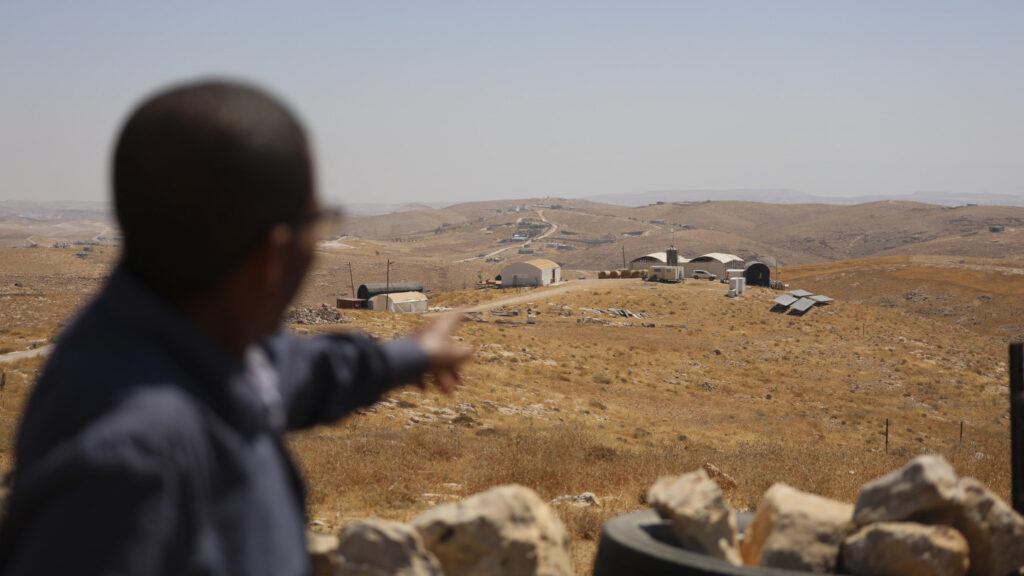
Qusra, near Nablus, illustrates how these pressures can converge. In August, settlers established a new outpost in Area B near three Palestinian families in the Ras Al Ein area. OCHA reported increased settler and military presence, damage to water and electricity infrastructure and severe restrictions on the families’ movement. By late August, two of the four roads connecting the area to Qusra were under Israeli control.
The mayor of Sebastia municipality, Mohammad Abdul Aziz Azem, described the pressure on Palestinian communities as part of a broader effort to empty land of its Palestinian inhabitants and confine them to increasingly restricted population centres.
“This is being pursued through organised terrorism supported by Netanyahu’s government, amid international silence and the absence of effective deterrent sanctions against the Israeli occupation government,” he told The New Arab.
Violence changes the map
The significance of settler violence lies not only in the immediate harm it causes, but in what happens afterwards.
A farmer who is attacked must decide whether returning to a field is worth the risk. A family facing repeated threats may stop using a road. A community whose water infrastructure is damaged becomes more dependent on outside assistance.
When such violence is followed by little accountability, and Palestinians subsequently face restrictions on accessing land from which they have been driven, temporary intimidation can create a lasting change in who uses the territory.
Yesh Din, which has monitored Israeli police investigations into ideologically motivated offences against Palestinians since 2005, found that 93.6% of the cases it tracked ended without an indictment. Only 3% resulted in a conviction.
“Settler violence is part of a comprehensive strategy aimed at determining the outcome of the conflict through the silent annexation of Palestinian land,” Dr Hosam Al-Dajani, a writer and political analyst, told The New Arab.
“This is being pursued by forcibly displacing the population through a series of measures imposed by the occupation, including escalating violence and targeting trees, property, people, and everything that connects Palestinians to their land,” he added.
From coercion to administration
On the ground, the process can be incremental. An outpost appears on a ridge. Settlers begin using surrounding land. Palestinians face threats or attacks. Access roads are closed or restricted. Roads, electricity connections and other infrastructure follow, while military protection makes the new arrangement more secure.
Eventually, what began as an unauthorised presence can acquire some degree of official recognition or state support.
OCHA reported in August that at least 26 settlement outposts had been established in Area B over the previous two and a half years, 19 of them since the end of 2024. Peace Now estimates that settlers have taken control of more than 100,000 dunams in Areas A and B, including through violence and threats that have restricted Palestinian access to land.
The process is increasingly accompanied by administrative measures.
Israel’s land-registration programme, approved in February 2026, is intended to complete title-settlement procedures covering 15% of unregistered land in Area C over five years. Israel says the process will clarify ownership. Critics, including Peace Now, argue that formalising land rights while Palestinians face restrictions on access risks turning inequalities created under occupation into an administrative record.
The concern is not simply that a registry might transfer land illegally. It is that the conditions under which evidence of ownership is produced are themselves unequal.
A Palestinian family may have inheritance documents, tax receipts and generations of knowledge establishing its claim to a field. But if repeated attacks or access restrictions prevent the family from regularly cultivating it, absence can begin to look like abandonment.
An outpost, meanwhile, may acquire roads, electricity, security and eventually official recognition.
Coercion can therefore precede administration. Violence does not have to be formally ordered by the state to alter the conditions under which land is subsequently governed.
“Settler violence is part of a comprehensive strategy aimed at determining the outcome of the conflict through the silent annexation of Palestinian land,” Dr Hosam Al-Dajani, a writer and a political analyst, told The New Arab.
“This is being pursued by forcibly displacing the population through a series of measures imposed by the occupation, including escalating violence and targeting trees, property, people, and everything that connects Palestinians to their land,” he added.
“The objective is to impose new facts on the ground in order to advance this strategy, which violates international law and resolutions of international legitimacy, particularly UN Security Council Resolution 2334,” Al-Dajani said.
Annexation without a declaration
Calls to annex the occupied West Bank have grown louder since the far-right government came to power, with ministers openly stating their intentions to seize the Palestinian territory.
Yet at an official level, and to international interlocutors, Israel says that security measures protect Israelis, that registration settles ownership questions, and that borders should be decided through negotiations.
But any future negotiations would not take place over a fixed landscape. While the political status of the territory remains unresolved, the land Palestinians can reach, the authority they encounter and the evidence they can produce to establish ownership are already changing.
Since 2023, the UN says more than 6,200 Palestinians have been displaced by settler attacks and related access restrictions since 2023, including more than 2,300 in 2026 alone. Forty-six communities have been completely displaced.
The cumulative effect is territorial change without a formal declaration of annexation.
“Palestinians face a major challenge that requires unity and cooperation in confronting this project. The threat is not only to Palestinian land but also to the Palestinian national political project itself,” Akram Atallah, a political analyst and columnist for Al-Ayyam newspaper, told The New Arab.
“It is also undermining the two-state solution, as the territory on which a Palestinian state is supposed to be established is being fragmented and brought under increasing Israeli control.”