When I think about the journey of heroin from its source to a European market, I don’t picture a criminal mastermind directing a supply chain from beginning to end.
What I see instead is a farmer, then a transporter, a courier and perhaps a broker who moves the drugs only as far as the next village. Another broker might get them across a border, after which a gang takes over one stretch of the journey before handing it to another. By the time the heroin arrives in Europe, still more people may be responsible for moving it to wherever it eventually ends up.
There are people making money throughout that journey.
A consignment moving through Iran, for example, might pass from one group between Mashhad and Tehran to another operating towards the Turkish border around Van. Others take over as it moves onwards, including once it reaches its European destination.
So what we call a ‘route’ is really a succession of transactions, relationships and handovers rather than one continuous supply chain.
Heroin has slipped from view
I think that is particularly important now because heroin has slipped somewhat from view. Cocaine and synthetic drugs increasingly dominate discussions about illicit drug markets, particularly in Europe, while Afghanistan’s opium economy appears at first glance to have undergone an extraordinary contraction following the Taliban’s 2022 ban on poppy cultivation.
The numbers certainly suggest a market in retreat. Afghan opiate output has fallen by an estimated 97% compared with 2017, while heroin seizures across the EU, Türkiye and Norway fell from 9.9 tonnes in 2018 to 5.4 tonnes in 2025. But heroin continues to move, and the trafficking economy around it has not disappeared. Stockpiles, cultivation elsewhere and increasingly varied trafficking methods have helped keep supply flowing.
That was something I kept coming back to during this research. Despite all the attention rightly being paid to the growth of synthetic drugs, there is still a very active illicit economy around poppy cultivation, opiate production, refinement and heroin trafficking, with people profiting from it all the way along the journey.
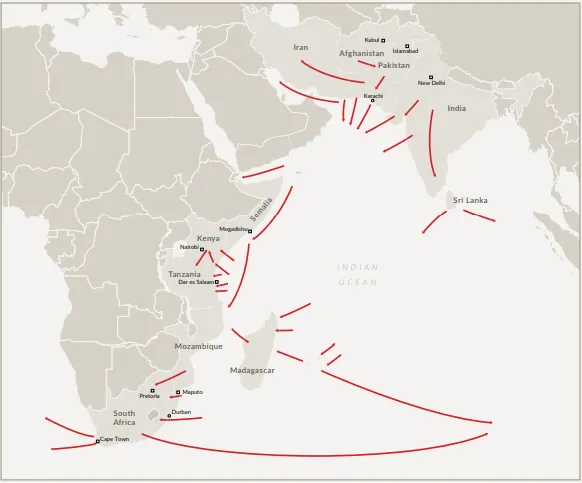
Its resilience becomes easier to understand once we discard the idea of one continuous supply chain. Our research found exit routes from Afghanistan sustained by different traffickers, couriers and brokers, while the southern route has splintered into an extraordinary range of maritime and overland options. Dhows carry drugs towards East Africa, loads can be transferred to fast boats and small dinghies or dropped offshore, while other consignments disappear into container traffic. With so many different options available, there is no single interdiction point that can meaningfully disrupt the entire supply.
The geography of production is changing
The research also changed the way I think about where the heroin economy begins. I no longer think about Afghanistan in isolation when it comes to opiate production. Increasingly, it makes more sense to think about a tighter production region encompassing Afghanistan and neighbouring Pakistan, particularly Balochistan.
Cultivation there has expanded significantly. In 2025, we estimate that Badakhshan accounted for around 40% of opium production across the Afghanistan–Pakistan region, compared with roughly 20% in Helmand and 25% in Balochistan. Field researchers subsequently reported bumper crops in both Balochistan and Badakhshan in 2026.
None of this means Afghanistan has ceased to matter. Far from it. But focusing too narrowly on the dramatic decline in cultivation in south-western Afghanistan risks obscuring what is happening around it. Demand is still being met through stockpiles and production elsewhere, while cultivation has become relatively more important in north-eastern Afghanistan and Pakistan.
Further downstream, the geography is changing too. The southern route has re-emerged as an especially dynamic pathway, connecting southern Afghanistan with Balochistan and the Makran coast, Iran and maritime routes stretching towards the Middle East, East and southern Africa and Europe. The Caucasus has also become more important as traffickers adapt to the disruption caused by the Russia–Ukraine war.
What stayed with me wasn’t on the map
Some of the observations that stayed with me most strongly, however, came not from tracing these routes on a map but from listening to the people trying to police them.
We held an expert consultation in South Africa during the research, bringing together South African police and drug-trafficking experts alongside participants from elsewhere in the region. I was struck by the practical difficulties the police face.
They described challenges with tackling the flows of drugs through ports and airports, often caused by organised crime being a step ahead of the police, meaning by the time officers get to the port or airport, someone may have been tipped off and whatever they were looking for has disappeared.
Another conversation, this time with a frontline police officer from Madagascar, brought out a very different problem: testing capacity. The equipment available was old and Madagascar had only one second-line facility capable of providing forensic confirmation of seizures, meaning authorities can face long delays before knowing precisely what they have intercepted.
Heroin isn’t travelling alone
That becomes especially significant as the boundaries between different drug markets grow harder to distinguish. Along both the northern and southern routes, we found that heroin is now rarely trafficked alone, with amphetamine-type stimulants, new psychoactive substances and cocaine appearing alongside it. Afghanistan has itself emerged as an important methamphetamine production centre, while heroin reaching European consumers is becoming less pure and is increasingly mixed with synthetic opioids.
The consequences are already serious in the UK, where heroin and morphine were implicated in more than a quarter of the 5,129 drug-related deaths recorded in 2024. Our research also found that some drugs sold as heroin contained highly potent synthetic nitazenes and, in some cases, no heroin at all.
This is why I think we need to be careful about treating heroin as yesterday’s drug problem.
Its relative position in the global drug economy may be shrinking, but that does not necessarily mean the risks associated with it are shrinking too. Production is shifting geographically and trafficking routes are adapting, while heroin is increasingly intersecting with synthetic drugs. At the same time, weakened testing and monitoring capacity can leave authorities struggling to see those changes quickly enough.
What I’m watching next
Over the next year, I’ll be watching several developments particularly closely. Continued cultivation in Balochistan is one, as is what happens to farmers affected by eradication in Helmand and south-western Afghanistan. The relationship between poppy cultivation and increasing unrest in Badakhshan also deserves attention, alongside the rise of synthetic drug use among young people in Central Asia.
I’ll also be watching what happens along the southern route. Traditional dhows and larger offshore vessels remain important to trafficking there, but traffickers elsewhere have already experimented with autonomous and semi-submersible vessels. Whether similar technologies become more prominent around the African coast and Indian Ocean is worth watching.
Perhaps the biggest thing I took away from the research is that we should stop expecting the heroin trade to behave like a single pipeline that can simply be squeezed until it runs dry. The reality is much messier: different people profit at different stages, production can move when conditions change, routes fragment and traffickers adapt their methods, increasingly moving different drugs through the same infrastructure.
Heroin may no longer command the attention that cocaine and synthetics do, but the criminal economy that has carried it across continents is still very much alive — and it is changing alongside them.