History is written by the victors, but if you understand the psychology of magic or the magic of psychology, you can write your victory into existence before the battle starts. You corrupt the texts. You plant a history that lays the foundation for a victory you authored years earlier and labeled “prophecy.” By the time the fighting begins, the outcome has already been narrated.
I know how this works because I watched a version of it from behind the curtain. Those who found me through my books on the Anunnaki, or through History’s Ancient Aliens, may read this as my most controversial piece yet, perhaps even a betrayal. Maybe it is, and it is precisely that vantage point that makes me feel I have to say what most people in this space will not.
We are living inside a corrupted historical framework built to serve a political and religious agenda you likely never signed on to.
None of what follows depends on your team. It does not matter whether you follow a religion or none, whether you think the Anunnaki are a loony grift, entertainment, or sacred myth. I am not here to challenge any of that. Not because beliefs should not be challenged, but because before we turn on each other, we ought to look up and check whether someone has put us in a ring and told us to fight.
Are these our battles, or battles in someone else’s war?
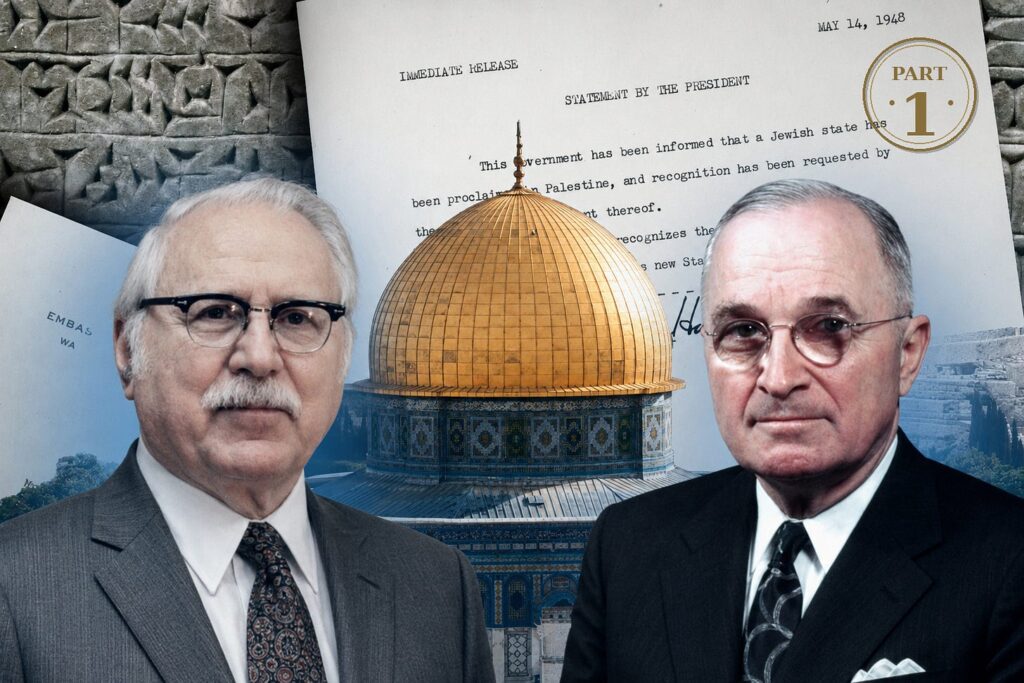
The following is the most in-depth H-File I’ve written, long enough that it comes in two parts. The argument, across both, is this: The Anunnaki story as popular culture depicts it, the version Zecharia Sitchin branded (but did not invent), is a twentieth-century construction resting on two older layers most of its consumers have never examined. The first is a nineteenth-century scholarly project built to vindicate the Bible with a spade and artifacts. The second is a wartime intelligence apparatus that turned that scholarship into statecraft and helped draw the borders of modern Iraq. Sitchin himself belongs to the third layer, and so does a curious errand of his involving President Harry Truman and the only signed copy of America’s recognition of Israel. That story is detailed in Part Two.
Most of the Israeli government press on Sitchin call him an “internationally acclaimed author and researcher” never clearly stating his involvement in creating Anunnaki lore. Instead, the focus is just how he and his wife were active in Jewish causes and organizations and he was a founding Director of the American-Israel Chamber of Commerce and Industry, and chairman of the American- Israel Pavilion at the New York World’s Fair held in 1964/65. His wife was President of the New York Chapter of Hadassah and a member of Hadassah’s National Board.
Sitchin was born in Baku, Azerbaijan SSR, but was raised in The British Mandate for Palestine which was a League of Nations mandate administered by the United Kingdom from 1920 to 1948, following the collapse of the Ottoman Empire after the First World War. Its stated purpose was to facilitate the establishment of a Jewish national home.
Below is the letter from the Raab Collection.
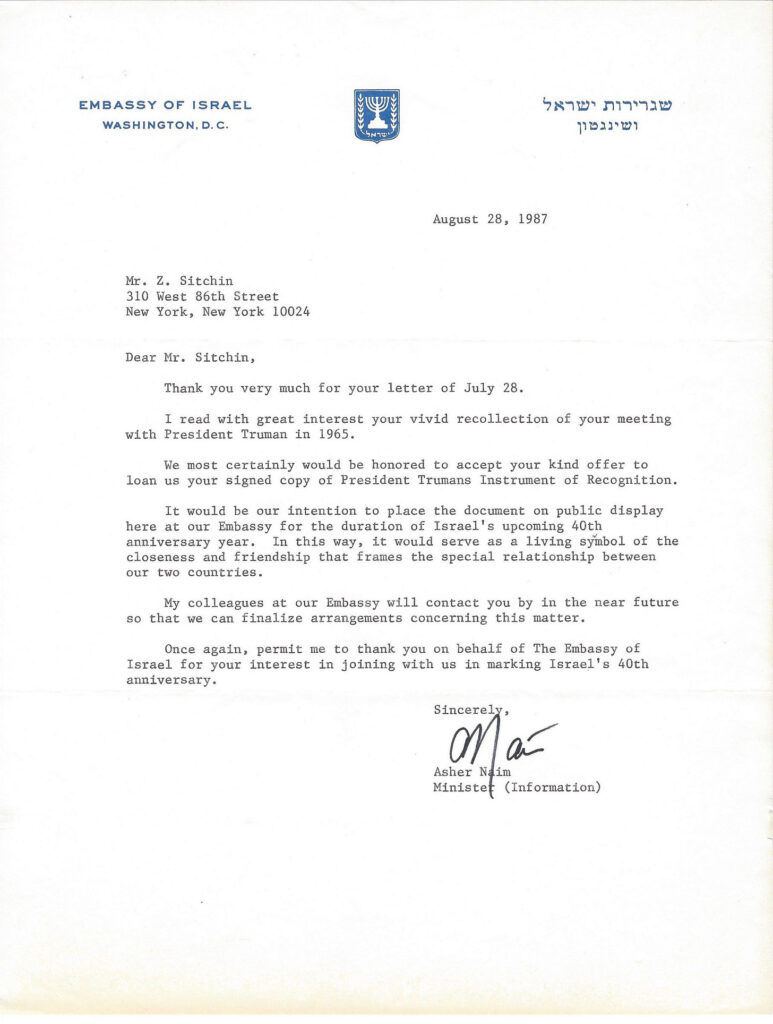
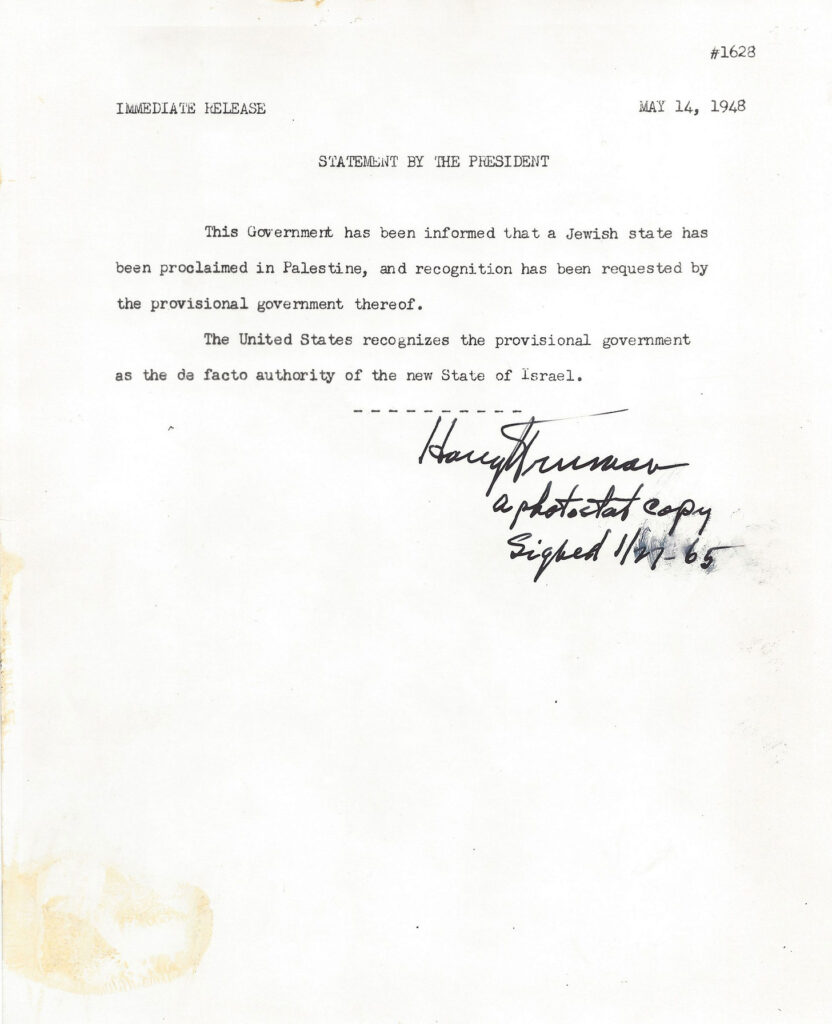
The man who turned ancient gods into alien gold-miners also created and controlled the only signed copy of America’s recognition of Israel. That fact alone raises several questions:
Why did the author who gave the Anunnaki their rockets also secure Truman’s signature on the official recognition of Israel?

What connects a media mogul who dominated academic publishing, his daughter’s central role in Jeffrey Epstein’s crimes, and a 1976 book about ancient astronauts?

If Sitchin didn’t invent the ancient-astronaut story, who did — and why did it suddenly need a Mesopotamian costume in 1976?

How did the collapse of trust in universities and peer review create the perfect opening for a new origin story?

Why do so many versions of the Anunnaki narrative end up claiming that some people carry the blood of the gods while everyone else descends from slaves?
This piece examines a recurring pattern across seemingly unrelated cultural and ideological streams. It is not an attack on Jewish people as a whole. Many of them are not in favor of the Netanyahu Zionist administration. It does not claim Christians, Muslims, or any group of people are inherently bad. Nor is it a dismissal of ancient mysteries or genuine spiritual questions. Those who know my work know I have explored those topics with great interest and respect.
What this analysis demands is consistency. We are told to scrutinize supremacy and radicalization wherever they appear. Yet when those same patterns emerge from groups currently framed as victims, many suddenly lose their nerve. That selective blindness is hypocrisy.
Supremacy in all forms is condemned, but when radical Zionism advances its own version of ethnic and religious supremacy, complete with claims of divine right, genetic destiny, and the right to seize land, large parts of the culture go quiet. This double standard cannot stand if we actually believe the values we claim to hold.
The pattern becomes clearest when we see how different audiences are being reached through parallel delivery systems. Biblical believers are sold the narrative through the language of the “chosen people.” Classical liberals and neocons are appealed to with arguments about Israel’s right to exist and defend itself as a nation-state. Spiritual seekers and those curious about the unexplained are given the Zecharia Sitchin framework, in which Jerusalem must be preserved because it is the seat of the Anunnaki, divine rulers whose blood supposedly grants certain people the right to rule over the rest of humanity, viewed as little more than slaves or cattle.
Any large-scale deception across a population would need to reach people on multiple fronts. Those who believe in the Bible and the narrative of the chosen people can be appealed to through biblical reference points. People with no Abrahamic background, who value classical Enlightenment ideals of liberty, property rights, and self-defense, can be reached through arguments that Israel has a right to defend itself as a nation-state with no religion required. Likewise, those with little religious or civic anchor but who lean toward the mystical or imaginative are offered a ready-made Star Wars-style mythology to step into.
No matter how different the narratives, the people, or the ideologies appear on the surface, it is striking how conveniently they all converge on the same conclusion.
So when something as seemingly playful as “ancient astronaut theory” shows fingerprints of Zionism all over it, it is worth paying closer attention. When the originators of these narratives are elevated to guru status and their followers heavily funded until a once-fringe idea becomes mainstream, terms like Anunnaki enter the popular vocabulary almost exclusively tied to ancient astronaut theory. It is reasonable to ask why. Who benefits from us believing that a particular set of possibly Semitic gods intermingled with human leaders, granting them a divine right to rule over the rest of humanity?What follows is the excavation beneath that signature. To understand how a twentieth-century businessman came to brand a race of alien gods and hand a president a pen, you have to start three generations earlier, with the men who first pulled Sumer out of the ground and decided what it meant. That is the ground floor, and it begins in Philadelphia.
Stand on the sidewalk in front of the Penn Museum of Archaeology and Anthropology in Philadelphia, look up, and in the stone you will find a six-pointed star fixed to the face of a building raised to hold the spoils of Mesopotamian excavation. The museum’s first section opened in 1899, by which point the University’s expeditions to the Sumerian city of Nippur had for a decade been shipping home the tablets, statues, and broken gods of the ancient Near East. The building exists because of that dig. Provost William Pepper, physician and academic reformer, dreamed of creating a museum tracing “the development and history of humanity from antiquity to the present.” Pepper had promised the expedition’s backers a fireproof museum to house whatever came out of the ground.
In 1894 Pepper obtained land from the City of Philadelphia for a “Free Museum of Science and Art” (the “free” signaling no admission charge, partly to court city politicians; it charged no admission until 1987). The institution was informally “The University Museum” (official 1913), and reached its current name, the University of Pennsylvania Museum of Archaeology and Anthropology, after later renamings. Pepper died in 1898, age 54, in California while convalescing, in the company of Phoebe Hearst (mother of William Randolph Hearst, and later the funder of Berkeley’s anthropology museum). The first museum building was reconceived partly as his memorial.1
The stars on the buildings are more than ornamental. The Magen David is not, in origin, a Jewish sign at all. The hexagram is one of the oldest and most widely borrowed shapes in the human decorative vocabulary, and for most of Jewish history it was the menorah, not the six-pointed star, that stood for the community. The figure was first named the Shield of David in Kabbalistic writing in the fourteenth century, and it became a broad emblem of Judaism only in the nineteenth, in the very decades the bricklayers at Penn were setting it above the door. By 1899 the symbol had also taken on a political charge. Two years earlier, David Wolffsohn had presented the blue-and-white banner bearing the star at the First Zionist Congress in Basel, and that design would go on to become the flag of the State of Israel in 1948.2
What gets lumped together as Sumerology and subsequently the Anunnaki is not one history but three, laid down as separate strata. The first stratum is the decipherment of cuneiform and the birth of Assyriology as a readable science: a European project of the 1840s through the 1870s, Protestant in motive and imperial in reach. The second stratum is the British handling of Mesopotamia during and after the First World War, when scholarship, intelligence work, archaeology, and statecraft began to grow into one another, and a small circle of archaeologists, officials, and imperial advisers helped shape the borders that became Iraq. The third stratum is the popular tale of the Anunnaki as ancient astronauts: not an ancient Mesopotamian doctrine, but a modern pop-cultural construction that gathered force from the 1950s onward, and that Zecharia Sitchin entered, amplified, and branded far more than he originated.
The decipherment of cuneiform is half a century older than the border-drawing and three full generations older than the flying saucers. This is where the better story begins: biblical scholarship and empire, wartime intelligence and territorial management, and twentieth-century mythmaking in the age of rockets, saucers, and mass media.
Cuneiform became legible through a handful of men in the middle of the nineteenth century. The first real break came from a German schoolteacher, Georg Friedrich Grotefend, who cracked Old Persian cuneiform around 1802, working from inscriptions that travelers like Carsten Niebuhr had copied by hand in the field. The rest of it swung open on a single three-language inscription cut high into the rock at Behistun in western Persia (modern-day Iran), the Rosetta Stone of the wedge-script.3
Edward Hincks was an Anglo-Irish Anglican clergyman, the rector of a parish in County Down, and one of the improbable architects of cuneiform decipherment. He was, in the most Victorian sense, a country parson with a formidable scholarly obsession. Working outside the formal machinery of the museum and university world, he helped reconstruct the logic of the Akkadian writing system and showed that the inscriptions were not antiquarian curiosities, but readable historical documents.
Part of what made his work so exciting to nineteenth-century readers was its biblical resonance. Names known from Scripture, including Jehu, Menahem, and Sennacherib, began to emerge from the cuneiform record, making the budding field of Assyriology appear to confirm the Bible. Yet Hincks also pushed beyond simple biblical validation. As early as 1849, he recognized that Akkadian could not have been the original language for which the script was devised, pointing instead toward an earlier, separate language behind the system, the language that would later be identified and called Sumerian.4
English soldier, diplomat, and orientalist, Sir Henry Creswicke Rawlinson is sometimes called the “Father of Assyriology.” He was an East India Company army officer whose enduring contribution was copying and publishing the Old Persian text of the Behistun inscription (work done in the 1830s–40s, at real physical risk on the cliff face). He was slower than Hincks to grasp the logo-syllabic nature of the script, clinging to the notion that it was partly alphabetic, and his later reputation was somewhat inflated at Hincks’s expense (notably in E. A. Wallis Budge’s 1925 history). He was an imperial-establishment figure to the core; his brother George wrote him an adoring biography that managed never to mention Hincks.5
As this small discipline was forming around the supposed discovery of texts that reinforced Christian biblical narratives, Jules (Julius) Oppert enters the scene. Born in Hamburg in 1825 into a Jewish family, he found the German academic posts of his day effectively shut to him as a Jew, which is much of why he built his career in France, where he eventually held a chair at the College de France. He is a genuine and important instance of Jewish participation at the founding of the field of Assyriology. In 1869 he gave the non-Semitic language behind Akkadian its name, Sumerian, reasoning from the royal title “King of Sumer and Akkad.”6
By the late 1850s the field still had to prove it was reading the script rather than guessing at it, and it did so in a way few decipherments before or since have dared. In 1857 the scholar William Henry Fox Talbot proposed a blind trial. Send a freshly dug cuneiform text, untranslated, to several experts working in isolation, seal their separate renderings, and see whether they agreed. The Royal Asiatic Society sent a new inscription of the Assyrian king Tiglath-Pileser I to Talbot, Hincks, Rawlinson, and Oppert, then sat a jury to weigh the four results against one another. The versions lined up closely enough, Hincks and Rawlinson nearest of all, that on the twenty-fifth of May the society pronounced the decipherment of cuneiform an accomplished fact. That afternoon is the moment Assyriology stopped being an inspired pastime and turned into a credentialed science.7
Then there is George Smith, a working-class self-taught engraver who taught himself cuneiform on his lunch breaks at the British Museum and became the great early translator. In December 1872, before the Society of Biblical Archaeology, he announced his discovery of a Babylonian flood account on a tablet from the Library of Ashurbanipal, the “Chaldean account of the Deluge.” The sensation was precisely that cuneiform appeared to corroborate Genesis; the announcement reportedly so excited the audience that Smith was funded to go find the missing fragments, which he did. He died young, at 36, on a collecting expedition near Nineveh in 1876.8
The foundations here were laid primarily by Anglican clergymen and British imperialists. Protestant hunger was the engine: the drive to vindicate Scripture by sinking a spade into the ground and pulling up the Bible’s own buried past. The men who built the early discipline understood themselves to be doing Christian apologetics with scientific tools. Archaeology has often been used as a scientific materialist mask over a metaphysical or ideological quest.
There was a genuine, decades-long scholarly fight called the “Sumerian Problem” (or sometimes the “Sumerian Question”): who invented the first writing system? The question’s core was racial in the nineteenth-century sense, where “race,” language, and culture were treated as one essence. Some scholars were eager to prove the “non-Semitic character” of so foundational an invention; others insisted the opposite.9
The real “Sumerian Problem” was who could claim the invention of the Sumerian language and all the subsequent “firsts” of civilization, as this would be evidence of racial superiority.One side held that only Semites had lived in early Babylonia, and so Semites must have invented writing. The loudest voice on that side belonged to Joseph Halevy, an Ottoman-born Jewish-French scholar, an ardent Hebraist and an early Zionist of the pre-Herzl kind. From 1874 onward, Halevy argued, stubbornly and at exhausting length, that Sumerian was not a real language at all. It was, he insisted, an artificial priestly cipher invented by the Semitic Babylonians themselves, a sacred code with no separate people standing behind it.
The most prominent Jewish scholar in the founding racial debate spent decades trying to abolish the Sumerians, to deny them a distinct existence, so that the Semites could keep the crown as inventors of civilization’s first technology. The Encyclopaedia Judaica puts the motive bluntly: “Prompted by his ‘Semitic’ pride, Halevy argued obstinately against the view that Sumerian was a non-Semitic language.”10
The debate was so live that the German scholar Friedrich Delitzsch accepted Halevy’s “secret code” thesis for roughly a dozen years (c. 1885–1897) before renouncing it. The evidence pried him off it, which means the most important figure in German Assyriology once spent over a decade convinced the Sumerians had never existed as a people at all. Halevy’s position was ultimately buried by sheer epigraphic evidence: the excavation of Sumerian sites (Tello/Girsu by de Sarzec from 1877, Nippur by Penn from 1888) and the publication of Sumerian lexical and grammatical work (Paul Haupt’s Sumerian Family Laws, 1879; Thureau-Dangin’s editions from 1898; Fossey’s dictionary, 1905–07) made a separate spoken Sumerian impossible to argue away.11
Delitzsch changed his mind, though.