
Key Takeaways
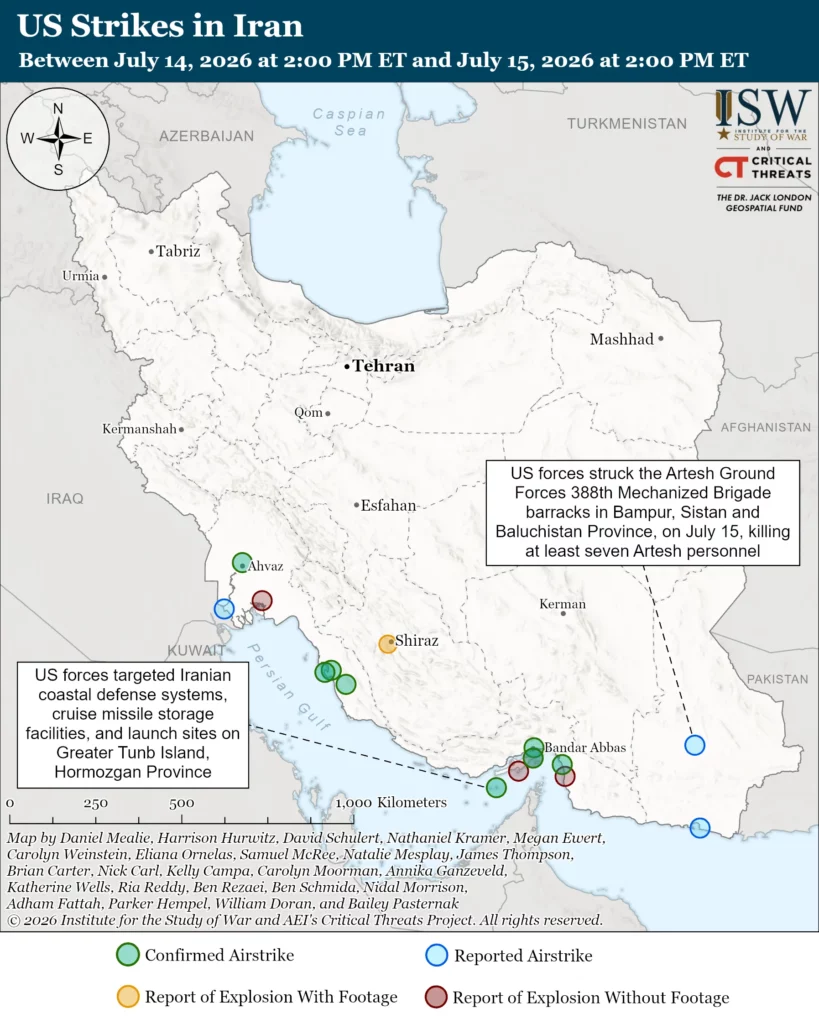
The United States has continued to strike Iranian military targets, including some targets further inland. Iranian regime media reported on July 15 that US forces struck the Artesh Ground Forces 388th Mechanized Assault Brigade barracks in Iranshahr, Sistan and Baluchistan Province. This strike is notable given that the 388th Brigade is located around 200 kilometers from the Iranian coast, while most US airstrikes in July have been concentrated around Iran’s southern coast. The Artesh has conducted operations throughout the war and most recently claimed on July 15 that it conducted drone strikes targeting US forces at Muwaffaq Salti Airbase in Azraq, Jordan.
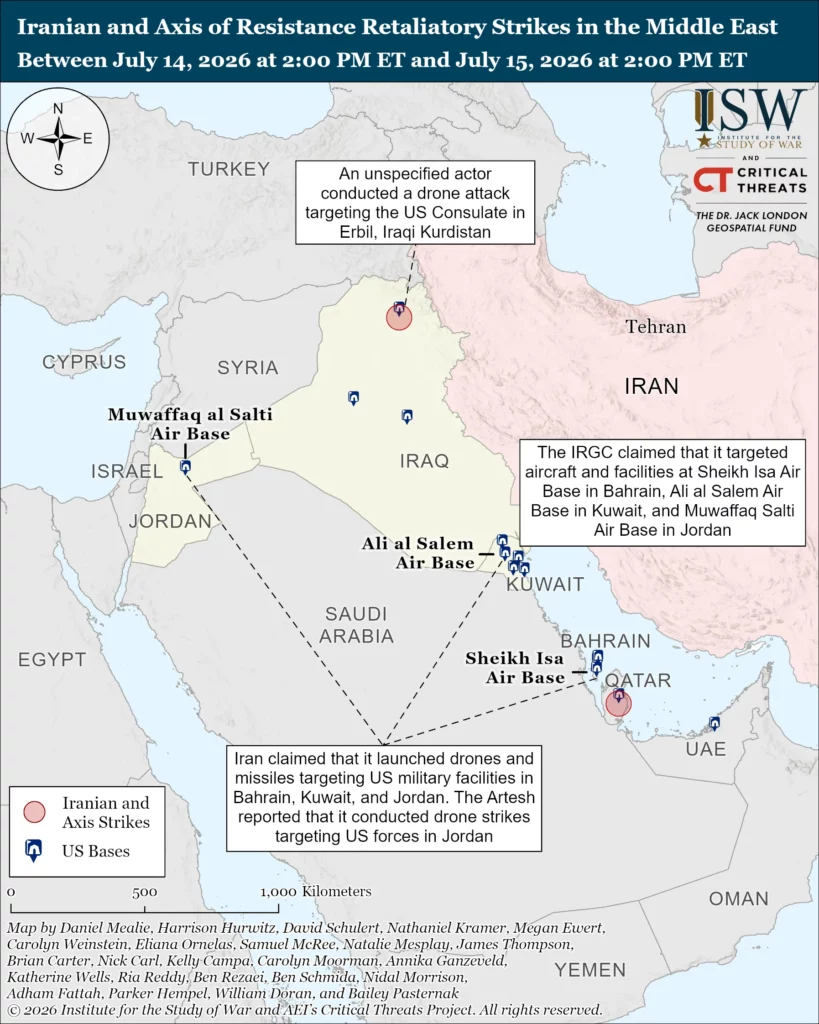
Iraqi media reported on July 15 that an unknown actor launched six drones targeting Erbil International Airport and the US Consulate in Erbil, Erbil Province. It is unclear whether Iran or Iranian-backed Iraqi militias conducted this attack.
Iran is attacking vessels that have adopted alternative mechanisms to bypass Iranian control of the Strait of Hormuz. Iran attacked three vessels in the strait on July 13, two of which were doing “shuttle runs,” or repeated short trips to ports outside the strait in order to transport oil through the strait while avoiding Iranian territorial waters.
Iran’s attacks on shipping are having some success in deterring shipping companies from using routes outside Iran’s illegal traffic separation scheme, which advances Iran’s objective of securing control over the strait. Seven maritime security and shipping industry sources told Reuters on July 15 that shipping companies are avoiding using the southern route despite US military escorts, highlighting how shipping companies’ willingness to use alternative routes in the strait is dependent on their risk calculations.
Toplines
The United States has continued to strike Iranian military targets, including some targets further inland. Iranian regime media reported on July 15 that US forces struck the Artesh Ground Forces 388th Mechanized Assault Brigade barracks in Iranshahr, Sistan and Baluchistan Province.[1] The strikes reportedly killed seven Artesh soldiers, injured 13 others, and destroyed several buildings.[2] This strike is notable given that the 388th Brigade is located around 200 kilometers from the Iranian coast, while most US airstrikes in July have been concentrated around Iran’s southern coast. The 388th Brigade operates under the 88th Armored Division, which is based in Zahedan, Sistan and Baluchistan Province.[3] US forces reportedly struck a second inland site — an unspecified IRGC base — in Saravan, Sistan and Baluchistan Province on July 15.[4] The Artesh has conducted operations throughout the war and most recently claimed on July 15 that it conducted drone strikes targeting US forces at Muwaffaq Salti Airbase in Azraq, Jordan.[5] The Artesh claimed that it has recently conducted eight waves of drone attacks against US bases in the region.[6]
Iran also conducted attacks against US forces in Bahrain and Kuwait on July 15. Iraqi media separately reported on July 15 that an unknown actor launched six drones targeting Erbil International Airport and the US Consulate in Erbil, Erbil Province.[7] It is unclear whether Iran or Iranian-backed Iraqi militias conducted this attack. Air defenses intercepted all of the drones.[8]
Iran is attacking vessels that have adopted alternative mechanisms to bypass Iranian control of the Strait of Hormuz. Iran attacked three vessels in the strait on July 13, two of which were conducting “shuttle runs,” or repeated short trips to ports outside the strait in order to transport oil through the strait while avoiding Iranian territorial waters.[9] The Wall Street Journal reported on July 14 that the two tankers were conducting “shuttle runs” using the US-backed southern route off the coast of Oman.[10] The two vessels — Mombasa B and Al Bahyah — operate under the Abu Dhabi National Oil Company (ADNOC).[11] ADNOC has previously adopted new methods — such as turning off its ships’ automatic identification systems (AIS) and using ship-to-ship transfers — to evade Iranian detection.[12] The United Arab Emirates has also insisted that Iran must not be allowed to control traffic in the strait. Iran has repeatedly attacked vessels attempting to transit through the strait using the southern route along Oman’s coast because maritime traffic through this alternative route undermines Iran’s efforts to achieve recognized control of the strait.[13]
Iran’s attacks on shipping are having some success in deterring shipping companies from using routes outside Iran’s illegal traffic separation scheme, which advances Iran’s objective of securing control over the strait. Seven maritime security and shipping industry sources told Reuters on July 15 that shipping companies are avoiding using the southern route despite US military escorts, highlighting how shipping companies’ willingness to use alternative routes in the strait is dependent on their risk calculations.[14] People familiar with the matter separately told the Wall Street Journal on July 14 that some tanker captains have refused to transit through the strait in recent days.[15] The threshold for Iran to disrupt shipping in the strait remains low, given that even individual attacks can deter ships from transiting through the strait.
US-Iran Negotiations
Nothing significant to report.
Maritime Activity in the Strait of Hormuz and Persian Gulf
See topline section.
US and Israeli Air Campaign
See topline section.
Iranian Domestic Affairs
The United States is increasing economic pressure on Iran’s weapons procurement, oil export, and sanctions evasion networks through further sanctions as part of its campaign to degrade Iran’s willingness to attack commercial shipping in the Strait of Hormuz.[16] The US Treasury Department sanctioned more than 50 individuals, entities, and vessels on July 14 for supporting Mohammad Hossein Shamkhani’s oil export, shipping, and sanctions evasion network.[17] Shamkhani is the son of former senior official Ali Shamkhani. The sanctions targeted Shamkhani’s financiers, logistics facilitators, container shipping companies, vessel operators, and Caspian Sea shipping network, which move Iranian and Russian petroleum products, sanctioned goods, and cargo to Iranian-backed actors, including the Houthis.[18] The United States previously sanctioned Mohammad Hossein Shamkhani and his multinational shipping network in July 2025 and April 2026 for generating tens of billions of dollars for the Shamkhani family and the Iranian regime.[19] The US Treasury Department separately sanctioned three individuals and four entities on July 15 for supporting the procurement of weapons for the IRGC.[20] The new sanctions follow the United States’ recent decision to revoke the sanctions waiver that it had implemented under the US-Iran memorandum of understanding (MoU) and reimpose the naval blockade on Iranian ports.[21] These economic measures are intended to reduce Iran’s willingness to attack commercial vessels by imposing an economic cost on Iran for conducting such attacks.
Iran’s Axis of Resistance
Lebanese Hezbollah and the Israeli Campaign in Lebanon
Israeli and Lebanese officials reportedly agreed on aspects of a plan to implement “pilot zones” in southern Lebanon during US-brokered negotiations in Rome, Italy, on July 14 and 15.[22] A US State Department official told an Israeli correspondent on July 15 that the Israeli and Lebanese delegations reached an agreement on the “structure and guidelines” of a plan for the Lebanese Armed Forces (LAF) to deploy to pilot zones in accordance with the June 26 Trilateral Framework Agreement.[23] Lebanese government officials told Lebanese media on July 15 that the LAF will deploy to two zones that include towns both currently under Israel Defense Forces (IDF) control, from which the IDF will withdraw, and without an IDF ground presence.[24] Saudi media previously reported on July 14 that Israeli and Lebanese officials disagreed on whether the LAF would backfill IDF positions or deploy to territory nominally under Lebanese government control instead.[25]
Many details surrounding the pilot zones plan remain unclear, including the plan’s timeline and scope, however. US and Lebanese officials said on July 15 that the IDF and LAF will implement the first pilot zones “within days,” whereas other unspecified US officials told Lebanese media on July 15 that implementation will not begin until the end of July.[26] Lebanese and international media also reported different details on the pilot zones’ territorial extents, with some media outlets claiming that the zones will include up to six towns while other reports have denied that the delegations made any changes to the zones that Israeli and Lebanese officials agreed on in June.[27] It is also unclear whether the Lebanese government will order the LAF to search private property to disarm Hezbollah in the pilot zones. Lebanese media reported on July 15 that neither the Israeli nor the Lebanese government has requested that the LAF search private property.[28] Other Lebanese media reported that the Lebanese government has authorized the LAF to conduct all “inspection operations” necessary to disarm Hezbollah, however.[29] The LAF only conducted limited private property searches at the IDF’s request during previous efforts to disarm Hezbollah after the November 2024 ceasefire.[30] Any Hezbollah disarmament plan that restricts the LAF from searching private property will likely fail because Hezbollah frequently conceals materiel in civilian homes.[31]
Other Axis of Resistance Activity
Unspecified Iranian-backed Iraqi militias have expressed concern that the United States is pressuring the Iraqi federal government to disarm the militias before the United States launches a “grand plan” to overthrow the Iranian regime, according to unspecified sources close to the militias speaking to Iraqi media on July 15.[32] The militias’ reported concerns come amid increased exchanges of fire between Iran and the United States in recent days.[33] Most of the militias that refuse to disarm, such as Kataib Hezbollah, Harakat Hezbollah al Nujaba, and Kataib Sayyid al Shuhada, maintain the closest ties to Iran.[34] These militias frequently attacked US military bases in Iraq and the Gulf countries during the US-Israel-Iran War.[35]
US Secretary of Defense Pete Hegseth reiterated after his meeting with Iraqi Prime Minister Ali al Zaydi on July 14 that Iraq must disarm Iranian-backed Iraqi militias.[36] Hegseth said that the militias conducted over 600 attacks targeting US personnel during the war.[37] Hegseth and Zaydi discussed expanding US technical, technological, and digital cooperation with the Iraqi military and security establishment.[38] The United States has not resumed its funding for some counterterrorism and training programs for the Iraqi Security Forces since suspending funding for these programs in April 2026 due to concerns about Iranian-backed Iraqi militia attacks during the war.[39] Iraqi Armed Forces Spokesperson Major General Sabah al Numan announced on July 14 that Zaydi had directed the formation of an Iraqi committee to negotiate the details of a new US-Iraq security cooperation framework ahead of the scheduled withdrawal of US-led coalition forces from Iraqi Kurdistan in September 2026.[40] US-led coalition forces are currently based in Iraqi Kurdistan following their withdrawal from federal Iraq in January 2026.[41]
US and Iraqi officials have continued to describe Zaydi’s recent visit to Washington, DC, as the start of a new US-Iraqi relationship. US Special Envoy to Iraq and Syria Tom Barrack called US President Donald Trump’s meeting with Zaydi on July 14 a “turning point” in US-Iraqi relations.[42] Barrack added that the future US-Iraqi relationship will focus on investment, trade, and economic opportunities in addition to security.[43] An informed source similarly told Iraqi media on July 14 that the Iraqi delegation is expected to sign more than 18 agreements with the United States covering energy, oil, education, and health during Zaydi’s visit.[44] One of these agreements could be what Iraqi and regional media have described as the “June agreement,” in which the United States will support investment in Iraq in exchange for the Iraqi federal government reducing Iranian influence in Iraq, including disarming Iranian-backed Iraqi militias.[45]
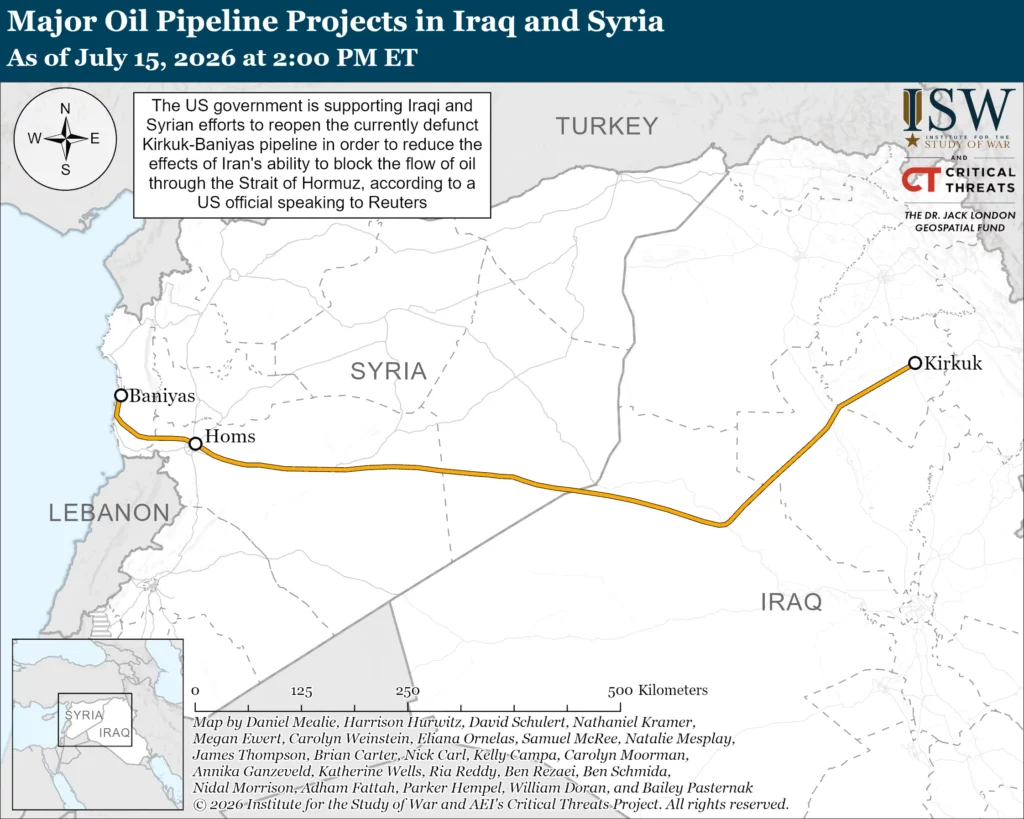
The Iraqi federal government is developing alternative routes to the Strait of Hormuz for Iraqi oil exports amid Iranian efforts to control traffic in the strait. A US State Department official told Reuters on July 24 that the United States is supporting Iraqi and Syrian efforts to revive the Kirkuk-Baniyas pipeline that extends from Kirkuk to the eastern Mediterranean Sea.[46] The pipeline has been largely inoperable for years, but Syrian and Iraqi officials have repeatedly discussed re-opening it since 2025.[47] The US State Department official’s comments are consistent with long-standing US efforts to reduce Iraqi dependence on Iran.[48] An unspecified Western source told Saudi media on July 7 that US Special Envoy to Iraq and Syria Tom Barrack seeks to create “a new alliance of interests” between Iraq, Syria, and other regional states.[49] This effort is intended, in part, to reduce regional reliance on the Strait of Hormuz by linking Iraq, Syria, and other regional countries to the Mediterranean Sea.[50] Iraqi Oil Minister Bassem Mohammad Khudair al Abadi also said on July 13 that a consortium of US and Qatari companies is working to develop another oil pipeline from Basra in federal Iraq to Peshkabour in Iraqi Kurdistan in order to connect this pipeline to pipelines in Ceyhan in western Turkey and Baniyas in western Syria.[51]
The Iraqi federal government reportedly designated Lebanese Hezbollah as a terrorist organization in early July and issued a directive to freeze the assets of individuals and corporations affiliated with Hezbollah and the Islamic State in Iraq and al Sham (ISIS), according to Iraqi and regional media.[52] Iraqi and regional outlets reported on July 15 that the Iraqi Foreign and Finance Ministries facilitated the designation in early July.[53] These reports follow increased US pressure on the Iraqi federal government to reduce Iranian influence in Iraq, including by dismantling Iranian-backed Iraqi militia financial networks.[54] Iranian-backed Iraqi actors exploit their access to the Iraqi economy to fund the Iranian regime and its Axis of Resistance, including Hezbollah.[55] The Iraqi federal government has previously retracted similar financial actions targeting Axis of Resistance members, however. The Iraqi Gazette, which publishes binding Iraqi federal decisions, published in December 2025 that the Iraqi government had designated Hezbollah and the Houthis as terrorist organizations.[56] Multiple Iranian-backed Iraqi actors publicly opposed the decision, however.[57] The Iraqi Committee for the Freezing of Terrorist Actions subsequently accused the Gazette of releasing the designation of the Houthis and Hezbollah as terrorist organizations “without revisions” and said that the committee would revise the decision.[58]