
Key Takeaways
Iran is threatening to target energy infrastructure in the Middle East, likely to try to deter the United States and Israel from following through on reported plans to strike Iranian energy infrastructure.
The IRGC reportedly used the US-Iran ceasefire in April 2026 to coordinate with the Houthis, Hezbollah, and Iraqi militias to expand the conflict and increase the costs of US military operations. Two senior IRGC officers told the New York Times on August 1 that senior IRGC Quds Force officers held calls with Hezbollah, Houthi, and Iraqi militia commanders during the ceasefire to coordinate efforts to expand the conflict with the United States. The IRGC officers’ decision to speak with the New York Times now is likely part of the Iranian information effort to try to deter US and Israeli strikes against Iranian critical infrastructure.
Kuwaiti air defenses intercepted an unspecified number of Iranian drones targeting Kuwait on August 1. Iran has not claimed nor commented on this attack at the time of this writing.
Iran continues to illegally assert control over the Strait of Hormuz with force by attacking civilian vessels that attempt to use non-Iranian-approved routes through the strait. Iran’s attacks on commercial shipping are also likely intended to impose economic costs on the global economy to erode the United States’ willingness to continue the war and force the United States to accept Iranian demands.
Toplines
Iran is threatening to target energy infrastructure in the Middle East, likely to try to deter the United States and Israel from following through on reported plans to strike Iranian energy infrastructure. An unspecified senior security official told Islamic Revolutionary Guards Corps (IRGC)-affiliated Tasnim News Agency on July 30 that Iran has prepared an attack plan that includes attacks on regional energy infrastructure in response to reports that US President Donald Trump has ordered new strikes on Iran.[1] IRGC-affiliated Fars News Agency reiterated this threat and published a list of regional energy facilities that it said Iranian missiles can reach.[2] The list included oil fields and other energy infrastructure in Israel, Saudi Arabia, Qatar, Kuwait, Bahrain, and the United Arab Emirates.[3] Iran issued these threats after Western media reported that the United States and Israel are considering conducting large-scale strikes against Iranian energy infrastructure.[4] An Iranian analyst close to the regime stated on August 1 that an attack on Iranian infrastructure would be a “terrifying scenario for everyone” and urged regional and international actors to prevent the “crisis.”[5] Iran likely seeks to prevent US or US-Israeli combined force operations by signaling that any attack on Iran’s energy sector would trigger Iranian retaliatory strikes against regional critical infrastructure.
The IRGC reportedly used the US-Iran ceasefire in April 2026 to coordinate with the Houthis, Hezbollah, and Iraqi militias to expand the conflict and increase the costs of US military operations.[6] Two senior IRGC officers told the New York Times on August 1 that senior IRGC Quds Force officers held virtual conference calls with Hezbollah, Houthi, and Iraqi militia commanders during the ceasefire to coordinate efforts to expand the conflict with the United States.[7] The officers added that Quds Force commanders and advisers also worked directly with these groups on the ground.[8] ISW-CTP has observed reports that are consistent with some of these officers’ claims. The IRGC reportedly set up covert cells in Iraq to carry out attacks on Gulf countries that host US forces during the ceasefire, according to eight Iraqi sources speaking to Reuters, for example.[9] The officers told the New York Times that the objective of this coordination was to make the war as costly as possible for US President Donald Trump.[10] These statements are consistent with ISW-CTP’s ongoing assessment that Iran seeks to weaken US resolve by increasing the military and political costs of sustained US operations against Iran.[11] The IRGC officers’ decision to speak with the New York Times now is likely also part of the Iranian information effort to try to deter US and Israeli strikes against Iranian critical infrastructure.
Kuwaiti air defenses intercepted an unspecified number of Iranian drones targeting Kuwait on August 1.[12] Iran has not claimed nor commented on this attack at the time of this writing. The drones targeted “vital facilities,” including a government building in northern Kuwait and a vehicle belonging to a civilian company on Bubiyan Island.[13] Iran claimed attacks on Bubiyan Island, which hosts US anti-aircraft equipment, in late March and on July 21.[14] Six IRGC officers previously attempted to infiltrate Bubiyan Island using a chartered fishing boat to carry out unspecified “hostile acts” against Kuwait in early May.[15] Iranian-backed Iraqi militias could have conducted the August 1 attack on Kuwait, but no militia has claimed or commented on the attack at the time of this writing. Iraqi militias conducted multiple attacks on Gulf countries, including Kuwait, in March and April and likely struck Kuwait’s Abdali border crossing with Iraq on July 23.[16]
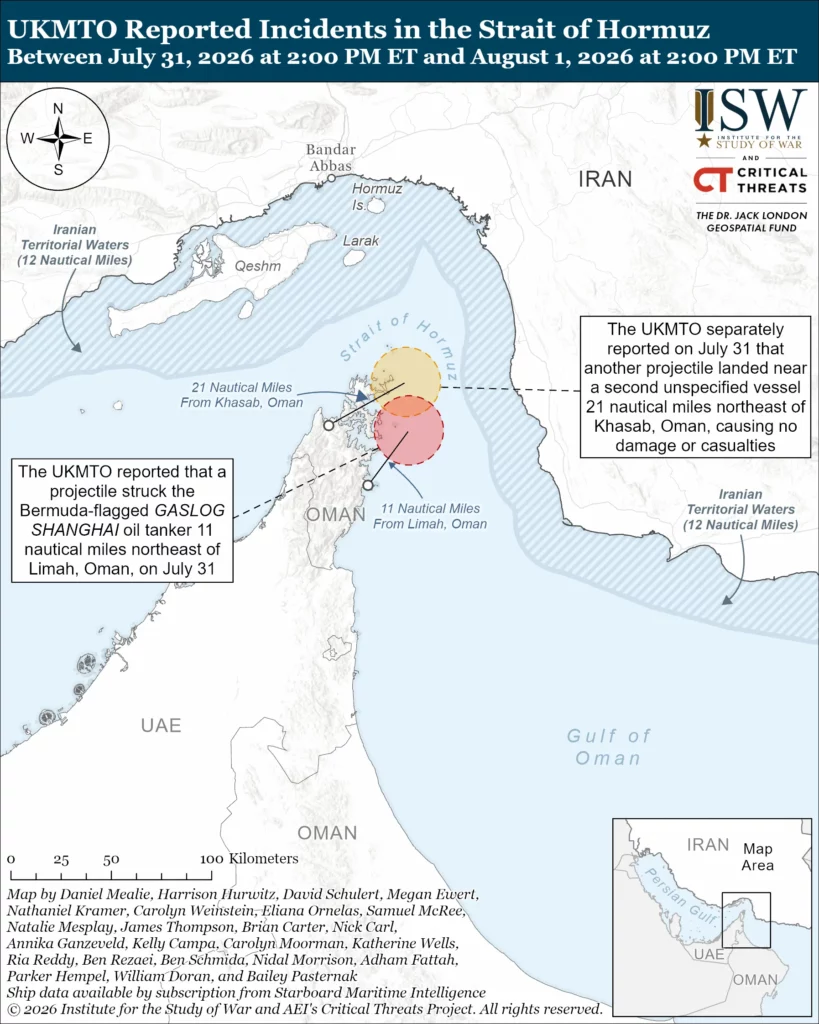
Iran continues to illegally assert control over the Strait of Hormuz with force by attacking civilian vessels that attempt to use non-Iranian-approved routes through the strait. Iran’s attacks on commercial shipping are also likely intended to impose economic costs on the global economy to erode the United States’ willingness to continue the war and force the United States to accept Iranian demands. United Kingdom Maritime Trade Operations (UKMTO) reported that a projectile struck the Bermuda-flagged GASLOG SHANGHAI oil tanker 11 nautical miles northeast of Limah, Oman, on July 31.[17] The likely Iranian projectile damaged the vessel’s engine room but caused no casualties.[18] UKMTO separately reported on July 31 that another projectile landed near a second unspecified vessel 21 nautical miles northeast of Khasab, Oman, causing no damage or casualties.[19] Iran has repeatedly targeted civilian vessels that transit through the strait using alternative routes to Iran’s illegal traffic separation scheme, such as the southern Omani route.[20] Alternative routes through the strait, including the southern Omani route, undermine Iranian efforts to assert full control over the strait. Iran’s Supreme National Security Council (SNSC) issued a statement on July 31 that Iran will continue to strengthen Iranian control over the Strait of Hormuz and close other waterways–presumably referring to the Bab al Mandeb Strait–in response to the US blockade of Iranian ports. The SNSC added that “the price [of increased Iranian control over the Strait of Hormuz] will be paid by” US citizens and the global economy, particularly the energy sector.[21] The SNSC’s emphasis on the economic costs for US citizens is part of Iran’s effort to increase domestic pressure on the US government to end the war. The SNSC’s statement follows an announcement from Iran’s Persian Gulf Strait Authority on July 31 that it will not issue transit permits for vessels to pass through the strait until the United States ends military operations in the region.[22]
US CENTCOM reiterated on July 31 that the Strait of Hormuz remains open to all vessel traffic.[23] Commercially available maritime shipping data indicates that at least four vessels transited through the strait using the southern Omani route since ISW-CTP’s last data cutoff at 2:00 PM ET on July 31.[24]
US and Partner Military Operations
Nothing significant to report.
Iranian Strike Campaign
Assessed Iranian War Aims:
Secure international recognition of Iranian control over the Strait of Hormuz
Degrade the US ability and willingness to continue the war
Restore deterrence vis-à -vis the United States and its regional partners
Divide the United States and Israel from the Arab states
See topline section.
US-Iran Negotiations
Nothing significant to report.
Iranian Domestic Affairs
Unspecified armed individuals reportedly killed a Sunni cleric in Zahedan, Sistan and Baluchistan Province, on August 1.[25] Borna News Agency claimed that unknown gunmen shot and killed Iranian Sunni cleric Molavi Khalil Barichi in Zahedan.[26] Several Iranian outlets recirculated Borna’s report but did not independently report or verify the attack.[27] Unspecified armed individuals previously killed Sunni cleric and Friday Prayer Leader Molavi Mohammad Anvar Rigi in Mirjaveh, Sistan and Baluchistan Province, on July 20.[28] Sistan and Baluchistan Province is a hotspot for anti-regime activity, including by anti-regime Baloch separatist groups that frequently attack Iranian security forces.[29]
Lebanon
Nothing significant to report.
Iraq
Nothing significant to report.
Arabian Peninsula
The Houthis denied on August 1 that they are currently imposing fees on international commercial vessels transiting the Bab al Mandeb Strait.[30] The Houthi-controlled Humanitarian Operations Coordination Center (HOCC) issued a press release on August 1 that emphasized that transit through the Bab al Mandeb Strait remains free of charge.[31] The HOCC is a Houthi body that liaises between the Houthis and international shipping companies.[32] The HOCC also stated that services for authorized vessels, which almost certainly excludes Saudi and Israeli ships subject to the Houthis’ blockade, are voluntary and cost-free.[33] This denial comes after regional sources told Reuters on July 29 that the Houthis may start imposing fees on international commercial vessels transiting the Red Sea and Bab al Mandeb Strait.[34] The Houthis could decide to impose fees at any time of their choosing, however. ISW-CTP assessed on July 29 that the Houthis may intend to impose fees on international shipping to further coerce Saudi Arabia to end its blockade on Houthi-controlled ports and airports and deter future Saudi strikes on Houthi targets by raising economic costs and international pressure on the Saudi government.[35]