
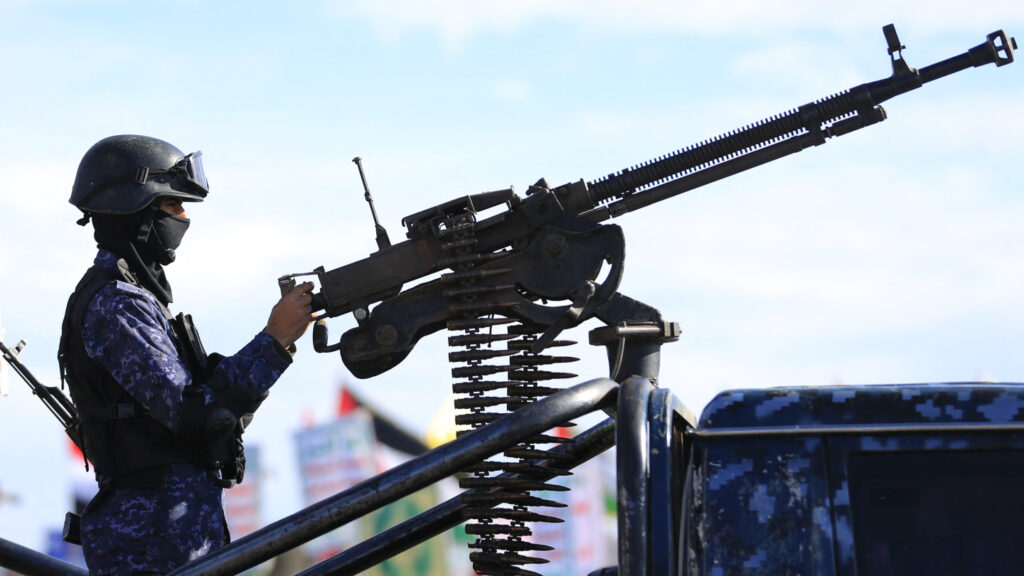
On 10 September, Ansar Allah, also known as the Houthis, captured the Red Sea port city of Mocha during a major offensive against Yemeni government-aligned forces.
The group then advanced south, reportedly reaching the coastal town of Dhubab on 11 September, before moving against strategic islands near the Bab al-Mandeb Strait, including Mayun, also known as Perim, and the Hanish Islands.
These gains have strengthened Houthi control along Yemen’s western coast and near the southern entrance to the Red Sea, threatening shipping on the wider Suez–Red Sea route, which carries about 12% of global trade and a significant share of global oil and LNG.
The offensive is part of a broader campaign that began in July, intensified in August, and peaked in September, including a Houthi naval blockade targeting Saudi-linked vessels and renewed attacks on Saudi oil facilities.
In September, Saudi Arabia’s East-West Pipeline was also hit by drones launched from Iraq.
Saudi Arabia and Yemen’s internationally recognised government and allied factions have so far struggled to stop the Houthi advance.
Saudi forces have provided air support against Houthi positions and reinforcements, while Yemeni government forces and allied groups continue ground operations.
Meanwhile, the Houthis have pushed from the Red Sea coast toward strategic positions in the Kahboub Mountains in Taiz and Lahj, triggering heavy clashes over high ground overlooking the Bab al-Mandeb strait.
The Houthis have learned from years of war
The struggle to halt the Houthi offensive reveals how the Iran-aligned group has refined its military capabilities and tactics over years of conflict to expand its territorial and political leverage while advancing an agenda broadly aligned with Tehran. The offensive is also deepening Yemen’s role in wider regional tensions involving the US and Iran.
The Houthis, a Zaydi Shia Islamist movement, were formed in northern Yemen in the 1990s, emerging as a major political and military force in September 2014, when they captured Yemen’s capital, Sanaa, effectively splitting the country and triggering a civil war against the internationally recognised government and allied forces.
In 2015, a Saudi-led coalition of Gulf and other Arab states intervened militarily in support of the government. A UN-brokered truce in April 2022 temporarily reduced major combat operations.
The Houthis’ military strategy and tactics have evolved significantly over time. Their early insurgency relied on guerrilla tactics, mountain terrain, tribal networks, local alliances, and captured weapons.
With Iranian training and technical support, and assistance from Hezbollah, the Houthis developed increasingly sophisticated ballistic and cruise missiles, UAVs, and anti-ship capabilities, which gradually allowed them to strike targets in Saudi Arabia, the UAE, and across the Red Sea.
This has led them to evolve into a regional force capable of targeting military, oil, and maritime interests beyond Yemen.
Their latest operations have also become more coordinated. The group, whose fighters are estimated to number up to 350,000, tends to attack using a combination of missiles, drones, artillery, and mobile ground forces.
The Houthi assault on Yemen’s western coast earlier this month, for example, suggests a shift toward smaller assault units that attack specific targets from multiple directions, according to Mohammed al-Basha, analyst and founder of risk advisory Basha Report.
“This approach makes them harder to target with airstrikes and allows them to maintain pressure on government forces,” he told The New Arab, adding that Houthi operations combining drone and missile strikes show growing firepower and ammunition capacity.
The latest escalation also highlighted the role of information warfare. The Houthis have allegedly used social media and digital platforms to put out propaganda and disinformation.
They were accused of using an AI-generated voice deepfake of Tareq Saleh, commander of the National Resistance Forces and nephew of former president Ali Abdullah Saleh, to send out a false withdrawal message, potentially causing confusion and lowering morale.
“The Houthis understand these forces really well and know that Tareq Saleh’s forces on the Red Sea coast are not trusted by the local people,” Michael Knights, head of research at New York-based strategic advisory Horizon Engage, told The New Arab. He explained that the Houthis effectively used SMS, email, and WhatsApp to flood Yemeni commanders with confusing messages.
“They also know that the Saudi forces are not particularly trusted by the Tariq forces, which makes it very easy for them to exploit the gap.”
A fragmented coalition struggles to respond
Internal divisions within the anti-Houthi coalition seem to have translated into poor coordination, making the Houthis more difficult to counter.
While the Houthis appear to have a more cohesive command structure, the anti-Houthi coalition remains divided, with Saudi Arabia and the United Arab Emirates (UAE) backing rival Yemeni factions.
In December 2025, tensions boiled over when Saudi-led forces struck a UAE-linked shipment at Mukalla, which Riyadh said was destined for UAE-backed separatists. Yemen’s Saudi-backed authorities then demanded the withdrawal of UAE forces.
“It’s impossible to bring them to work together because each of these groups has different political agendas,” Ahmed Nagi, a senior analyst for Yemen at the International Crisis Group, told The New Arab.
“There are also many issues related to military coordination, which have weakened the government and prevented it from mounting a strong resistance when the Houthis move toward any of their fronts.”
Internal divisions have, as a result, left Saudi Arabia without a unified, effective Yemeni ground partner.
RANE’s Middle East and North Africa analyst Freddy Khoueiry told The New Arab that “airpower can destroy infrastructure and slow advances, but historically it has struggled to translate that into durable territorial gains without a capable ground force”.
This, coupled with weaknesses in the Saudi-led command structure and an intelligence failure to detect the Houthi buildup, has “likely contributed to the rapid collapse along the Red Sea coast”.
Yemen’s geography is also a factor to take into account. The Houthis benefit from the country’s mountainous terrain, which means airstrikes have limited impact.
But at the same time, local forces have taken advantage of the same terrain to hold off Houthi attacks. This week, government and local forces in Taiz reportedly held strategic positions and slowed the Houthi advance.
Saudi Arabia is also struggling to secure external direct military support. The US said it won’t join the conflict for now, while Turkey and Pakistan, part of the Mecca agreement with the Kingdom, have yet to provide military assistance.
Riyadh has sought air-defence support from Egypt. The UK has agreed to provide defensive air-to-air refuelling.
Basha doesn’t rule out US intervention but said Washington’s reluctance reflects its existing commitments in the Iran war and concerns over diverting resources to Yemen.
“The Houthis appear to understand this risk,” he told The New Arab. “Their strategic communications have been carefully calibrated to avoid directly threatening American interests and to reduce the likelihood of US intervention.”
US President Donald Trump said earlier this month that the Houthis had contacted the US and “don’t want to fight us,” adding that they were “letting most ships go through,” while excluding Saudi-linked shipping.
Houthi control of Bab al-Mandeb adds a further layer to the US-Iran war. It potentially gives the Houthis leverage over a key strategic chokepoint while advancing their own agenda, and it could give Iran an additional pressure point alongside tensions over the Strait of Hormuz.
Fatima Abo Alasrar, a researcher and founder of The Ideology Machine, a publication on authoritarian information systems, said the Houthi campaign could serve a broader Iranian strategy of raising economic costs for Saudi Arabia and the US by disrupting oil and trade.
With Iran constrained by sanctions, its allies can disrupt rivals’ energy flows and create pressure for negotiations.
“The Houthi strategy is to drive a wedge between Washington and Saudi Arabia, leaving Saudi Arabia exposed while offering not to attack the US,” she said, noting that Tehran employed a similar coercive approach in 2018, when former President Hassan Rouhani warned that if Iran could not export oil, “no one else” in the region would be able to either.
“If that weakens Saudi Arabia and erodes trust in Washington, the Gulf security architecture begins to shake,” she told The New Arab.
The Houthis’ growing regional role has prompted Iran to become more vocal in its support. Nagi said the Iranians “are no longer supporting the Houthis from behind the scenes”.
Despite developing some military autonomy, the Houthis “remain heavily reliant on Iran for key components of their missile, air-defence and anti-ship systems,” Knight explained.
And despite being part of the ‘Axis of Resistance’, the Houthis still pursue their own priorities. Khoueiry argued they have incentives to calibrate escalation independently rather than automatically joining every stage of the US-Iran conflict.
“Houthis are more likely to complicate the wider war than fundamentally change its military balance,” he said.