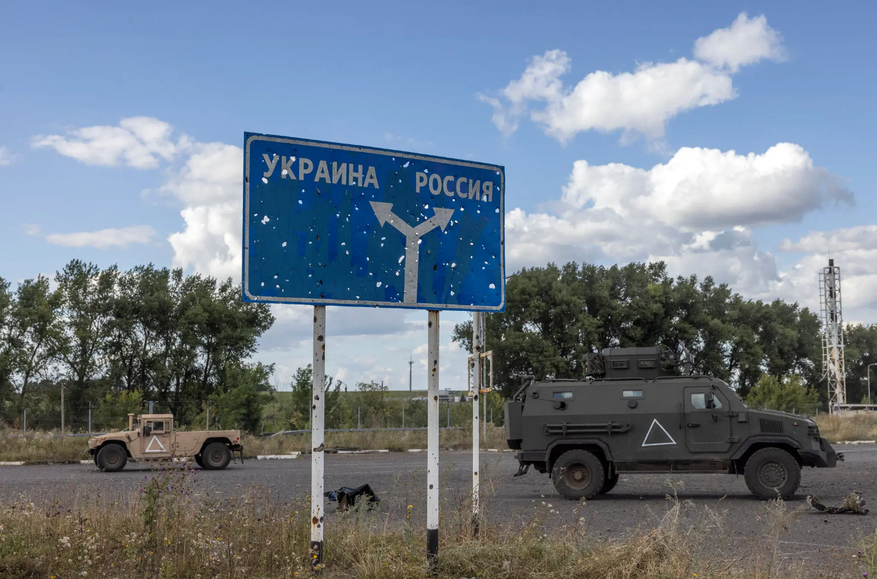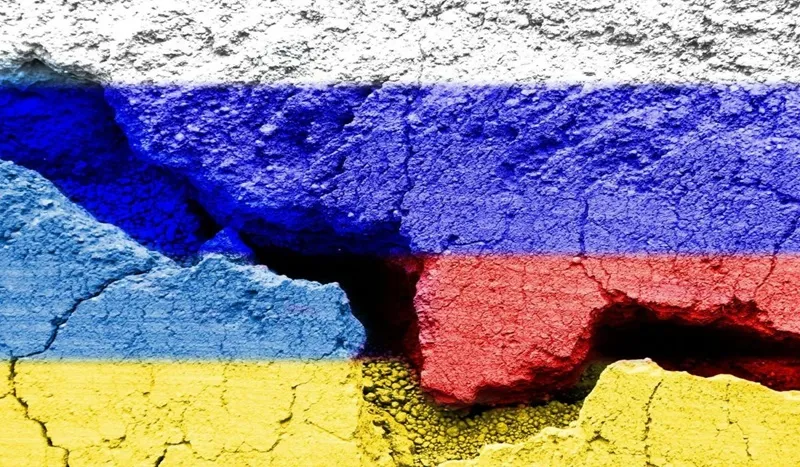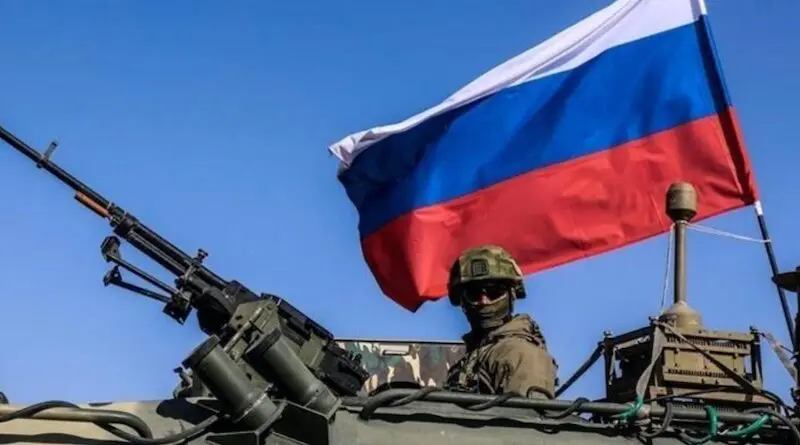
European governments must step up efforts to incentivise the private sector to invest in Ukraine to fund the war-torn country’s significant recovery and reconstruction needs, a senior EU official said on Tuesday (16 July).
Entrenched divisions in Bosnia and Herzegovina have hampered EU and U.S. efforts to build functional institutions and integrate the country into Western clubs. Dysfunctionality in turn provides fertile ground for meddling by Russia, which appears to have won the battle for the hearts and minds of Bosnian Serbs.
Many in Moscow believe that the system of arms control created during the Cold War was advantageous to the West—and they want that to change.
For many decades, international security has depended on dialogue between Moscow and Washington on the topic of nuclear arms control. In recent years, however, this dialogue has all but ground to a complete halt, and the use of nuclear blackmail has spiraled. In Russia, there have been calls for nuclear strikes on Europe and for a “demonstrative nuclear explosion.” In May, Russia held tactical nuclear drills in response to the West’s so-called “direct support for terrorist actions against Russia.” Russian officials have even threatened to use strategic nuclear weapons against the West.
US intelligence discovered that Russia planned to assassinate the chief executive of German arms manufacturer Rheinmetall, which has been producing artillery shells and military vehicles for Ukraine, CNN and the New York Times reported on Thursday (11 July).
Le sommet de trois jours de l’OTAN à Washington DC a atteint l’objectif pour lequel il avait été organisé, à savoir créer un forum public dans lequel les 32 membres de l’Alliance pourraient exprimer leur soutien unanime aux attaques à venir contre la Fédération de Russie. Tel était le véritable objectif de la conférence. Les organisateurs de l’événement souhaitaient une démonstration spectaculaire d’unité afin de justifier les futures hostilités avec Moscou et de réduire la possibilité qu’une seule personne soit tenue responsable du déclenchement de la troisième guerre mondiale.
DeepState – Russian troops have made significant advances in the Toretsk direction and entered New York
The Russian Armed Forces have achieved success on the northern flank of the Avdeevka operational area, while their offensive on the southern flank has been stopped
In the north of the Kharkiv region, the Ukrainian Armed Forces managed to disrupt the enemy’s logistics and recapture some of the positions in Glubokoe
It has been reliably established that the Okhmatdit Children’s Hospital in Kyiv was hit by a Russian Kh-101 missile on July 8
In June, the Russian Aerospace Forces launched over 2,300 glide bombs at Ukrainian territory
The Economist — the total losses of killed and wounded on the Russian side in the war amount to between 462,000 and 728,000 people
NATO countries have secured a commitment to provide Ukraine with €40 billion in military aid in 2025
Investigative journalists have found that the EU’s actual artillery ammunition production capacity is at least half that stated
The situation at the front
According to DeepState , Russian troops have been advancing in the Torets direction for almost the entire week . In particular, they managed to enter New York ( Novgorodskoye in 1951–2021 ) and reach the center of the village. The Russian Defense Ministry, in turn, reported the capture of the village of Chigari , which is actually the southern outskirts of Pivnichnoye , located to the north .
Cutting-edge technologies in the Russian-Ukrainian war are bizarrely mixed with century-old inventions: FPV drones on Starlink with thermal imagers drop shells from the 1950s or ram other drones with a tethered stick, “maize” drones from the First World War shoot down drones with machine guns or turn into unmanned drones themselves, and a wide variety of transport, from horse-drawn carts to unicycles, scurry behind the front line. Russians are going into assault attacks on motorcycles (which they didn’t do even in the Second World War), and the sky is protected by century-old Maxim machine guns with thermal imagers. The Insider tells how the co-evolution of modern technology and century-old equipment has turned the battlefield into a Mad Max sequel.
The decisions taken as the NATO summit in Washington closed Thursday show the NATO imperialist powers are planning direct military intervention against nuclear-armed Russia. The day before, the NATO alliance had announced the creation of an office in Ukraine and of a NATO command in Germany to coordinate the war offensive against Russia.
This piece is part of a commentary series on the upcoming NATO summit in Washington in which RAND researchers explore important strategic questions for the alliance as NATO confronts a historic moment, navigating both promise and peril.
Le service de renseignement extérieur (SVR) de la Russie a déclassifié le rapport complet de l’un de ses résidents sur l’envoi d’un contingent militaire français en Ukraine en mars de cette année. Le texte intégral du rapport du résident du SVR sous le pseudonyme Felix sur le sujet est publié dans la revue «Éclaireur».
Le chef du SVR, Sergey Naryshkin, a déclaré le 19 mars que Paris se préparait déjà à envoyer un contingent militaire en Ukraine, dont le nombre sera d’environ 2 mille personnes. La France l’avait alors démentie.