
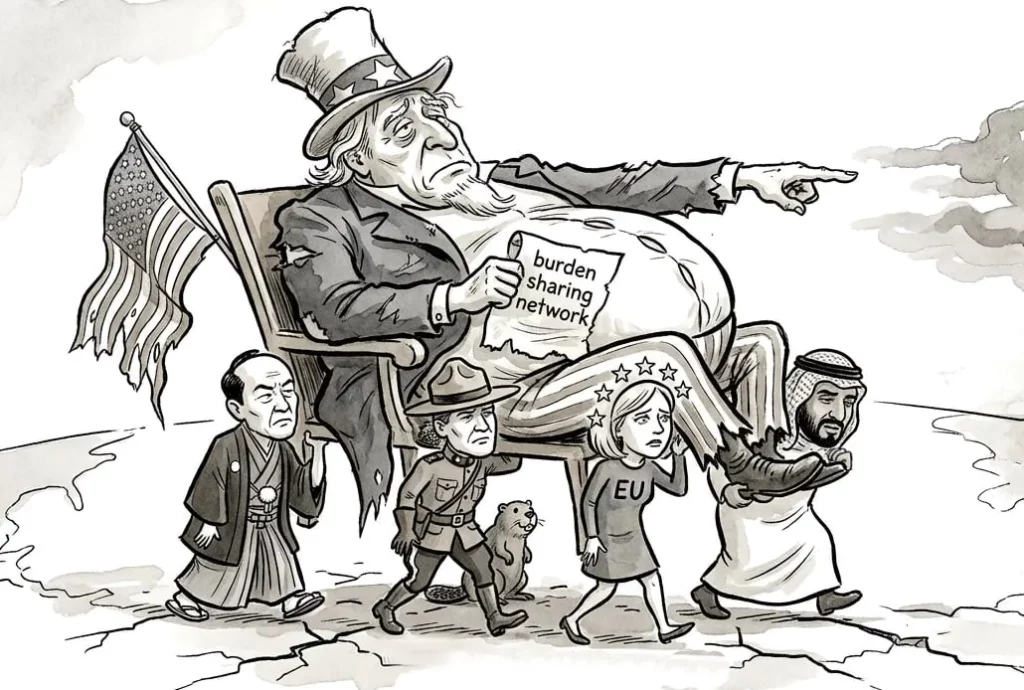
In 2025, the US National Security Strategy paper would be broadly misinterpreted as a US plan to break with its historical pursuit of global primacy and instead retreat to the Western Hemisphere while somehow reconciling or coexisting with traditional targets of US aggression.
Many analysts even claimed there was an absence of any direct mention of Russia or China as part of long-standing “great power competition.”
Yet, even throughout the document itself, terms like “hostile and subversive influences” simply stood in for “Russia” and “China,” reaffirming continuity of US foreign policy objectives rather than upsetting or breaking from them.
Included within the 33-page document was a detailed explanation of exactly how the United States would continue pursuing “great power competition” against not only Russia and China but all other nations obstructing US primacy.
This US strategy is less about enduring dominance than it is a desperate gamble against inevitable decline.By liquidating the resources and stability of its own client states to menace the rise of multipolarism, Washington and Wall Street are accelerating the very factors contributing to their continuous decline
Under a section titled, “priorities,” was a policy of “burden-sharing and burden-shifting” which explicitly stated:
“…the United States will organize a burden-sharing network, with our government as convener and supporter. This approach ensures that burdens are shared and that all such efforts benefit from broader legitimacy. The model will be targeted partnerships that use economic tools to align incentives, share burdens with like-minded allies, and insist on reforms that anchor long-term stability. This strategic clarity will allow the United States to counter hostile and subversive influences efficiently while avoiding the overextension and diffuse focus that undermined past efforts.”It should be noted that the introduction of a US “burden sharing network” describing the coercion of other nations into serving as extensions of US power and influence followed a section titled “primacy of nations” claiming, “it is natural and just that all nations put their interests first and guard their sovereignty,” thus a complete contradiction.
But that is only if one assumes the US discussed the “primacy of nations” as a general principle applied to all nations and not just a means of absolving the US — and the US alone — of its obligations under international law.
The threat of “economic tools” to “align incentive” and to “insist on reforms” for what the US paper claims is “long-term stability” are clearly euphemisms for the coercion of nations to serve US foreign policy objectives and, specifically, to uphold US primacy even at the expense of these nations’ own objective best interests.
The Burden Sharing Network in Practice
One of the most blatant implementations of this “burden sharing network” was actually publicly announced months before the National Security Strategy paper was published. In February 2025, US Secretary of Defense Pete Hegseth would publicly demand Europe “double down and re-commit” to what he referred to as “Ukraine’s immediate security needs” and “Europe’s long-term defense and deterrence goals.”
At a time when many in the public and analytical circles still believed the US under the new Trump administration was trying to either end or distance itself from the ongoing war in Ukraine — Secretary Hegseth made it clear that any shift in US policy toward Ukraine was merely what he would call a “division of labor” between US interests in Europe and the Pacific and realistic limitations preventing the US from pursuing both without extracting more resources from its client states.
Amid this same directive, Secretary Hegseth would insist on Europe expanding military spending from 2% of each respective nation’s GDP to 5% — an insistence European nations obediently accommodated (e.g., the UK, Germany, and France).
Secretary Hegseth would also explicitly demand:
“This means: Donating more ammunition and equipment. Leveraging comparative advantages. Expanding your defense industrial base. And importantly, leveling with your citizens about the threat facing Europe.

Part of this is speaking frankly with your people about how this threat can only be met by spending more on defense.”
With increased military spending highly unpopular across the European continent — creating and selling a “threat facing Europe” is imperative in the creation and utilization of Washington’s “burden sharing network” — a threat that is portrayed not only through continuously fabricated claims regarding the Russian Federation and its allies and partners (China, Iran, and North Korea) but also the added threat of the US “abandoning” Europe to Russia and its alleged “aggression.”
Secretary Hegseth publicly admitted that the US-European relationship is one of a “division of labor,” later expanded upon in the 2025 National Security Strategy as a “burden sharing network,” allowing the US to “counter hostile and subversive influences efficiently while avoiding the overextension and diffuse focus that undermined past efforts.”
The war in Ukraine began as and continues to be exclusively a US proxy war waged against Russia — a proxy war triggered first by the US politically capturing Ukraine in 2014, then taking control of and leveraging Ukraine’s military and intelligence agencies right along Russia’s borders, and since 2022, directing the war against Russia from a US base in Germany at the very top of “Ukraine’s” chain of command, including directing drone strikes against both energy infrastructure inside Russian territory, as well as strikes on ships exporting Russian energy out at sea.
Were one to believe the Western media narrative of a US-European “split” — one would have to believe the US was simply “abandoning” Europe and even Washington’s own proxy war in Ukraine against Russia. It would require ignoring the fact that the US is still running the war in Ukraine from its military base in Germany, supplying both Ukraine with weapons directly, but also Europe with weapons meant explicitly to then be handed over to Ukraine.
It would also require ignoring Secretary of Defense Pete Hegseth admitting the US isn’t abandoning its own proxy war but is simply putting its “burden sharing network” into motion and exercising the US-European “division of labor” laid out in February 2025.
Burden Sharing Network: The Saudi Bureau
Similar charades have been performed, including between the US and Canada, after which Canada signed a 100 year deal with Ukraine, rhetorically cementing its commitment to what is a US proxy war.
And more recently, Saudi Arabia allegedly called US President Donald Trump, requesting military support in response to recent advances along the southwest coasts by Ansarallah in neighboring Yemen. Amid the Western media’s daily political circus, the US reportedly denied Riyadh’s request.
In reality, Saudi involvement in Yemen is a US war in all but name — and part of the wider US war on Iran itself.
For decades, the US has built up Saudi Arabia’s military capabilities.
“Saudi” attacks on targets in Yemen — for years — have been carried out by US-built warplanes, maintained by US contractors, carrying US munitions, guided to their targets using US intelligence, surveillance, and reconnaissance gathered not only by US assets over the battlefield, but also by US special forces operating in Yemen, on the battlefield.
Even as US President Donald Trump publicly turned down Riyadh’s request for military assistance, the US is reportedly expanding ISR support for ongoing Saudi operations in Yemen.
Amid local Saudi Arabic media, the advances of Ansarallah is being portrayed as an existential threat to both Saudi Arabia’s national security and the economic stability of the entire region in an attempt to compel the public to accept the necessary military spending (in both treasure and blood) required to continue or expand what was and still is a US proxy war on both Yemen and Yemen’s Iranian allies.
Just like with the US-European “split” or the recent “division” between the US and Canada, the supposed “abandonment” by the US of Saudi Arabia amid what is essentially a US proxy war on Yemen is simply meant to help Riyadh “level with their citizens” about the “threats” facing them to help justify “spending more on defense” and other unpopular sacrifices required by Saudi society as part of Washington’s “burden sharing network.”
As the US deliberately disrupts energy exports from all of West Asia (including among US client states like Saudi Arabia, the UAE, Qatar, and others), while demanding the sale of larger amounts of US arms to these nations, the slashing of social programs across the region to do so will require sufficient political narratives and control to avoid internal instability.
The Cannibalizing of Client States
The US has for decades used its global network of client states as an extension of its own political, economic, and military power. As Russia reemerges, China rises, and the multipolar world continues to displace the US’ ill-gotten and abused global power, the US will admittedly need to squeeze these client states further.
The 2025 US National Security Strategy openly calls for a “burden sharing network” to extract more resources from US client states than ever before — but as illustrated by US Secretary of Defense Pete Hegseth in the directive he delivered to Europe in early 2025 — to do so will require convincing the populations of US client states of sufficient “threats” facing them.
If a fictional “Russian invasion” of Europe or “Ansarallah missile attacks” on Saudi Arabia aren’t enough to panic the populations of US client states into surrendering their social programs and collective future to the preservation of waning US global hegemony — than maybe the threat of the US abandoning its proxies amid proxy wars the US dragged them into in the first place will be enough.
Despite the political theater of emerging splits between the US and its client states unfolding, US client states are spending more now than at any other time following the end of the Cold War on military capabilities — either buying additional weapons from the US itself or diverting public spending from social programs into military industrial production to support ongoing US wars and proxy wars around the globe.
The irony is that while the governments among US client states point at Russia, China, Iran, and other nations as “threats” to peace, stability, and prosperity — it is their subordination to the US and their obedient participation in US wars and proxy wars actively destroying their respective economies and ruining the lives of their respective populations.
And while the US has accelerated the squeezing of its client states through this “burden sharing network,” nothing about the manner in which it is done is sustainable. The US strategy appears to be the using of its own remaining power — and wring dry its proxies — to disrupt the rise of the multipolar world faster than the multipolar world can establish itself and displace Washington and Wall Street’s unwarranted influence around the globe.
This US strategy is less about enduring dominance than it is a desperate gamble against inevitable decline. By liquidating the resources and stability of its own client states to menace the rise of multipolarism, Washington and Wall Street are accelerating the very factors contributing to their continuous decline.
Rather than falling for the political theater the US uses to sustain this strategy, people living among the US and its client states must try to reach out and connect with the multipolar world before the US — through its “burden sharing network”— takes these client states down with it.