
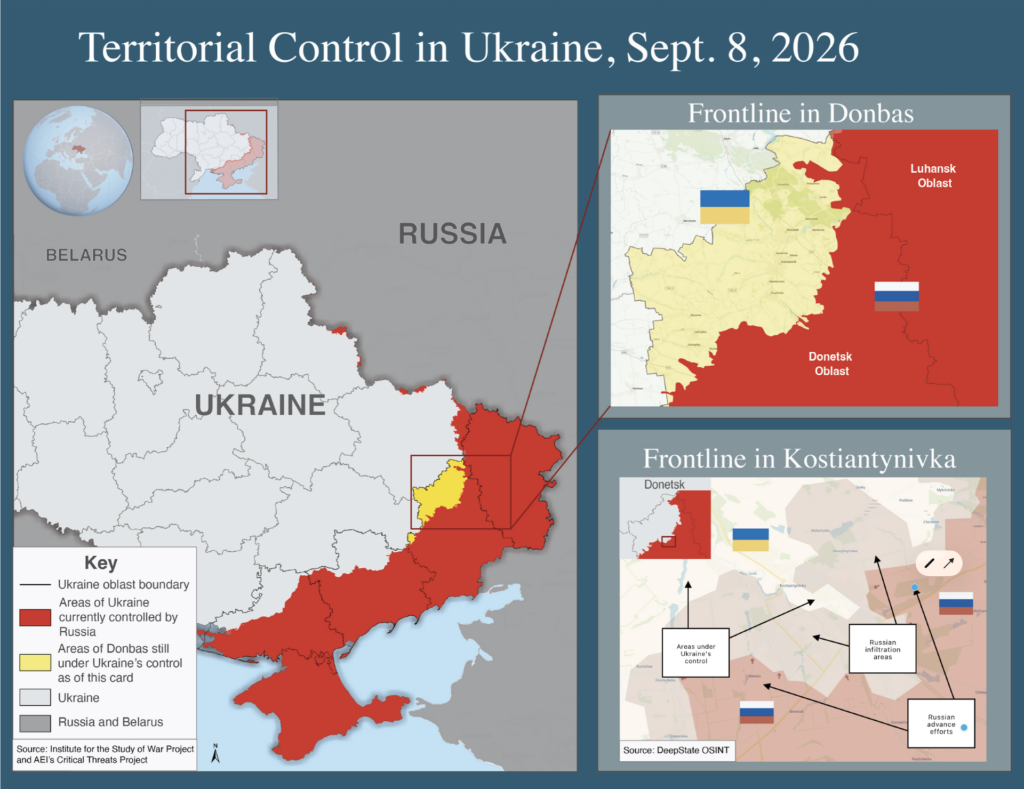
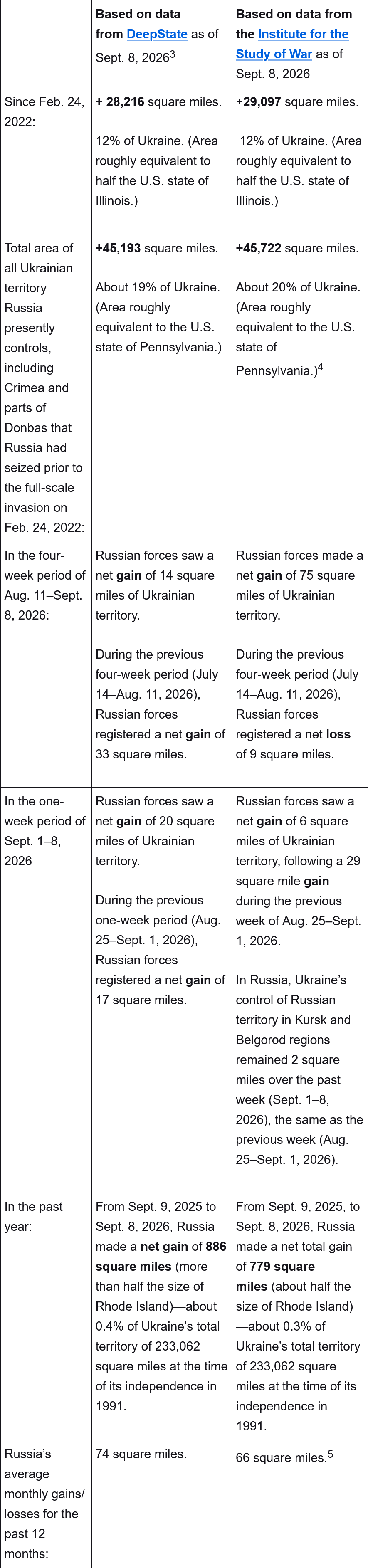
Sept. 8, 2026, update: Based on data from Ukraine’s DeepState OSINT group, Russian forces made a net gain of 14 square miles of Ukraine’s territory in the past four weeks (Aug. 11–Sept. 8, 2026).1 In comparison, Russia made a net gain of 33 square miles during the previous four-week period (July 14–Aug. 11, 2026), according to DeepState’s data. In contrast, RM’s analysis of data from ISW indicates that Russia made a net gain of 75 square miles of Ukraine’s territory in the past four weeks (Aug. 11–Sept. 8, 2026). According to the map maintained by DeepState, Russian forces advanced near 15 Ukrainian settlements2 in the period of Sept. 1–8, 2026. On Sept. 3, 2026, the Ukrainian Armed Forces regained control of an area near one settlement (Dvorichna), according to DeepState.
Territorial Control (DS and ISW figures as of Sept. 8, 2026)2
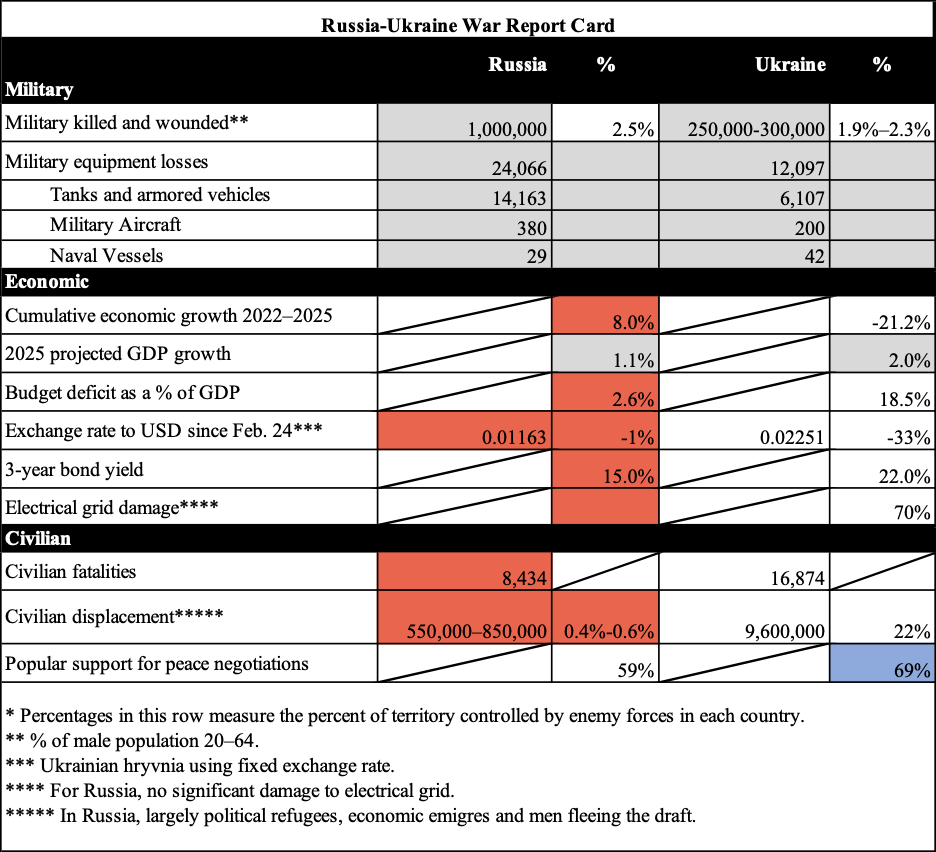
Report Card*
Change in Russia’s control of Ukrainian territory and change in Ukraine’s control of Russian territory
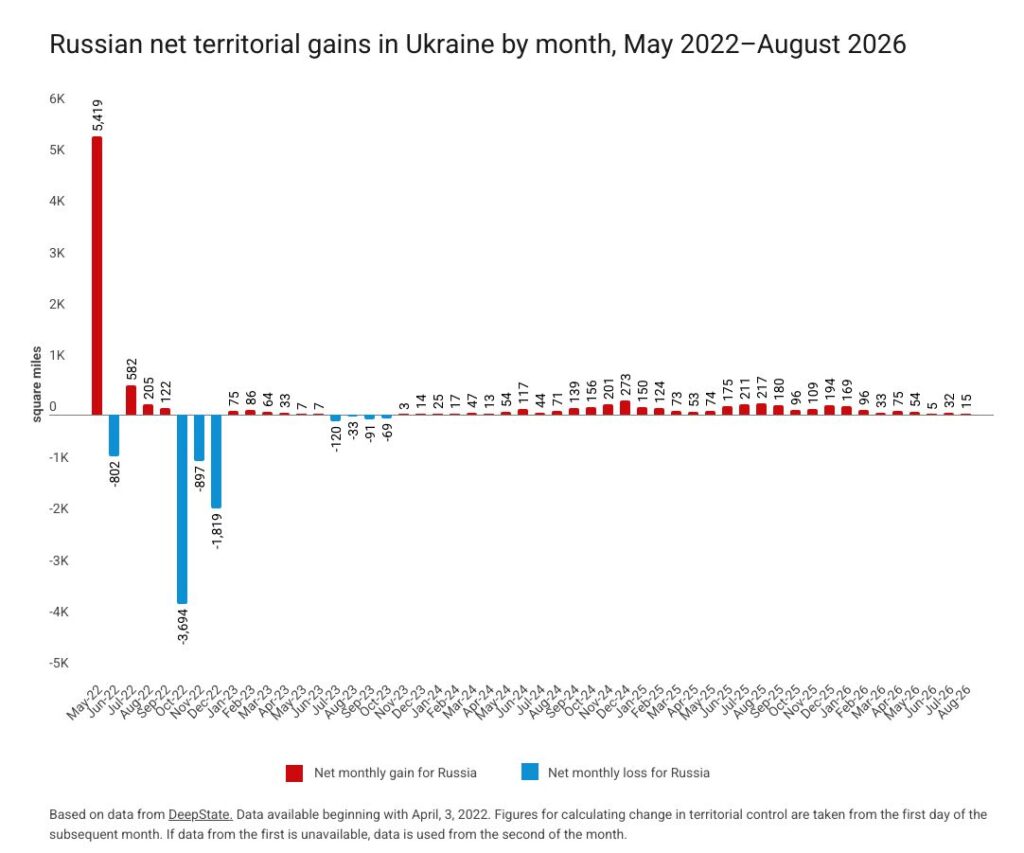
Russian net territorial gains in Ukraine by month, May 2022–August 2026 (Based on data from DeepState; click here for an interactive version of this chart).6
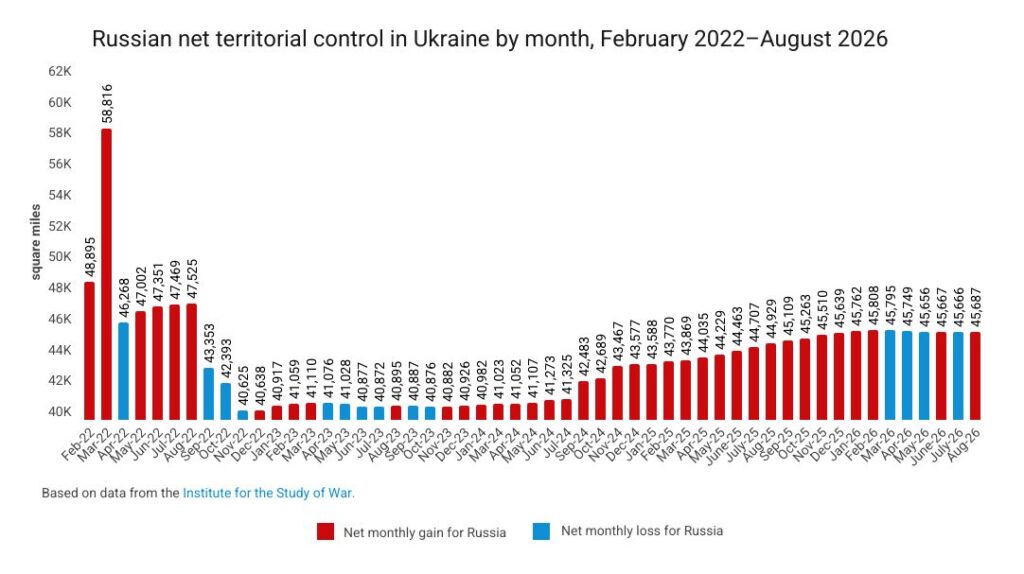
Russian net territorial control in Ukraine by month: February 2022–August 2026 (Based on data from the Institute for the Study of War; click here for an interactive version of this chart).
Military casualties (see footnotes for detailed source estimates)
1,000,000 Russian military casualties (killed and wounded), according to a February 2026 estimate that a highly-informed former high-ranking Western official shared with RM.7
250,000–300,000 Ukrainian military casualties (killed and wounded), according to a February 2026 estimate that a highly-informed former high-ranking Western official shared with RM.8
Civilian fatalities9
Russia: 8,434 persons “killed… in attacks” by the Ukrainian armed forces, according to the RF government.
Ukraine: 16,874 civilians killed, according to the U.N.
Military vehicles and equipment10
Russia: 24,066.11
    Tanks and armored vehicles: 14,163.12
    Aircraft: 380.13
    Naval vessels: 29.
Ukraine: 12,097.
    Tanks and armored vehicles: 6,107.
    Aircraft: 200.
    Naval vessels: 42.
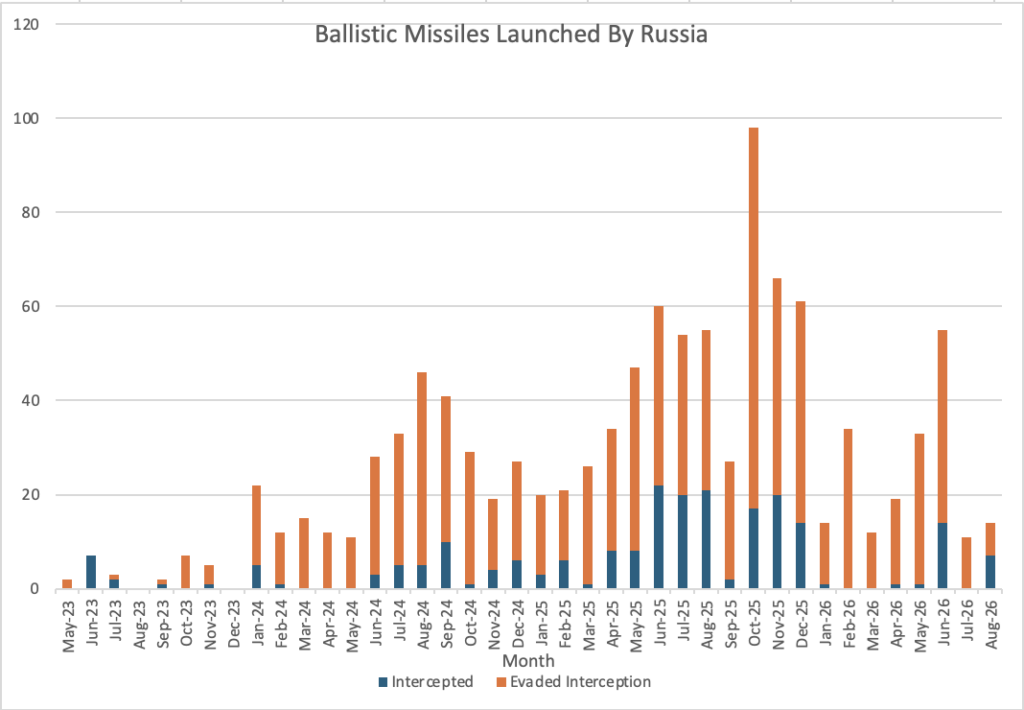
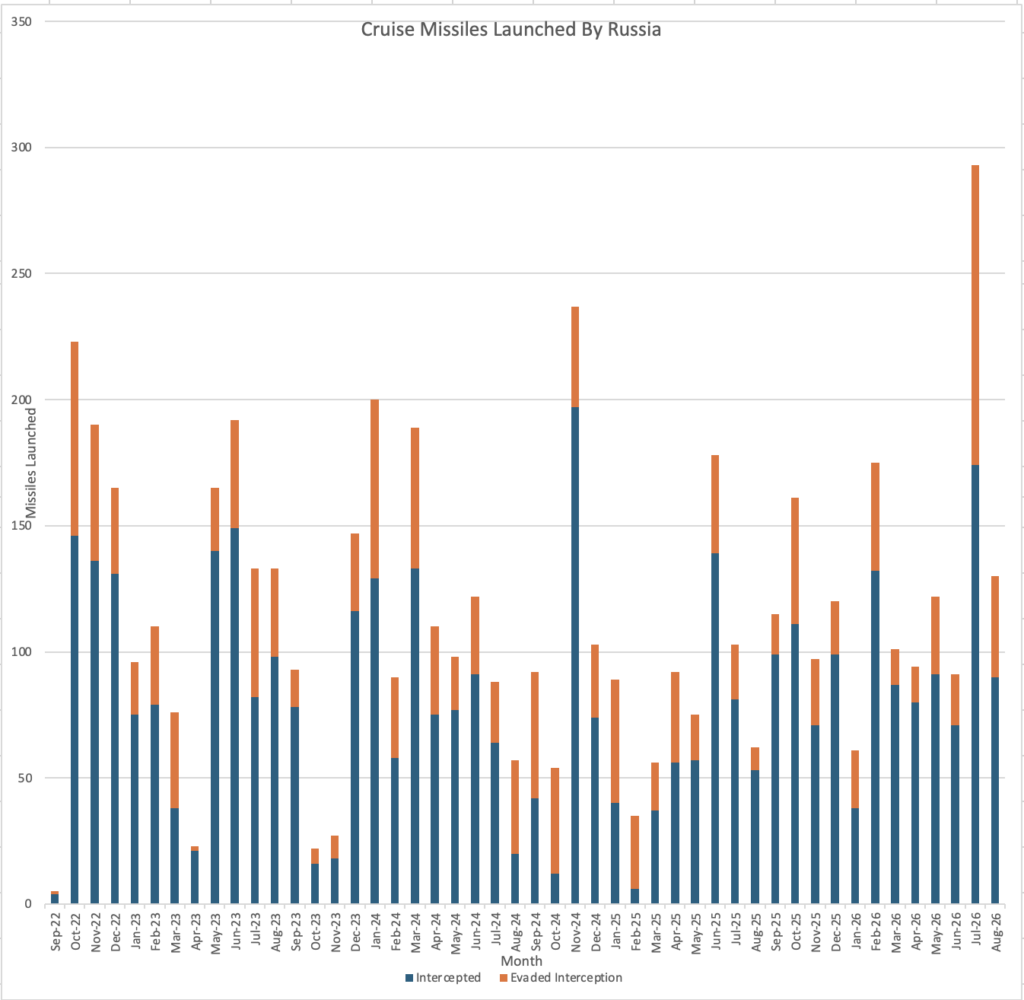
Russian aerial attacks and Ukrainian interceptions14
In August 2026:
Russia fired15
    7,025 drones
    14 ballistic missiles
    130 cruise missiles
Ukraine intercepted
    6,179 drones
    7 ballistic missiles
    90 cruise missiles
Since September 2022 through August 2026:
Russia fired
    130,672 drones
    1,217 ballistic missiles
    5,734 cruise missiles
Ukraine intercepted
    103,336 drones
    256 ballistic missiles
    4,178 cruise missiles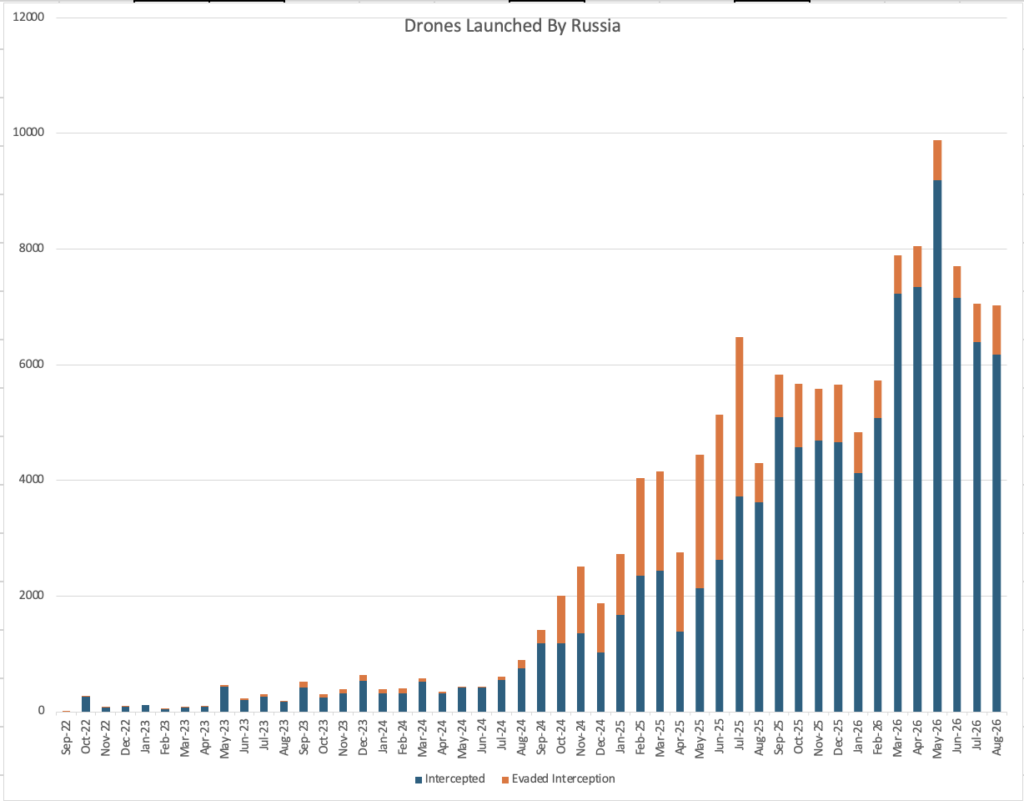
Citizens displaced
Russia:
    Internally displaced: 23,000, including 3,419 in the Kursk region.
    1,000,000 (0.7% of Russia’s 2022 population) left Russia for economic or political reasons in the first year of the full-scale war. Between 15% and 45% of those who had left have returned since then, so, between 550,000 and 850,000 people have not returned to Russia.
Ukraine: 9,600,000 displaced Ukrainians, 22% of Ukraine’s pre-invasion population of 44,000,000, including:
    Internally displaced: 3,700,000.
    International refugees: 5,900,000.
Economic impact15
Russia’s cumulative economic growth in 2022–2025: 8%.
    1.1% GDP growth in 2025.
    Budget deficit for 2025: 2.6% of GDP.
    Russian ruble: 0.01163 U.S. dollars. -1% since the invasion.
    3-year bond yield: 15%.
Ukraine’s cumulative economic growth (negative) in 2022–2025: -21.2%
    2% GDP growth in 2025.
    Budget deficit estimate for 2025: 18.5% of GDP.
    Ukrainian hryvnia: 0.02251 U.S. dollars: -33% since the invasion.
    3-year bond yield: 22%.
Infrastructure
Check out RM’s timeline of infrastructure damage here.
Russia estimates since Jan. 1, 2026:16
In January 2026, Russia’s western border regions saw weeks‑long outages caused by Ukrainian strikes, with heating at only 50% capacity and thousands without power as of early February 2026.
At least 40% of Russia's oil export capacity was at a halt following Ukrainian drone attacks on all three of Russia's major western oil export ports, including Novorossiysk on the Black Sea and Primorsk and Ust-Luga on the Baltic Sea, according to Reuters calculations based on market data on March 25, 2026.
In late March-early April 2026 Ukraine intensified its drone campaign against Russian oil infrastructure. The strikes have damaged or destroyed about 20% of Russia’s refining capacity since early 2024, according to an April 7, 2026, assessment by NYT.
Oil industry sources estimated that in April 2026 Russia was forced to reduce oil production by roughly 300,000–400,000 barrels per day from first-quarter levels—the sharpest monthly drop in about six years—because of Ukrainian drone strikes, according to Reuters.
April 2026 saw at least 21 Ukrainian strikes on Russian oil refineries, export terminals, ships and pipeline pumping stations—the highest monthly total since December—cutting refinery runs to their lowest in over 16 years, according to Bloomberg. As a result, Russia’s crude-processing rate fell to 4.69 million barrels a day, about 11–12% below early‑2026 levels, according to Bloomberg’s estimate.
Months preceding May 2026 saw Ukrainian drones and missiles knock out 10% of Russia’s refining capacity, according to Volodymyr Zelenskyy’s May 19, 2026, estimate.
From April to mid-May 2026, Ukrainian armed forces hit 20 oil refineries and export terminals in Russia, according to a May 18, 2026, estimate published in FP.
Due to Ukrainian strikes Russia lost basically one-fifth of its refining capacity, from “about 5.2 million barrels a day before the war to 3.8 million now,” the “lowest level in 21 years,” according to a June 2026 estimate by Oxford Institute for Energy Studies cited by FP on June 13, 2026.
Analyst Sergey Vakulenko estimated more than a quarter of Russia’s refining was offline in June 2026, according to the June 20, 2026, issue of WSJ.
Since March 2026, analysts estimated that Ukrainian strikes on Russian oil refineries have knocked out some 20% of the country’s refining capacity, according to a June 25, 2026, estimate published in the WSJ.
Ukrainian drone and missile strikes have knocked out up to 28% of Russia’s refining capacity, according to a June 2026 estimate by WSJ on June 30, 2026.
Ukraine’s deep‑strike campaign has knocked out 20–40% of Russian refining capacity, according to a July 2026 estimate by economists cited by WSJ on July 7, 2026.
Ukraine’s strike campaign has knocked out more than 30% of Russia’s actual refining capacity, driving its worst fuel crisis since the Soviet collapse, according to FT’s July 30, 2026, report.
Ukrainian long-range attacks have reduced Russia’s oil-refining capacity by 25–30%, according to estimates of Russian industrialists cited by ISW on Aug. 22, 2026.
Ukraine’s strikes have pushed Russian oil processing to just over 3.8 million barrels per day in August 2026, down from 5.3–5.5 million barrels per day last summer, according to an Aug. 28, 2026 estimate reported by Bloomberg.
Ukrainian attacks inflicted damage equivalent to about 1% of Russia’s GDP during a 40-day campaign of strikes ordered by Ukrainian President Volodymyr Zelenskyy on June 25, 2026, according to Russian President Vladimir Putin’s Sept. 1, 2026 estimate.
Ukraine estimates since Jan. 1, 2026:17
As a result of the Russian attacks, Ukraine’s available generating capacity has fallen from 33.7 GW at the start of the full‑scale invasion to about 14 GW as of January 2026, according to The Economist. The resulting outages have produced blackouts of several days in parts of Ukraine, The Economist wrote in January 2026.18
Russian attacks on Ukraine’s rail network “have caused $5.8 billion in damages since the start of the invasion,” according to a December 2025 report by WSJ.
Ukrainian energy provider DTEK’s CEO said in late January 2026 Ukraine has lost about 70% of its generation capacity and many civilians get only 3–4 hours of electricity daily, driving roughly 600,000 people to leave Kyiv, according to a Jan. 29, 2026, report by Istories. DTEK then said Russia’s Feb. 3 assault “dealt the most powerful blow to the energy sector since the beginning of the year,” WP reported.
From early October 2025 through mid‑January 2026, Ukraine’s intelligence service logged 256 drone and missile strikes on Ukrainian energy facilities: 11 on hydroelectric plants, 94 on thermal plants and 151 on substations. Ukraine’s then energy minister Denys Shmyhal said on Jan. 16 that “there is not a single power plant in Ukraine that the enemy has not attacked” and that “thousands of megawatts of generation have been knocked out,” according to The New Yorker.
Every power plant in Ukraine has been damaged by Russian attacks, according to Volodymyr Zelenskyy’s February 2026 estimate.
At one point, about half of Kyiv’s 12,000 apartment buildings were without heating because of the Russian attacks, according to a February 2026 estimate reported by Financial Times.
Russia launched 15 large-scale strikes on Ukraine’s energy system between December 2025 and February 2026—over three times the average of the previous three winters—leaving Kyiv’s 3.5 million residents on average without power for about half of each day in January, according to a March 2026 report by NYT.
At least two-thirds of Ukraine’s energy production capacity has been destroyed, damaged or occupied by Russia since the fall of 2024, according to an estimate by Western military officials reported by The Times of London in late February 2026.
Ukraine has restored 3.5 gigawatts of generating capacity at thermal power plants, combined heat and power plants, and hydropower plants out of more than 9 gigawatts damaged by Russian strikes, Energy Minister Denys Shmyhal told the Ukrainian parliament in mid-March 2026, according to a Korrespondent.net report.
Ukrainian energy expert Oleksandr Kharchenko estimated in March 2026 that restoring Ukraine’s full electrical and heating capacity would require years. “In the best-case scenario, we will be able to restore maybe 30 or 40% of electrical capacity before next winter,” he estimated according to a NYT March 30, 2026 report.
Energy blackouts, which have been caused by Russian attacks, have cut economic growth in Ukraine by 2.5 percentage points so far in 2026, according to a May 2026 estimate by the Economist.
“Russians have destroyed or damaged more than 80% of Ukraine’s power generation,” according to an Aug. 3, 2026, estimate given by Energy Minister Denys Shmyhal.
In the three weeks preceding Aug. 18, 2026, Russian strikes on Ukrainian warehouses had cost Ukrainian businesses $500 million, according to an Aug. 18, 2026, estimate by The Economist.
Russian strikes have destroyed about 90% of Ukraine’s food-logistics infrastructure, according to an August 30, 2026 estimate by Ukraine’s Agriculture Minister Taras Vysotskyi.Popular support
Russia: 59% support peace negotiations.
Ukraine: 69% say they favor a negotiated end to the war as soon as possible.
Other criteria which may be even more important (about which we continue to search for reliable indicators):
Ammunition supply
Drone supply
Foreign military aid
Force generation
Military leadership
Training
Morale
Control of strategic locations
Information war: with U.S./Europe; with world.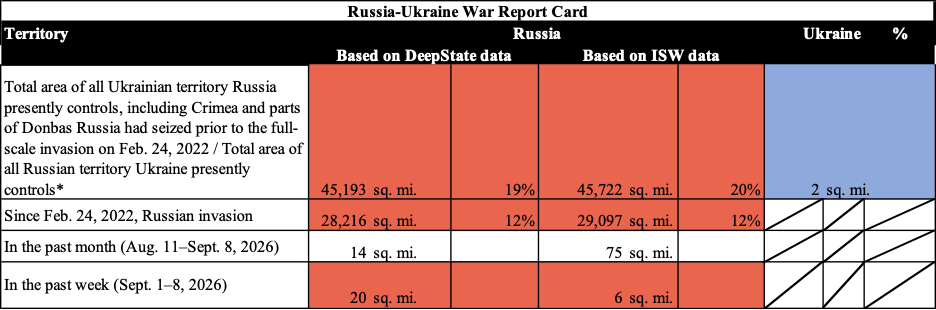
Endnotes
- The Economist estimated on Sept. 8, 2026, that over the preceding 30 days, Russia’s armed forces had gained about 78 square miles of Ukrainian territory.
- Settlements near which Russian forces advanced Sept. 1–8, 2026, according to DeepState: Bochkove, Ivashkyne, Luhivske, Hulyaypilske, Holubivka, Stupochky, Kostiantynivka, Shevchenko, Mali Shcherbaky, Varvarivka, Hryshyne, Kalenyky, Fedorivka Druha, Stepanivka, and Kotlyne.
- RM’s map graphics incorporate publicly shared map features from ISW, ESRI, AParrish1 (European countries) and collab2021_Fleming (Black Sea). National flags indicate relative positions across frontlines only. The map key applies to all three map insets.
- RM’s methodology sums three ISW map layers to arrive at its totals each week rather than two (specifically, RM adds “Claimed Russian control over Ukrainian territory” to “Assessed Russian-controlled Ukrainian territory” and “Assessed Russian Advances in Ukraine”).
- Russia’s average monthly gain for the past 12 months is calculated using the same ISW data that is used in the “Russian net territorial control in Ukraine by month” graph. However, in its May 2, 2026, Russian offensive campaign assessment, ISW warns that “comparisons of Russian gains this year with those of previous years when infiltration tactics were rarer thus are not straightforward, as Russian forces exert a significantly lower degree of control over infiltration areas than they do over seized areas.” This complicates inferences drawn from raw annual comparisons of changes in territorial control.
- To see DeepState’s own estimates of changes in territorial control in the recent months, please access this link.
- Here are more estimates of losses of the Russian military personnel [in chronological order]:
- 600,000 killed or injured, according to Trump’s December 2024 estimate.
- Almost 1,000,000 killed, according to Trump’s January 2025 estimate.
- More than 750,000 killed or injured, according to a March 2025 estimate by DNI/U.S. intelligence community.
- More than 790,000 killed or injured, according to an April 2025 estimate by then-SACEUR Cavoli. 84,568 missing, according to an April 2025 estimate by the Ukrainian Coordination Center for the Treatment of Prisoners of War.
- 950,000 killed or injured, according to CSIS’s June 2025 estimate, including 250,000 killed and 700,000 injured.
- More than 1,000,000, including 250,000 killed, according to the U.K. Defense Ministry’s June 2025 estimate.
- 219,000 Russian soldiers identified as killed in Meduza’s and Mediazona’s August 2025 estimate.
- Some 1,000,000 in casualties, including 250,000 KIAs, according to then-British spy chief Richard Moore’s September 2025 estimate.
- Some 1,168,000 killed and wounded, according to the U.K. Ministry of Defense’s December 2025 estimate.
- 1,100,000 casualties, according to ex-CIA director William Burns’ January 2026 interview in FT.
- 1,200,000 Russian military casualties (killed, wounded and missing) with as many as 325,000 killed between February 2022 and December 2025, according to CSIS’s January 2026 estimate.
- 1,000,000 Russian soldiers have been killed or wounded, according to a February 2026 estimate by the Estonian Foreign Intelligence Service.
- 1,200,000 casualties, including killed and wounded, according to a February 2026 estimate by Western officials reported by Bloomberg. The unnamed officials estimate that this casualty total includes 430,000 casualties in 2024 and 415,000 casualties in 2025.
- More than 200,000 identified as killed in a February 2026 estimate by Mediazona and BBC.
- 1,100,000-1,400,000 casualties, including 230,000–430,000 dead, according to a February 2026 estimate by The Economist.
- 1,200,000 casualties, including 325,000 killed, according to a February 2026 estimate by WSJ.
- Russia has suffered about 1,200,000 permanent losses, including more than 500,000 dead, according to an April 2026 estimate of Netherlands’ Military Intelligence and Security Service.
- 352,000 identified as killed in Meduza’s and Mediazona’s May 2026 estimate.
- 1,100,000-1,500,000 killed and wounded, according to Economist’s May 17, 2026, estimate.
- Nearly 500,000 Russian soldiers are estimated to have been killed since 2022, Anne Keast-Butler, top British intelligence official, has said in a May 2026 estimate.
- “Some intelligence reports” indicate that 1,200,000 Russian soldiers have been killed or wounded since February 2022, according to a May 2026 FT article.
- Russian forces have lost some 1,400,000 killed, wounded or missing between February 2022 and June 2026, according to a July 2026 report by CSIS.
- 450,000 Russians have been killed, according to a July 2026 estimate by ex-SACEUR Christopher Cavoli.
- Here are more estimates of losses of the Ukrainian military personnel [in chronological order]:
- 400,000 killed or injured, according to Trump’s December 2024 estimate.
- 43,000 Ukrainian soldiers have been killed and 370,000 injured, according to Zelenskyy’s December 2024 estimate.
- 700,000 killed, according to Trump’s January 2025 estimate.
- 100,000 killed, according to Zelenskyy’s April 2025 estimate.
- 400,000 killed or injured, according to CSIS’s June 2025 estimate, including somewhere between 60,000 and 100,000 killed and 300,000-340,000 injured.
- 73,000–140,000 killed, according to The Economist’s July 2025 estimate.
- 140,000 killed, according to BBC’s December 2025 estimate.
- 500,000–600,000 Ukrainian military casualties, including killed, wounded and missing, and between 100,000 and 140,000 fatalities between February 2022 and December 2025, according to CSIS’s January 2026 estimate.
- 55,000 Ukrainian soldiers have been killed, according to Ukrainian president Volodymyr Zelenskyy’s February 2026 estimate.
- 500,000–600,000 killed, wounded or missing, according to a February 2026 estimate by RFE/RL.
- Ukraine has suffered about 500,000 “permanent losses,” according to an April 2026 estimate of Netherlands’ Military Intelligence and Security Service.
- The Ukrainian military has suffered somewhere between 500,000 and 600,000 casualties, according to Western estimates, reports a May 2026 FT article.
- Ukrainian forces have lost somewhere between 525,000 and 625,000 killed, wounded or missing between February 2022 and June 2026, according to a July 2026 report by CSIS.
- 150,000 Ukrainians have been killed, according to a July 2026 estimate by ex-SACEUR Christopher Cavoli.
- RM cannot verify military or civilian casualty figures or equipment losses estimated by various sources cited in this card.
- Oryx, “Attack On Europe: Documenting Equipment Losses During The 2022 Russian Invasion Of Ukraine,” Oryx(blog), https://www.oryxspioenkop.com/2022/02/attack-on-europe-documenting-equipment.html; “The Military Balance 2022,” IISS, https://www.iiss.org/publications/the-military-balance/the-military-balance-2022; Oryx, “List Of Aircraft Losses During The Russian Invasion Of Ukraine,” https://www.oryxspioenkop.com/2022/03/list-of-aircraft-losses-during-2022.html; Oryx, “List of Naval Losses During The Russian Invasion Of Ukraine,” https://www.oryxspioenkop.com/2022/03/list-of-naval-losses-during-2022.html.
- In early May 2026, Oryx revised down the total numbers of military vehicles and equipment lost by Russia and Ukraine, as well as the numbers of tanks and armored vehicles lost by the combatants. To date, Oryx has not explained on its website how these numbers could have decreased with time. The figures in this card reflect the current numbers published by Oryx.
- Oryx revised down its estimate of lost Russian tanks and armored vehicles from 14,167 as reported in the Sept. 2, 2026, issue of the Russia-Ukraine War Report Card, to 14,163 in this issue.
- Oryx did not update tallies of either Russian or Ukrainian lost aircraft and naval vessels from Jan. 7, 2026, to May 18, 2026. Then aircraft tallies were updated on May 19, 2026, while naval tallies were not. As of Aug. 25, 2026, tallies of Russian or Ukrainian lost aircraft and naval vessels have not been updated.
- Jensen, Benjamin and Yasir Atalan, “Russian Firepower Strike Tracker: Analyzing Missile Attacks in Ukraine,” Center for Strategic and International Studies, Dec. 17, 2024, https://www.csis.org/programs/futures-lab/projects/russian-firepower-strike-tracker-analyzing-missile-attacks-ukraine?f%5B0%5D=content_type%3Aarticle&f%5B1%5D=content_type%3Areport. Note that due to limitations associated with refreshing of attack and intercept data, this section of the scorecard is updated once a month.
- On Aug. 11, 2026, Bloomberg reported that Ukraine has paused reporting the numbers of missiles Russia fired during attacks.
- International Monetary Fund, World Bank, and Russian estimates. “Russia and Ukraine 3-Year Bond Yield,” Investing.com, https://www.investing.com/rates-bonds/russia-3-year-bond-yield; World Bank Group, “Europe and Central Asia Economic Update,” https://openknowledge.worldbank.org/server/api/core/bitstreams/94bdc078-9c64-4833-992a-fda7b3d1a640/content; World Bank, “Russian Federation MPO,” https://thedocs.worldbank.org/en/doc/d5f32ef28464d01f195827b7e020a3e8-0500022021/related/mpo-rus.pdf; Trading Economics, “Russia 3-Year Bond Yield,” https://tradingeconomics.com/ruge3y:gov; World Bank, “The World Bank in Ukraine,” https://www.worldbank.org/en/country/ukraine/overview#3; https://www.exchange-rates.org/exchange-rate-history/rub-usd-2024-11-01.
- For earlier estimates, see the Aug. 5, 2026, issue of this card.
- For earlier estimates, see the Aug. 5, 2026, issue of this card.