
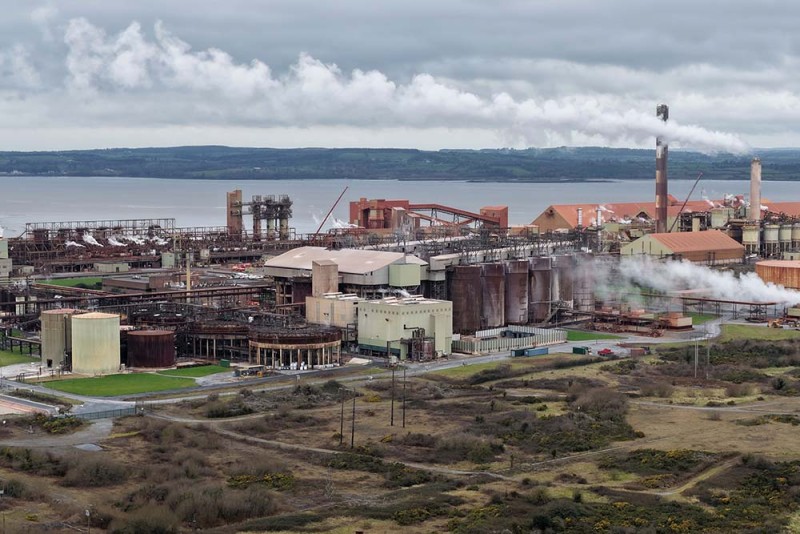
Following an investigation by OCCRP and partners, the Irish government launched its own probe into whether the country’s alumina exports have been feeding into the supply chains of sanctioned Russian arms makers. Here is what the leaked report says, what questions remain, and what comes next.
After OCCRP and partners published an investigation in March exposing how Europe’s largest alumina refinery was feeding into a supply chain linked to Russian weapons manufacturers, the reaction was big.
Lawmakers and officials across Europe called for Brussels to halt all exports of alumina — the key input needed to produce aluminum — to Russia, in hopes of dealing another blow to Putin’s war machine.
In Ireland, where the factory is based, the government promised to investigate the matter, and announced late last month that it had shared the findings of its probe with the European Commission.
The report has not been made public, but The Irish Times obtained a leaked copy and shared it with OCCRP and other media partners.
Here is what the leaked report says, what remains unknown, and what could come next.
What did OCCRP’s investigation expose?
As a key resource for industries ranging from energy to defense, the powdery precursor to aluminum known as alumina has been branded a “critical raw material” by the European Union, whose leaders have called on member states to stockpile the good as a bulwark against hostile powers.
But the investigation by OCCRP and iStories, KibOrg, De Tijd, The Irish Times, The Guardian, and Delfi found that the continent’s biggest producer of the material, the Ireland-based Aughinish Alumina, had since 2023 been sending most of its alumina exports to smelters in Russia owned by the Irish plant’s parent company, the Russian aluminum giant Rusal.
Reporters could not track the final destination of a specific batch of Aughinish’s alumina after it reached Russia, as the substance is typically mixed together with alumina from other sources in the process of turning it into aluminum.
But leaked transaction data revealed how specific Rusal smelters which imported Aughinish’s alumina were at the same time selling some of their final product to a Moscow-based trader, Aluminum Sales Company (ASK), which supplies aluminum to dozens of Russian defense contractors.
In total, the transaction data shows ASK bought more than $640 million worth of aluminum from Rusal smelters between the start of Russia’s 2022 invasion of Ukraine and April 2025.
ASK’s clients, reporters found, included 143 Russian companies that made purchases in order to fulfill state defense contracts. At least 63 of these companies were sanctioned by the EU, which notes that 53 of them produce weapons frequently used in Ukraine.
What was the reaction to OCCRP and partners’ investigation in Ireland and beyond?
Irish ministers had long faced questions over whether the Aughinish refinery, a key provider of jobs in County Limerick, was indirectly supporting Russia’s assault on Ukraine.
In response to the investigation by OCCRP and partners, the Irish government noted that a lack of data made it “difficult to ascertain where Russia is sourcing its tools and weapons from,” and promised to investigate whether any of the country’s alumina was making its way into Russia’s military supply chain.
Both the government and Aughinish also stressed that the export of alumina to Russia did not violate EU sanctions as the material’s export is not banned.
A flurry of European lawmakers and officials pushed to change that fact, with members of the European Parliament adopting a non-binding call for a “full ban” on alumina exports to Russia with an overwhelming majority in July.
However, the EU Council did not include alumina in the most recent sanctions package adopted later that month.
What does the Irish government report say?
The Irish government completed its report in July, and shared it with the European Commission alongside promises from Taoiseach (Prime Minister) Micheál Martin to jointly “develop an approach that would deal with the core issue here, in terms of material going from that plant to Russia.”
Carried out by Ireland’s Department of Enterprise, Tourism and Employment (DETE), the report states that the probe “has not identified sufficient evidence to establish that alumina produced at Aughinish is … being utilised by the Russian military.”
DETE said it did not have access to the leaked transaction data that OCCRP used to draw the link between the Russian smelters that import Aughinish’s alumina and the Moscow-trader that sells metal to arms makers.
However, the DETE report says that Aughinish had provided it with a warranty, signed by the CEO of its parent company Rusal two weeks after OCCRP’s investigation was published, “which states that it can confirm that no alumina produced in Limerick is used for military purposes and that it is used solely in the production of aluminium for export from Russia.”
Aughinish “confirmed that they had specifically asked the parent company for this document, the contents of which had previously been given verbally,” the report notes.
The report adds that Aughinish also provided documentation showing that its alumina was processed in dedicated facilities used solely for the export market. Aughinish did not respond to OCCRP’s requests for further evidence.
Rusal “indicates” it has now hired a Swiss inspection company “to perform independent audits at the smelters in Russia to produce verifiable evidence that the alumina supplied by Aughinish is not entering the Russian military supply chain,” the report says.
Ireland’s report did note that if Aughinish’s alumina was going into the Russian weapons supply chain, it could in fact constitute an EU sanctions breach.
The report cites an EU regulation saying: “It shall be prohibited to sell, supply, transfer or export, directly or indirectly, goods and technology which might contribute to Russia’s … defence and security sector.”
It notes that the Aughinish refinery had “good knowledge of sanctions requirements,” although they were not put into writing, and that this has now been “rectified with written procedures.”
Contracts from the parent company, Rusal, “contain clauses prohibiting sanctions violation and military end use,” the report says. However, the documentation Aughinish provided from Rusal “relating to end user clauses cannot be verified or scrutinised satisfactorily,” it adds.
Can Aughinish’s claim that its alumina is exclusively exported from Russia be verified?
While the Irish government report says Aughinish provided documents to show its alumina is processed by “specific smelters” solely for export, the report notes that it “has no means to physically trace the product sold from Aughinish within Russia.”
In a statement about the findings, DETE Minister Burke cited “a lack of verifiable internal trade data within Russia.”
Neither Aughinish Alumina nor Rusal responded to OCCRP’s requests for evidence that the Russian smelters maintain such a segregation of production lines, or details about how long this arrangement has been in place for.
But in order to ensure Aughinish’s alumina did not reach the domestic market, the smelters would have to maintain a completely separate set of infrastructure, beginning with the vast silos in which they mix together alumina from different sources.
Detailed information about the amount and origins of aluminum that Rusal smelters export is also not readily available in Russia, making it difficult to track which alumina is used to make aluminum that is ultimately destined for abroad.
However, leaked data seen by OCCRP indicates that 27% of the aluminum produced by the Krasnoyarsk smelter — one of the top importers of Aughinish’s alumina — was destined for the domestic market in 2025.
What did OCCRP’s data show about the link between Russian smelters and the trading firm that supplies arms makers?
OCCRP’s investigation was based in part on leaked financial data showing bank transactions between Rusal’s in-house trading arm OK Rusal TD — which is described by Rusal as handling aluminum sales to Russian buyers — and the metals trader ASK.
The data does not include how much aluminum ASK sourced from each smelter through OK Rusal TD, though it does show the trader paid service fees to specific smelters for loading and unloading aluminum, some 40 percent of which went to Krasnoyarsk and Sayanogorsk, the two plants that in 2024 imported around half of all of the alumina Aughinish produced that year.
Aughinish, according to the Irish report, denies that OK Rusal TD was involved in trading any aluminum produced with its material at the Krasnoyarsk and Sayanogorsk smelters.
The DETE report adds that the government was unable to obtain “details of ASK’s trade,” and that “in the absence of such information, there is no evidential basis upon which the Department can determine whether ASK currently procures materials, including aluminium, for military contractors or, if it does, whether any such materials can be traced… to Aughinish.”
What has the reaction been to the Irish government’s report?
Ireland’s Minister of State Niall Collins told public broadcaster RTÉ that the report has not been shared publicly because of “commercial sensitivities” and “legal reasons,” but that this should not be seen as a “deliberate attempt to withhold anything from anybody.”
The Ukrainian Embassy in Ireland and Ukraine’s sanctions policy chief, meanwhile, have pressed the Irish state to release the findings.
“In my view, the public interest makes it wrong — and indeed impossible — to conceal any aspect of the investigations surrounding Aughinish,” said Vladyslav Vlasiuk, Commissioner of the President of Ukraine for Sanctions Policy.
A spokesperson said the EU Commission is “examining the report and analyzing the role played by Aughinish itself vis-a-vis its export flows to Russia and to any third country’s aluminum supply chains, notably with respect to supplying Russia’s war efforts.”
Afterward, “we will decide on an appropriate follow-up, of course, while remaining in contact with the Irish government,” the spokesperson added.
The Irish Times said in an editorial that “an investigation that declines to examine the evidence it was established to test cannot claim to have cleared anyone.”
Commenting in the Irish Examiner, Dublin City University politics professor Donnacha Ó Beacháin said: “The Government has behaved as though the absence of definitive proof settles the matter. It does not.”
“The evidential threshold set by ministers is impossible,” he added.
Pavlo Shkurenko, a sanctions research fellow at the Kyiv School of Economics, stressed that the report overlooks the bigger issue of the entanglement of Europe’s alumina industry with Russia more broadly.
“Overall, I think that looking for Irish atoms in Russian weapons is the wrong framing of the problem,” he told OCCRP, adding that the goal should be for Europe to reduce its economic dependency on Russian clients in the alumina sector.
“The solution will have to address decoupling: creating markets for alumina and refining within the EU.”
What happens next?
The report will be considered by the EU Commission, which alongside the High Representative for Foreign Affairs will decide whether to propose any sanctions. Such measures would then require the unanimous agreement of the Council of the European Union.
“EU policymakers have to draw a balance between potential impact of sanctions on Russia and potential impact of sanctions on their domestic economies,” Alex Prezanti, a U.K. barrister and sanctions specialist, told OCCRP at the time of the investigation.
Critics of the Irish government’s approach to Aughinish’s Russian exports have pointed to Australia, which banned alumina exports to Russia early in the war. Moscow had relied on Australia for nearly 20% of its alumina needs, much of it from a Rio Tinto-Rusal joint venture in Queensland.
The EU could also decide to impose sanctions on Rusal in light of another issue — the degree of control that Russian oligarch Oleg Deripaska, an EU-sanctioned ally of Putin, has over Rusal.
An investigation by Swedish tax authorities into Kubikenborg Aluminium AB (Kubal), a Rusal-owned aluminum smelter in Sweden that also imports alumina from Aughinish, recently concluded that its parent firm remains under the effective control of Deripaska, despite corporate restructuring meant to distance him from the business.
Consequently, the Swedish authority ruled that Rusal assets should be subject to EU sanctions, and froze the equivalent of around 5.1 million euros in the smelter’s tax account.
Italy’s finance minister came to similar conclusions in 2023, according to the Swedish ruling, leading it to freeze the assets of Rusal entity Eurallumina, located on the west coast of Sardinia, “on the basis that Deripaska effectively owned more than 50% of UC Rusal.”
Deripaska did not respond to OCCRP’s request for comment but has previously mounted failed legal challenges to U.S., EU, and Australian sanctions against him.
The Swedish smelter Kubal has since appealed the decision of the Swedish authorities. In June, the smelter’s lawyers told the Swedish newspaper Sundsvall Tidning that the decision could have serious consequences: “If the enforcement continues, Kubal risks being forced to close its operations and go bankrupt soon, despite the fact that the company is one of the world’s leading companies in its industry and one of the largest private employers in the Sundsvall region.”