
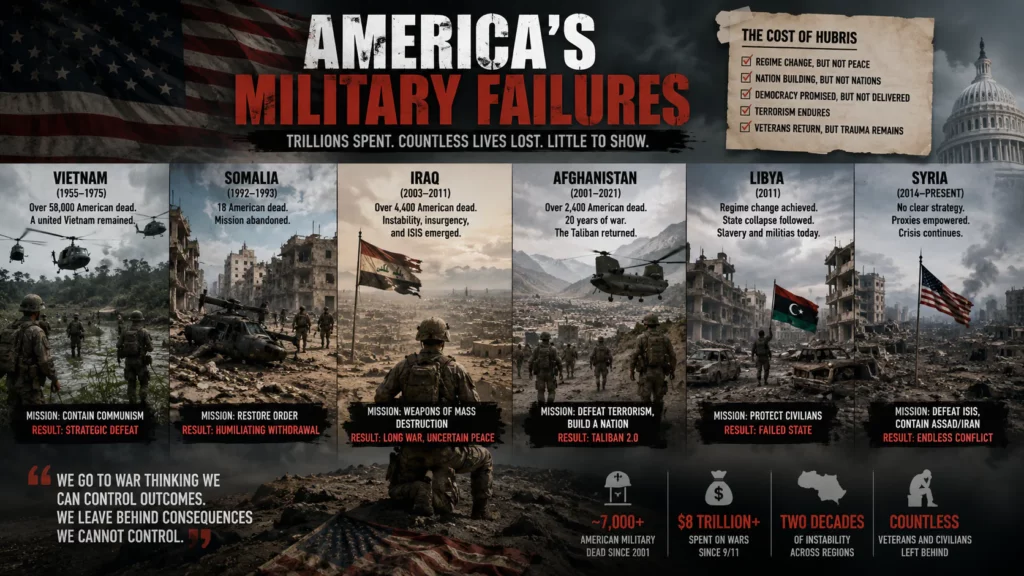
To “secure its national interests”, America went to war multiple times over the past several decades, yet all of the wars ended in stunning failures with wide ranging implications for the countries involved.
It is said that national interests triumph over every other consideration in the realm of foreign policy. The idea of national interest varies for different countries, depending on their history, politics, economic development, and relationships with their internal and external actors. The nature of interests, Hans Morgenthau contended, changed over time. In contemporary times, state actors resort to a variety of means to secure their national interests. In today’s time, coercive measures seem to have acquired a particularly strong currency among leaders. Among coercive measures, war, which was deemed to be the measure of last resort when everything else failed, has now emerged as the first option.
In fact, the latest American misadventure must be understood as a part of the long history of stunning failures of Uncle Sam’s illegal campaigns over the course of history
This has become particularly true of the United States of America. For more than five months now, the American nation, with its Israeli counterpart, has been ravaging Iran. While the war has inflicted enormous costs on Iran in terms of lives and destruction of infrastructure, far from denting the spirit of the Iranian people, it has galvanized them. Now, the Islamic Republic is righteously punishing the American and its Israeli imperialist partner for unfairly attacking Iran by taking punitive action in the strategic Strait of Hormuz.
That being said, it compels us to ask a key question—is America winning the war?
Not by a long margin.
In fact, the latest American misadventure must be understood as a part of the long history of stunning failures of Uncle Sam’s illegal campaigns over the course of history.
The Ghost of Vietnam
The first war that comes to mind is the Vietnam War. Between 1961 and 1973, successive American administrations adopted a multiplicity of measures to assert American power in Vietnam. What was the cause? To prevent the spread of communism in Vietnam in general and in Southeast Asia in particular. The war saw the American nation deploying massive numbers of troops to fulfill this utterly foolish aim. This American misadventure did result in horrific consequences.
Who can forget the massacre by American troops in the village of My Lai? Apart from this, the American war machine inflicted terrible suffering upon the innocent and brave people of Vietnam. A greater tonnage of bombs was dropped on the country in that period than what was dropped on Nazi Germany by the same nation during the Second World War. But what was the end result? The Americans had to sue for peace, for the Americans, the involvement in the long-running came to an ‘official end’ with the announcement of a ceasefire in January 1973, and the American armed forces eventually withdrew.
However, America’s aim of preventing the spread of communism ended in a stunning failure because just two years later, in April 1975, the two halves of Vietnam were united under communist rule. To rub salt on American military and ideological wounds, communist governments also came to power in Laos and Cambodia.
The Two-Decade Fiasco in Afghanistan
The ‘War on Terror’ campaign was launched by the United States on October 7, 2001, in response to the 9/11 terror attack on its soil. The Americans, looking for blood, set their sights on the Taliban regime in Afghanistan, which was sheltering Osama Bin Laden. Under Operation Enduring Freedom, the Taliban regime was quickly dislodged from power. For the next two decades, the Americans occupied the country.
However, what happened in the end? The Americans again had to renegotiate with the Taliban regime, which had quickly regained its strength. Through the Doha Accord of 2020, the Americans agreed to withdraw from the country in the hope that the Afghan constitutional order, a creation of the American jus post bellum initiative, was excluded. This accord was followed by the Taliban rapidly advancing across the country in an extremely swift military campaign. This culminated in the Taliban once again seizing power following the withdrawal of the last of the American troops from the country in August 2021.
Once again, America faced defeat—this time at the hands of an insurgent organization-cum-movement, which was certainly no match for the mighty bald eagle in conventional military terms. However, after two decades, trillions of dollars, and the deaths of thousands of American soldiers, what was the end result—a total failure!
This underscores the idea that merely possessing state-of-the-art military assets does not guarantee victory. America and its acolytes will understand this soon.