
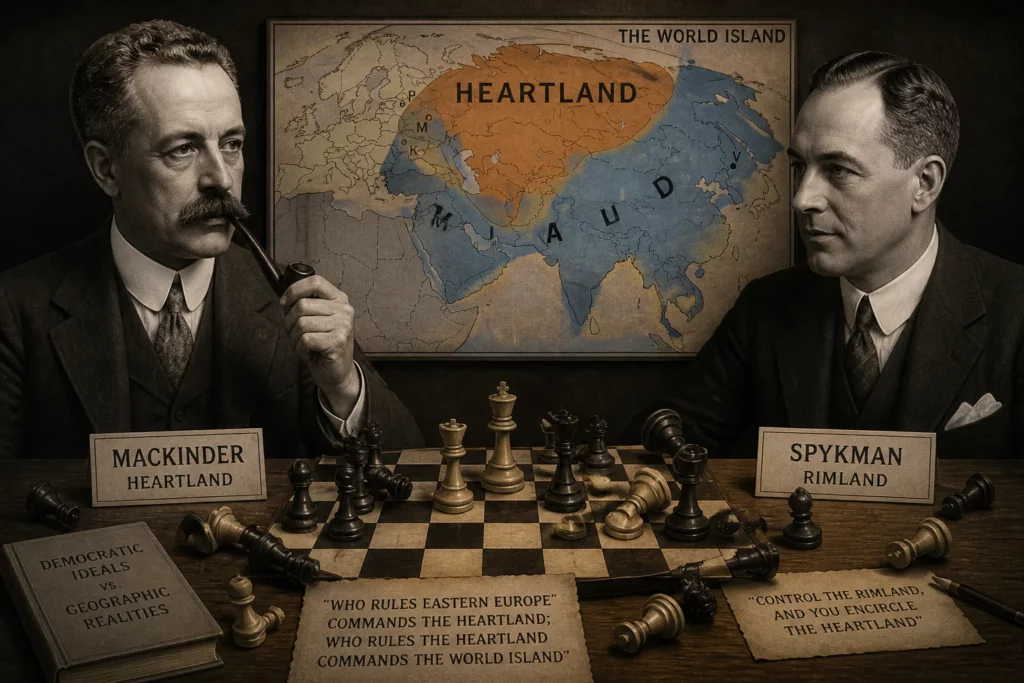
For anyone still selling the West’s grand strategy as a coherent product, is that the framework itself has aged worse than either of its authors could have imagined. Mackinder and Spykman were writing about a world where land power and sea power were mutually exclusive career choices.
There is a particular kind of comedy in watching the world’s most expensive military establishment behave as though a British geographer’s 1904 lecture to the Royal Geographical Society were still classified. Halford Mackinder stood at the front of that room and said a sentence that would outlive empires: “Whoever commands Eastern Europe commands the Heartland; whoever commands the Heartland commands the World-Island; whoever commands the World-Island commands the world.” It was neat, quotable, and, crucially for the Anglo-American strategic imagination, terrifying.
A land-based power, unbothered by blockades and unreachable by gunboats, gliding across its own railways from the Volga to the Yangtze, was Britain’s nightmare and, later, Washington’s inherited anxiety. One hundred and twenty-two years on, the nightmare has a passport, a seat on the UN Security Council, and lately a rather large Caribbean-adjacent hobby.
Mackinder’s rebuttal arrived courtesy of Nicholas Spykman, a Dutch-American strategist writing in 1942 with the tanks of two hemispheres rolling past his window.
The confrontation with Iran exposes an imperial reflex in which oil, dollar reserves, food, and finance are all simply weaponized in sequence, each new front less about strategy than compulsion
Spykman looked at the map and decided the interior was overrated. What mattered, he argued, was the Rimland, the crescent of coastal and littoral states running from Western Europe through the Middle East and South Asia to the Pacific Rim, because that was where the population, the industry, the ports actually were. His own dictum, less lyrical than Mackinder’s but far more practical, was that he who rules the Rimland rules Eurasia, and he who rules Eurasia rules the world.
Where Mackinder trusted railways, Spykman trusted the amphibious reach of a navy that could put troops ashore anywhere the tide allowed. It is not an exaggeration to say that Spykman, not Kennan, drew the map that Kennan’s containment doctrine would later color in. NATO, CENTO, SEATO, and eventually the “First Island Chain” running from Japan through Taiwan to the Philippines are Spykman’s Rimland with alliance logos stapled on.
This is the faceoff that has quietly organized Western strategic thought for eight decades, and it is worth saying plainly: the West never actually chose between these two men. It absorbed both. The Heartland became the thing to be contained; the Rimland became the wall built to contain it. Every US defense posture since 1947 – namely, from the Marshall Plan’s economic tripwires to AUKUS submarines — meant that Spykman won the argument, provided someone keeps refuting Mackinder by force.
It is less a doctrine than a security blanket, and Washington has been clutching it so tightly for so long that it has started to mistake the blanket for the child.
Enter Beijing, Which Read Both Books
The genuinely interesting development of this decade is that a single power has stopped picking a side in the Mackinder-Spykman quarrel and started buying both arguments at once. The Belt and Road Initiative’s “Belt” is Mackinder made literal: rail corridors, pipelines, and highways threading through Central Asia toward Europe, engineering a transcontinental logistics network that no carrier strike group can intercept because there is, structurally, nothing at sea to intercept.
The “Road” is Spykman’s inheritance: deep-water ports at Gwadar, Hambantota, and Djibouti, a maritime silk road stitched along precisely the coastal chokepoints the Rimland theory once designated as the leash around the Heartland’s neck. China is not refuting either Englishman.
It is quietly notarizing both wills and inheriting the whole estate, continental depth as insurance against naval containment, maritime reach as insurance against continental isolation. It is the geopolitical equivalent of hedging a bet by owning the casino.
Washington’s discomfort with this arrangement is not subtle. It shows up as tariffs, export controls, and a trade war whose choreography has become almost seasonal: escalate, threaten triple-digit tariffs, discover that Beijing’s grip on rare-earth refining, roughly seventy percent of global processing capacity, makes semiconductors and F-35 magnets hostage to Chinese customs officials, then retreat to a “truce” that nobody pretends is permanent.
The current arrangement, patched together after the Kuala Lumpur and Busan meetings, holds tariffs near 31 percent and rare-earth controls in suspension until the truce’s expiry later this year, which is to say, the two sides have agreed to keep loading the gun rather than fire it, for now. It is less a resolution than an armistice between two men who both intend to reload. Beijing’s own language for this hedge is, characteristically, far less martial than anything Mackinder or Spykman ever wrote.
Xi Jinping has long advocated for what he calls a “community with a shared future for mankind,” a phrase weighty enough to frame four separate global initiatives on development, security, civilisation, and governance, all in service of what Beijing now openly calls an “equal and orderly multipolar world.”
You need not take the slogan at face value to see what it does: it dresses the Belt-and-Road hedge in the language of universal benefit instead of strategic denial, which is exactly the branding exercise a power spanning both Mackinder’s and Spykman’s maps needs if it is to have the Global South cheering rather than counting warships.
Perhaps nowhere is the fallout of this century-old quarrel more visible, or more darkly comic, than in Europe, which spent eighty years as the Rimland’s western anchor and has recently discovered that anchors do not get consulted on where the ship sails
Where the Rimland Is Currently on Fire
If you want proof that Spykman’s geography still writes the invasion orders, look no further than the Strait of Hormuz, where roughly a fifth of the world’s oil transits a chokepoint that Iran can, and periodically threatens to, close with a shrug.
The American economist Michael Hudson, never a man to let Washington’s self-flattery go unpunctured, has taken to describing the pattern as a kind of institutional pathology, arguing that “the confrontation with Iran exposes an imperial reflex in which oil, dollar reserves, food, and finance are all simply weaponized in sequence, each new front less about strategy than compulsion”.
Hudson has coined the term for it: geopathology, the doctrine of coercive control dressed up as foreign policy, running on the fumes of a dollar system that no longer commands the deference it once did, and that’s why it’s fighting, one ought to add. But Hudson already did that when he said that the United States is in the “desperate defense of dollar empire,” and he is obviously not being poetic nor sarcastic here.
He is describing Rimland strategy in its senility: a maritime hegemon trying to hold a coastline together with sanctions because it no longer has the industrial base to hold it together with production.
And then there is Venezuela, which in January 2026 became the most literal demonstration imaginable of Rimland enforcement in the Western Hemisphere: American special forces, a captured head of state, and a Caracas skyline lit up by explosions, all in the name of narcotics interdiction against a country whose principal export has, remarkably, always been oil rather than cocaine.
One does not need to admire Nicolás Maduro’s governance to notice that regime change executed without congressional authorization, justified after the fact, is not a footnote to the Monroe Doctrine; it is the Monroe Doctrine finally admitting what it always was: America’s own private Heartland-denial exercise, conducted in its own backyard against the one hemisphere Mackinder never bothered to map because he assumed Washington already owned it outright.
Europe, or the Rimland That Forgot It Had a Say
Perhaps nowhere is the fallout of this century-old quarrel more visible, or more darkly comic, than in Europe, which spent eighty years as the Rimland’s western anchor and has recently discovered that anchors do not get consulted on where the ship sails.
Vladimir Putin’s recurring theme, restated in his first major address of this year, is that the “unipolar world” was always “a world of one master, one sovereign,” destructive to the subjects and, eventually, to the master itself, a line delivered with the confidence of a man who has been saying it since Munich in 2007 and watched events oblige him at every turn.
Whatever one makes of the Kremlin’s own appetite for spheres of influence, it is difficult to argue with the observation that European strategic autonomy has, in practice, meant autonomously agreeing with whatever Washington decided last month, whether the subject was Nord Stream, Chinese 5G equipment, or the tariff schedule Brussels never actually negotiated.
None of this requires actual armies to register as combat. Ukraine remains the textbook case of a proxy theater engineered along precisely the fault line Mackinder identified as decisive: control of Eastern Europe as the gateway to the Heartland, fought with Western provisions, Western financing, and, notably, no Western soldiers, because the entire point of a proxy war is to test a rival’s continental resolve without spending the “motherland’s” own blood.
Trade wars function the same way with different weapons: tariffs and export licenses are simply a chokepoint strategy conducted through customs forms rather than naval patrols, and the fact that Washington and Beijing keep signing “truces” they both openly expect to collapse tells you the war was never really about tariff percentages. It was, and remains, about who gets to decide whether the Heartland’s industrial base can reach the sea on its own terms.
The Fallout, Assembled
Strip away the doctrine, and what remains is a fairly unglamorous ledger. The United States, still instinctively Spykmanite, polices chokepoints from Hormuz to the Caribbean with a navy it can no longer easily afford and a dollar it can no longer easily defend, all while running a trade war against the one power capable of choking its own defense-industrial supply chain in return.
Russia, cast permanently as the Heartland’s occupant whether it wants the role or not, has spent a decade being encircled precisely as Spykman’s students would have scripted it and has responded, predictably, by doing exactly what Mackinder said it would: building the internal cohesion and continental partnerships that make blockade increasingly irrelevant.
China, refusing to audition for either archetype, is quietly assembling the only power in modern history to hold serious Heartland depth and serious Rimland reach simultaneously, a combination that neither Mackinder nor Spykman, writing in eras when no single actor could plausibly claim both, ever thought to war-game.
Iran sits at the Rimland’s most sensitive hinge, absorbing sanctions and airstrikes as the toll for occupying real estate that both theories flagged as indispensable a century before Tehran had an opinion on the matter.
The inconvenient conclusion
For anyone still selling the West’s grand strategy as a coherent product, the framework itself has aged worse than either of its authors could have imagined. Mackinder and Spykman were writing about a world where land power and sea power were mutually exclusive career choices.
China has simply declined to choose, Russia has stopped waiting for permission to consolidate its own periphery, and the United States, still reciting Rimland scripture through gritted teeth while its own hemisphere burns and its own currency wobbles, resembles nothing so much as a general refighting a war whose terrain has quietly rearranged itself underneath him.
The chessboard, as it turns out, got tired of being read from only two angles at once.