
Part One: Napoleon’s Cannons and the Awakening of the Arab World
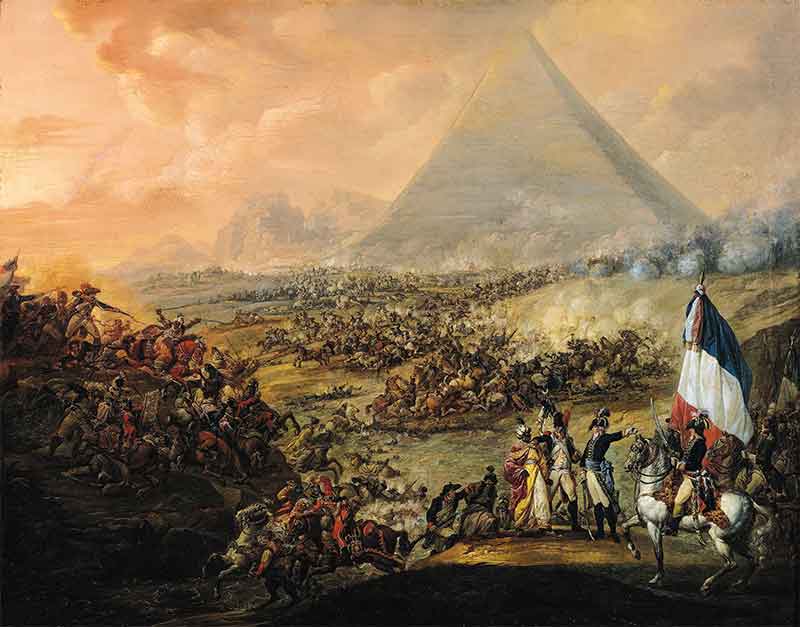
When Napoleon’s cannons began bombarding Alexandria in 1798, Europe the region geographically closest to the Arab world had already undergone profound transformations. The great voyages of discovery had redrawn the map of the world, steam power was beginning to replace the sails of ships, and remarkable advances had been made in artillery and firearms. At the same time, Europe had entered an intellectual renaissance that propelled it toward rationalism, scientific inquiry, and modern political thought.
The French and English revolutions had transformed the political landscape, while philosophers such as John Locke, Thomas Hobbes, Voltaire, Baruch Spinoza, Jean-Jacques Rousseau, and Immanuel Kant profoundly reshaped political and social thinking. Medieval ideas rooted in superstition, the absolute authority of kings, and the unquestioned power of the Church were gradually giving way to new concepts of liberty, reason, and the rights of the individual.
The French Revolution emerged from the collapse of the old order and the rise of revolutionary ideas that challenged long-established institutions. Voltaire, in particular, played a crucial role in defending religious freedom, freedom of expression, and the separation of religion from the state. He did not live to witness the Revolution itself, having died in May 1778, more than a decade before it began.
Although the French Revolution proclaimed the ideals of liberty, equality, and fraternity as universal values, in practice these principles were often applied selectively, particularly in relation to colonial subjects. Similarly, critics argue that double standards in Western policies continue to demonstrate a gap between proclaimed universal values and their implementation.
Napoleon’s expedition to Egypt was officially intended to sever Britain’s route to India and establish a lasting French presence in the East. Yet Napoleon also nurtured a more personal ambition: he dreamed of following in the footsteps of Alexander the Great, whose conquest of the East had become one of history’s enduring legends.
At that time, Egypt was effectively governed by the Mamluks, although it remained formally under Ottoman sovereignty. Internal rivalries and civil wars had severely weakened the Mamluks before the arrival of the French army.
The swords of the Mamluk commander Murad Bey could not withstand the artillery produced in France’s modern foundries. After a brief resistance, he entered into negotiations with General Jean-Baptiste Kléber and gradually moved toward cooperation with the French.
Murad Bey himself had been born in Tbilisi, in present-day Georgia., he was converted to Islam, given a new identity, and trained within the Ottoman military establishment.
A very different path was taken by Muhammad Karim, the governor of Alexandria. Refusing to surrender the city, he called upon its inhabitants to resist the French invasion. After the city’s fall, he was subjected to a summary trial and executed, becoming one of the earliest symbols of Egyptian resistance to foreign occupation.
As Napoleon advanced toward Palestine, he encountered determined resistance. Among his most formidable opponents was Sheikh Yusuf al-Jarrar, whose forces conducted effective guerrilla attacks in the hills around Nablus. According to some local traditions, these fierce battles contributed to the city’s enduring nickname, Jabal al-Nar the Mountain of Fire.
Napoleon’s army also failed to capture Acre, whose defenders, together with the forces of its Ottoman governer Ahmad Pasha al-Jazzar, successfully resisted the prolonged siege. Ottoman historical narratives later emphasized the role of al-Jazzar in defending the city, often overlooking the broader popular resistance mounted by local communities throughout the regions of Jenin, Nablus, and Tulkarm.
After abandoning hope of taking Acre, Napoleon returned to Egypt, leaving General Kléber in command before secretly sailing back to France.
Soon afterward, the Syrian student Sulayman al-Halabi, who had been studying at Al-Azhar, assassinated Kléber. The Egyptian historian Abd al-Rahman al-Jabarti described the trial in considerable detail, expressing admiration for aspects of its legal procedure, even though it ended with the brutal execution of the young assassin.
Although Napoleon’s military failed expedition was a colonial project , its intellectual consequences proved far more enduring. During the campaign, the Rosetta Stone was discovered, enabling the French scholar Jean-François Champollion, years later, to decipher the ancient Egyptian hieroglyphic script and reopen the door to Egypt’s forgotten past.
Yet, in my view, the expedition’s greatest legacy lay elsewhere. It forced Egyptians and later the wider Arab world to recognize that history had moved forward without them. Europe had entered a new age while much of the Arab world remained bound to older political and intellectual structures.
In this atmosphere, questions began to emerge that had rarely, if ever, been asked before. Perhaps the most influential was the famous question posed by Shakib Arslan: “Why has the West advanced while the Muslims have fallen behind?”It remains one of the most enduring questions in modern Arab and Islamic thought.
In the years that followed, this question gave rise to a variety of intellectual currents. Among the most prominent was the secular current, which looked to the Western model as its principal point of reference, and the religious current, which argued that progress could only be achieved through a return to what it regarded as the true teachings of Islam.
The intellectual debate between these two currents has continued, in one form or another, to the present day.
Napoleon’s cannons awakened a civilization from a long historical slumber. They marked the beginning of a difficult and unfinished journey a two-hundred-year search for identity whose consequences continue to shape the Arab world to this day.
Part Two: The Rise of Arab Nationalism
In late 19th century , Arab nationalist societies began to emerge in Beirut, Damascus, Jerusalem, Nablus, and Baghdad. Their aim was to awaken Arab political consciousness and restore what they believed to be the Arabs’ historical role. Yet it is important to recognize that political developments were not uniform throughout the Arab world.
At that time, the concept of Arab nationalism was centered primarily in the Arab East, the regions of Iraq and Greater Syria. These lands were under direct Ottoman rule, and many Arab intellectuals regarded the Ottoman Empire as the principal obstacle to Arab political and cultural revival. Arab Christian intellectuals especially from today’s Lebanon played a crucial role in this trend. Although the Ottoman Empire was a multiethnic state, real political power had increasingly come to rest in Turkish hands, particularly after the rise of the Committee of Union and Progress.
Egypt followed a different historical path. Having fallen under British occupation in 1882, the Egyptian national movement focused primarily on ending British rule. Consequently, while many Arab nationalists in the Levant regarded the Ottoman Empire as their principal political challenge, many Egyptian nationalists continued to view it as a potential ally against Britain.
North Africa developed along yet another trajectory. One Ottoman province after another fell under European colonial rule. Algeria, Tunisia, and Libya were occupied by France or Italy, while Morocco retained a degree of formal autonomy until the establishment of the French Protectorate in 1912.
Although many Arab intellectuals had become convinced that the Arab world needed to reclaim its historical role after centuries of decline, they remained divided over their relationship with the Ottoman Empire.
This division became evident at the First Arab Congress, held in Paris in 1913. Arab intellectuals and political leaders from Greater Syria and Iraq gathered to discuss the future of the Arab provinces within the Ottoman state.
The majority did not demand complete independence. Instead, they called for administrative decentralization, greater autonomy for the Arab provinces, recognition of Arabic as an official language, and the right for Arab soldiers to perform their military service within Arab territories rather than being deployed elsewhere in the empire.
The resolutions adopted in Paris represented a compromise between several political currents. One favored complete separation from the Ottoman Empire, another sought reform while preserving the empire, and a third represented by figures who did not attend the congress continued to support the Ottoman state without major constitutional change.
The congress’s demands, however, received little response from Istanbul. After the turkish Committee of Union and Progress consolidated its power, the Ottoman government adopted increasingly centralized policies. Influenced by the rise of European nationalism, its leaders later allied the empire with Germany when the First World War broke out.
These events unfolded against a broader cultural awakening, captured memorably by the Lebanese writer Ibrahim al-Yaziji in his famous poem calling upon the Arabs to awaken from their long slumber.
In my view, this emerging nationalist spirit also played an important role in resisting attempts to organize society primarily along religious lines. Later after the defeat of the ottoman state and during the French Mandate in Syria, for example, several statelets were created on sectarian foundations, including Alawite and Druze entities. The rise of Arab nationalism offered an alternative vision based on a broader common identity. From that moment onward, the central question facing the Arab world became increasingly clear: Should loyalty belong primarily to the newly created nation-state, to the wider Arab nation, or to older religious, sectarian, and tribal identities?
That question, I believe, has remained one of the defining political and intellectual challenges of the Arab Levant region throughout the past century and continues to shape its future today.
The defeat of the Ottoman Empire in the First World War transformed the political map of the Middle East. Under the Sykes–Picot Agreement and the postwar settlement that followed, the Arab provinces of the former empire were divided into British and French spheres of influence. New political entities gradually emerged in Iraq, Syria, Lebanon, Transjordan, and Palestine, and over time distinct national identities developed within each of them.
One of the historical paradoxes of the First World War one that is rarely discussed is that the Arabs allied themselves with Britain and France against the Ottoman Empire after being promised the creation of an Arab state encompassing the Arabian Peninsula, Iraq, and Greater Syria. It later became clear that these promises were largely intended to secure Arab support for the Allied war effort.
At the same time, the Zionist movement supported Britain in the hope that, if Britain emerged victorious, it would grant the movement a national home in Palestine. This was later reflected in the Balfour Declaration of 1917 and in the establishment of the British Mandate over Palestine, which created the political conditions for implementing that promise. All wars, instability that is taking place in the region now is the outcome of Belfour declaration and consequently the enforced plantation of the state of Israel.