Part One of this H File investigation laid the first two strata under the Anunnaki story. The first was the nineteenth-century decipherment of cuneiform, a Protestant project built to vindicate the Bible with archaeological discoveries, which hardened into a racial contest over who invented civilization and gave Friedrich Delitzsch the platform for a scholarly campaign to cut Christianity loose from its Jewish roots, particularly the notion that Yahweh was God.
The second was the moment archaeology became statecraft, when Gertrude Bell and T. E. Lawrence walked off the dig and into the intelligence service and helped draw the borders of modern Iraq. Running through both was the broker: whoever held the chokepoint between the buried past and the meaning made of it, the money that decided what came out of the ground and the translator who decided what it was allowed to say.This installment climbs to the third stratum, the one we are still living in: how the ancient gods acquired their spaceships, how President Truman’s signature ended up on the recognition of Israel, and how the man who branded the Anunnaki connects to a publishing empire and, through it, to the crimes of Jeffrey Epstein.
This stratum opens in the most bloodless corner imaginable, the machinery of academic publishing, and it ends with Jeffrey Epstein and the Anunnaki. Stay with the journals, because the publisher who cornered them fathered the woman now in federal prison for her part in Epstein’s crimes, and the collapse of public trust that gatekeeping produced is the exact vacuum Zecharia Sitchin walked into.
When an institution people have trusted stops earning that trust, the vacuum does not stay empty, and it does not fill with better inquiry. It fills with whoever is quickest to work the opening. A contrarian selling a novel story is held to no standard of evidence by the mere fact of being contrarian. Just because the academic-industrial complex may be flawed does not mean that all alternative sources are trustworthy.
The control of knowledge does not end with the ancient past. It reaches into the present, into the machinery that decides what counts as legitimate scholarship in the first place. Peer review is widely treated as the thing that keeps published science honest. As the business of academic publishing has changed, so have the ways that check fails, and many people working inside it argue that it has become corrupted, consolidated, and ineffective at the task it was built for.
The concept of peer review can be traced back to the seventeenth century, when scientific societies like the Royal Society of London were established. It began as an informal process whereby editors sought advice from knowledgeable colleagues before deciding whether to publish a manuscript, and it grew more formalized in the twentieth century as academic disciplines expanded and the number of scholarly publications increased.1
The modern form of peer review, in which external experts evaluate manuscripts before publication, is a relatively recent development. Many groundbreaking scientific papers, including Watson and Crick’s 1953 paper on the structure of DNA, were published without formal peer review. The editor-driven model, whereby knowledgeable editors took responsibility for the quality of their journals, was the norm for much of the history of scientific publishing.2
The transformation of academic publishing in the twentieth century is inseparable from Robert Maxwell, a British media mogul whose influence extends far beyond the confines of academic journals.
Maxwell, born Jan Ludvik Hoch in 1923, built an empire through sheer ambition and ruthless business practice, and that empire would reshape academic publishing. He founded Pergamon Press in 1951, recognizing the growing importance of scientific research in the postwar era. He capitalized on the demand for specialized journals as scientific disciplines became more segmented and the volume of research grew exponentially. Under his leadership Pergamon expanded rapidly, acquiring existing journals and launching new ones at an unprecedented rate. This aggressive growth allowed Maxwell to dominate the landscape, and it had far-reaching consequences for the quality and integrity of peer review.3
Maxwell’s approach prioritized rapid expansion and profit over the traditional values of scholarly publishing. This began to erode the editor-driven model of quality control that had long governed the field. In its place Maxwell introduced a more standardized and externalized peer review process which, though capable of handling the growing volume of submissions, often sacrificed thorough editorial oversight. The emphasis on quantity over quality became a hallmark of the industry under his influence, producing a system that many argue prioritizes commercial interests over the advancement of knowledge.4
The legacy extends beyond Pergamon. In the decades following Maxwell’s innovations the industry has grown steadily more consolidated, with a handful of large corporations dominating the market. Giants such as Elsevier, which acquired Pergamon in 1991, along with Wiley and Springer, now control a significant share of academic journals across disciplines. This concentration of power has driven up subscription fees, creating barriers to access and slowing the global exchange of knowledge. The financial priorities of these publishers often conflict with the core mission of academic research, which is the advancement and dissemination of knowledge.5
The current system, shaped by this history of expansion and consolidation, faces numerous criticisms: a lack of transparency, bias and conflicts of interest, difficulty publishing innovative or controversial work, and peer review “rings,” among others. Consolidation aggravates all of it. With a few major players dominating the market, there is less room for innovation in review and a tendency toward homogenization across diverse fields. This one-size-fits-all approach fails to account for the unique needs and norms of different disciplines, and the emphasis on impact factors and citation metrics as proxies for quality can reward sensationalism over solid methodology and bias the record toward positive results.6
Maxwell’s influence ran well beyond academic publishing. There was scandal, there was espionage, there was financial misconduct on a scale that only surfaced fully after he went off the deck of his yacht into the Atlantic in 1991. The speculation about his ties to powerful people has never settled, least of all around what his family did after his death.7
A particularly dark strand of Maxwell’s legacy connects to Jeffrey Epstein, the financier and convicted sex offender. Ghislaine Maxwell, Robert Maxwell’s daughter, became one of Epstein’s closest associates. Deeply involved in her father’s business affairs before his death, she moved into a role that would become central to Epstein’s crimes. She has been accused of recruiting and grooming young girls for Epstein and helping to facilitate the trafficking network he operated.8
The connection is often read as a continuation of the father’s methods: manipulation, secrecy, exploitation. Robert Maxwell worked to control and profit from the flow of scientific information; his daughter and Epstein leveraged power and influence to control and exploit vulnerable people for their own ends. The same ruthlessness and disregard for ethical limits that marked Robert Maxwell’s business dealings appear mirrored in the activities of Epstein and Ghislaine Maxwell. The link between academic publishing and such crimes, while indirect, underscores the dangers of unchecked power and the ways influence can be turned to predatory ends. The legacy of Robert Maxwell is a cautionary tale about the concentration of power in any form, whether over scientific discourse or over human lives.9
That carries us into the third and final stratum, and to Zecharia Sitchin, the man most responsible for the Anunnaki-as-astronauts story and the figure a certain telling most wants to turn into a smoking gun. Before weighing the charges against him, two things have to be established: who he actually was, and where his ideas actually came from. Both cut against the conspiracy that has attached itself to his name.
Start with the ideas, because the single most important fact for honest framing is that Sitchin did not originate the ancient-astronaut genre. He entered an already-cresting commercial wave and gave it a Mesopotamian, pseudo-philological spine. The lineage that precedes him is well documented and reaches back more than a century before The 12th Planet.
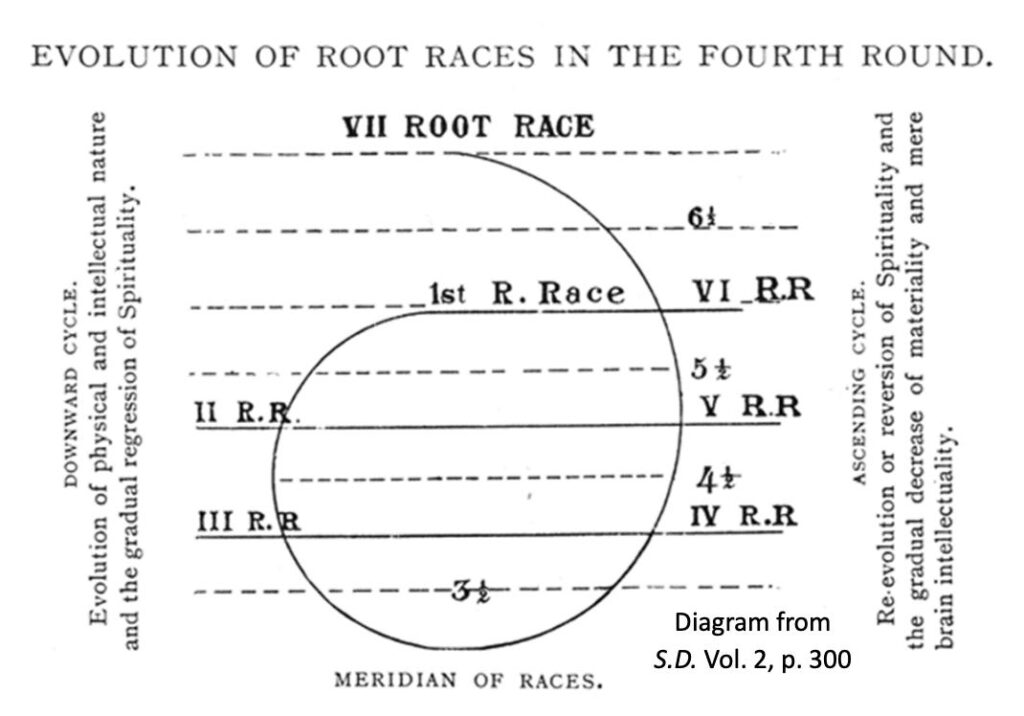
The deep template was laid by Helena Blavatsky and Theosophy in the 1870s and 1880s, with its “root races,” its lost civilizations of Atlantis and Lemuria, and its superhuman teachers from elsewhere. This is the wellspring of the modern esoteric origin-myth, and it supplied the “Book of Dzyan” that von Daniken would later cite.10
Charles Fort carried the impulse forward in The Book of the Damned in 1919, a catalog of anomalies famous for the speculation that “we are property,” the notion that Earth has been visited or owned.11 In the 1920s and 1930s H. P. Lovecraft translated the same material into fiction, populating it with the “Old Ones,” ancient extraterrestrials who seeded and shaped life on Earth, most memorably in “The Call of Cthulhu” of 1928 and At the Mountains of Madness. His influence on the mood and imagery of the genre is enormous, reaching even people who never read a word of him.12
The strands were braided together in 1960 by Jacques Bergier and Louis Pauwels in Le Matin des magiciens, translated as The Morning of the Magicians, the countercultural source-text that fused Lovecraft, Theosophy, and the UFO movement into what has been called the entire case for ancient astronauts as we now know it.13 Robert Charroux organized and popularized that material in One Hundred Thousand Years of Man’s Unknown History in 1963, and the debt was concrete enough that von Daniken’s publisher was later forced to add Charroux to the bibliography to avert a plagiarism suit.14 Running parallel to all of it was Immanuel Velikovsky, whose Worlds in Collision of 1950 reinterpreted ancient texts as catastrophist records of real cosmic events, and who remains the academy’s standard comparison point for Sitchin’s method.15
The genre became a mass phenomenon with Erich von Daniken’s Chariots of the Gods? in 1968, a global blockbuster that sold more than seven million copies and formed the direct commercial context for The 12th Planet eight years later. Von Daniken, a Swiss hotelier raised a strict Catholic, carried a fraud and embezzlement record and admitted in a 1974 Playboy interview to having contrived some of his evidence. His thesis already included the artificial genetic uplift of humanity by aliens, the very move Sitchin would go on to Mesopotamianize.16 The last marker sits in the same year as Sitchin himself: Robert K. G. Temple’s The Sirius Mystery of 1976, the Dogon-and-Sirius version of the same contact idea.17
Sitchin was born in 1920, in or near Baku, and raised in Mandatory Palestine, fluent in Hebrew and steeped in the Old Testament and Near Eastern history from boyhood. He took a degree in economics in London, worked as a journalist and then in commerce, served in the British Army in the early 1940s and afterward briefly in the Israeli army around the state’s founding in 1948 and 1949, and moved to New York in 1952, where he spent decades as a businessman before publishing a word about the Anunnaki. The 12th Planet did not arrive until 1976, with a quarter century of New York commerce sitting between the soldier and the author.18 He was, in other words, a Zionist activist and a shipping executive who taught himself cuneiform on the side.19
His activism was more than signs and slogans. He made an actual impact on the solidifying the state of Israel in the documented historical record, with the help of President Harry S. Truman.
The United States recognized Israel within hours of its founding, and yet there was nothing official. On May 14, 1948, the White House released a short statement to the press, typed on plain paper and unsigned, announcing that the government recognized the provisional government as the de facto authority of the new State of Israel. The Truman Library in Independence holds two versions of it: a draft carrying inked corrections that Truman approved, and a clean copy of the final text. Neither bears a signature. The signature arrived years later thanks to Zecharia Sitchin.
Sitchin was a committed Zionist activist, and there is no need to argue the point. He sat as a founding director of the American-Israel Chamber of Commerce and Industry and chaired the American-Israel Pavilion at the 1964 and 1965 New York World’s Fair. In that second role he noticed a gap in the record that troubled him. The only American instrument recognizing the State of Israel was the press statement of May 14, 1948, which had gone out to reporters typed on plain paper and unsigned, and a later search for an official document of recognition turned up nothing at all.20
He went to see the former president at his library in Independence and asked him to close the gap. On Truman’s instruction a photostat was made of the clean final statement, which Truman signed in Sitchin’s presence and dated January 27, 1965. Sitchin kept it. It stayed with the family for half a century before a Philadelphia dealer offered it for sale at an estimated three hundred thousand dollars.21
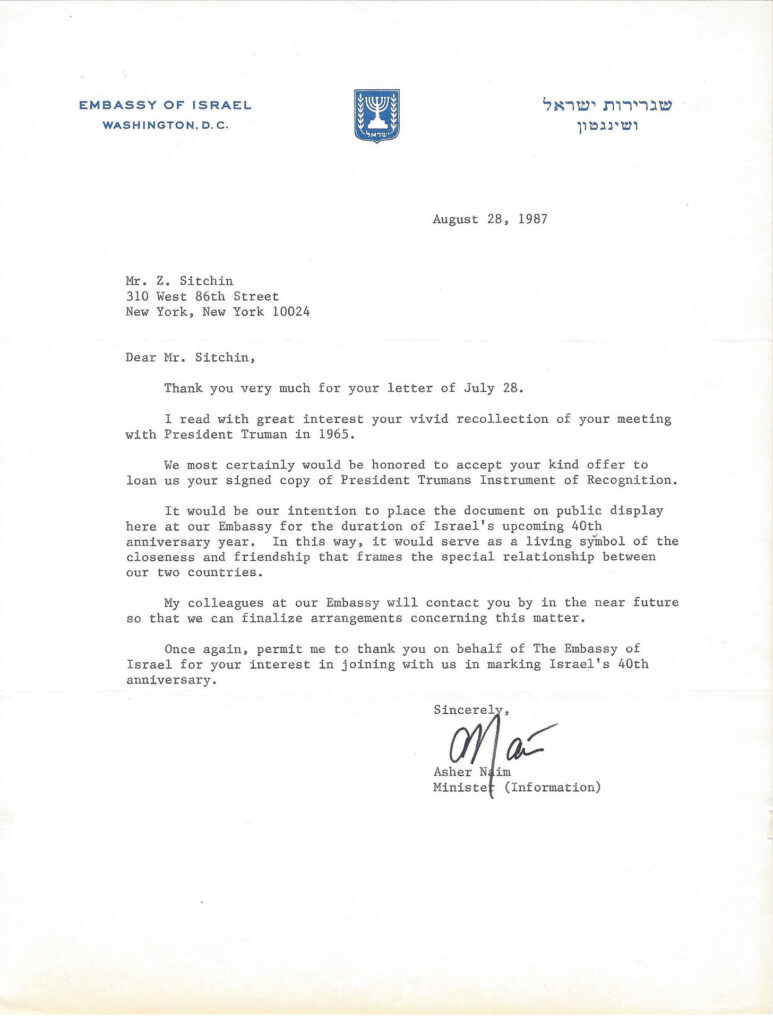
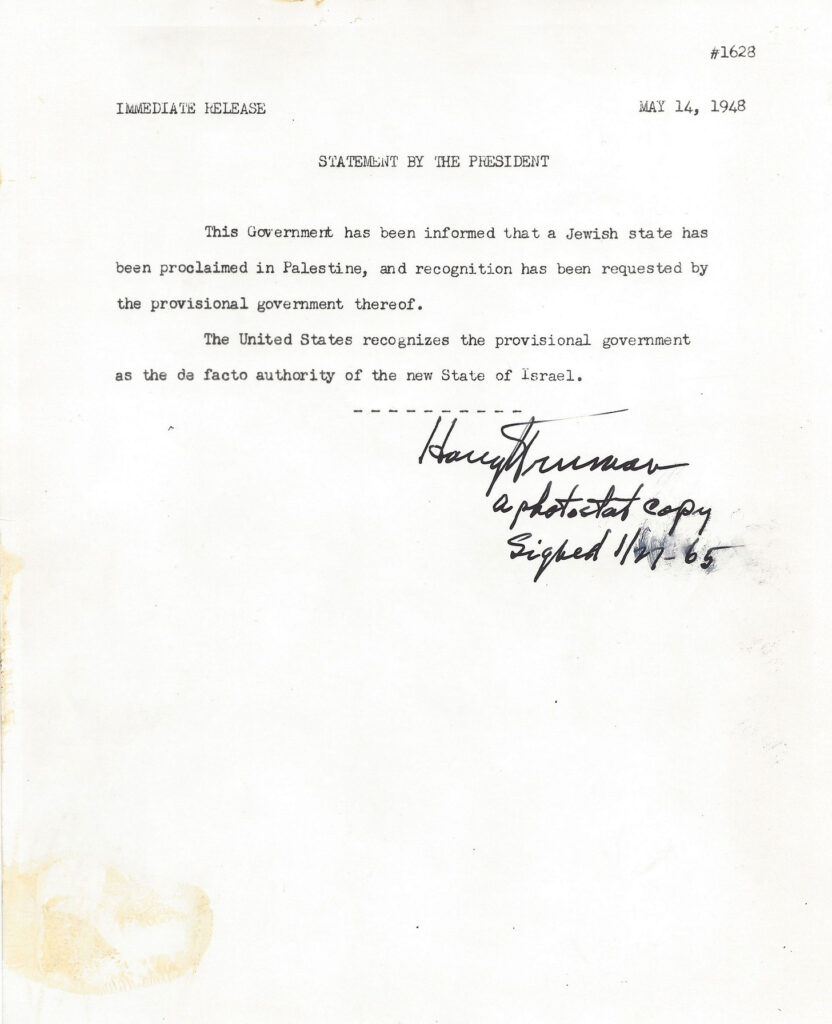
That single sheet became the object the governments of Israel and the United States would exhibit as the recognition of Israel. It hung in the American-Israel Pavilion at the World’s Fair. In 1986 it appeared at Federal Hall in New York in the “Documents of Liberty” exhibition mounted for the Statue of Liberty centennial, in the company of the Magna Carta and the first French constitution of 1791. The Israeli Embassy in Washington made it the featured document at the fortieth anniversary of Israeli independence in 1988, and the Zionist Organization of America displayed it the same year. It remained with the Sitchin family for roughly half a century and reached the market only when his descendants sold it, the sole signed version of the document by which America recognized the state.22
What Sitchin did with Truman’s signature was unapologetic Zionist activism. What he did in his books was something stranger, and it does the conspiracy no favors at all, because his actual claims are wild and wholly his own. Beginning with that 1976 book and unfolding across seven volumes, Sitchin argued that the Anunnaki were a technologically advanced alien race from a planet called Nibiru on a 3,600-year orbit, that they came to Earth roughly 450,000 years ago to mine gold, and that they engineered human beings as a slave species by splicing their own genes into a hominid. He folded the Anunnaki into the Nephilim of Genesis and read human kingship as an office set up to mediate between people and these sky-gods, his personal gloss on the divine right of kings.23
The academy rejected the whole edifice, and the rejection is technical rather than political. The Hebrew and Semitics scholar Michael Heiser showed that Sitchin’s signature translation, rendering “Anunnaki” as “those who from heaven to earth came,” simply is not what the Sumerian says; the word lands closer to “princely offspring,” earth-dwelling gods with no whisper of space travel in the name.24 Peter James pointed out that Sitchin assigned invented planetary identities to gods whose planetary associations were already locked in across hundreds of astronomical tablets, so the system collides with the very texts it claims to unlock.25
I will not litigate translations further here, nor argue the merits of paleocontact, evolution, or the host of debates that can be had. As I discussed in the earlier piece linked below, this is a level of analysis that asks us to set aside our pet theories and beliefs so we can see the deeper problem of narrative control.
That deeper problem is that Sitchin’s work can be and has been read as Israeli nationalist propaganda, and it is only honest to say it out loud. His system naturalizes every god of the ancient world into a flesh-and-blood colonist. The one exemption he ever carved is the telling one: at the close of Divine Encounters he runs Yahweh against the entire Anunnaki roster, rejects every match, and leaves the God of Israel outside the system altogether, universal and unreduced. Read as propaganda, it sends every tradition’s gods into the dirt except the one the author was raised in.26
The last thing to remember about the Anunnaki narrative is that Sitchin did not raise it from nothing, and this is the fact that finally cuts the third clock loose from the first two. He climbed onto a train already moving. The ancient-astronaut idea was a proven commercial genre by 1976, with the pedigree traced above, from Theosophy and Fort and Lovecraft through The Morning of the Magicians and Charroux to von Daniken’s millions of copies. Sitchin’s contribution was to dress that old genre in Mesopotamian costume and a coat of counterfeit philology. He supplied the cuneiform flavor. He did not supply the recipe.
The clearest sign that the genre carried itself, with or without him, sits in the calendar. Velikovsky had already trained a mass readership to treat ancient texts as coded records of real cosmic events, the very turn of mind the academy still names as the nearest cousin to Sitchin’s method. And in 1976 itself, the same season The 12th Planet reached the shelves, Robert Temple published The Sirius Mystery, a wholly separate case for ancient contact built on the star-knowledge of the Dogon rather than the clay of Sumer. Two men who shared nothing reached for the same notion in the same year, which is what it looks like when an idea is loose in the culture and not the property of any single author.27