Obscure Islamist Group Targets Turkish Military in Northwest Syria

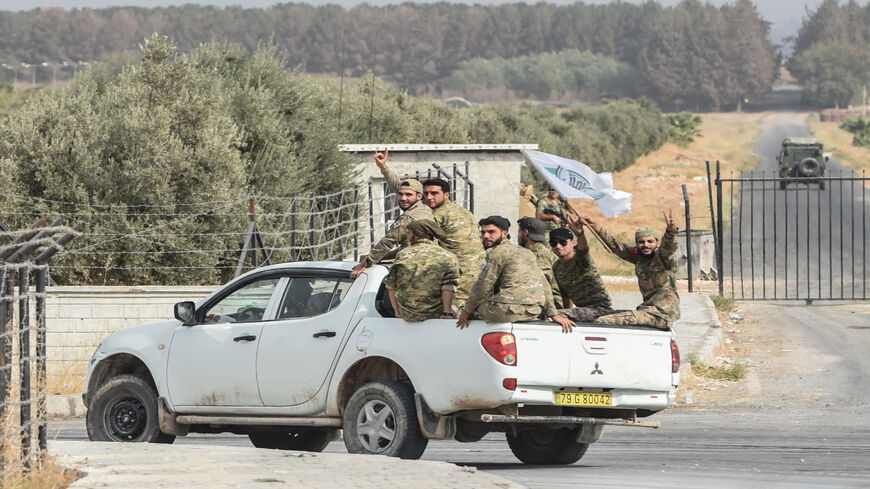
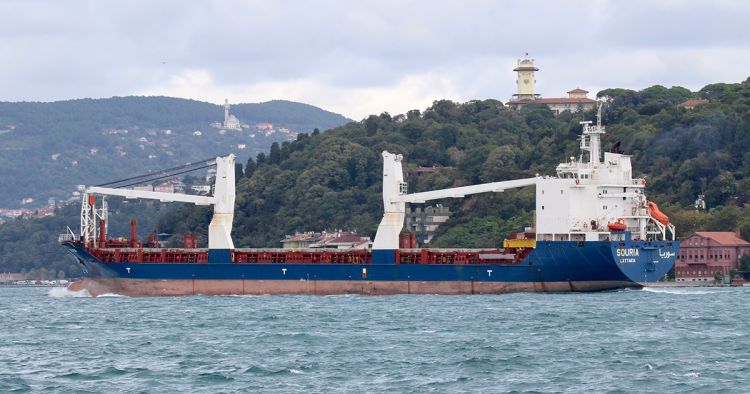
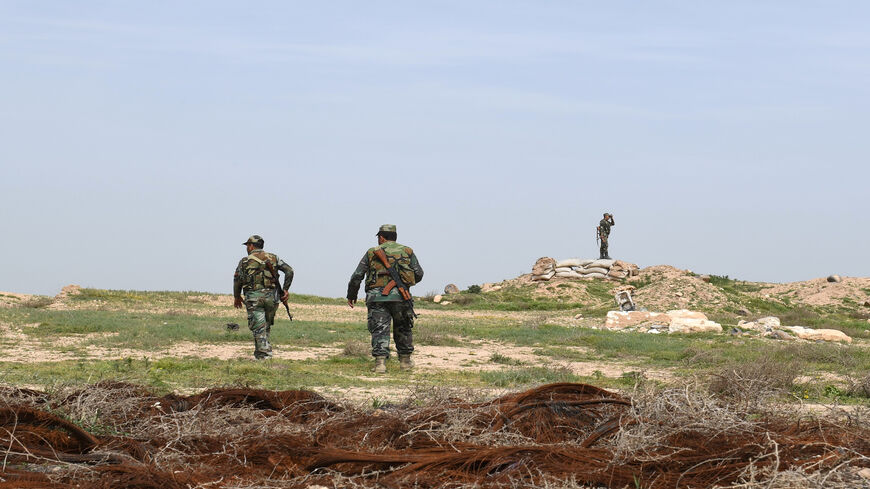
A small Islamist militant group has claimed responsibility for an attack on Turkish forces in the northwestern Syrian province of Idlib.

The Ansar Abu Bakr al-Siddiq Squadron said it was behind the attack Saturday that targeted a Turkish military outpost in the northern countryside of Idlib.

“The sniper platoon of the Abu Bakr al-Siddiq Squadron targeted one of the main bases of the ‘Turkish NATO’ military stationed near the town of Batbo, north of Idlib,” the extremist group said Sunday in a statement published on social media.

International Order in the Coming Cryptocurrency Age: The Potential to Disrupt American Primacy and Privilege?

Abstract

Although a significant body of literature in the field of International Relations has emerged over the past decade proclaiming the coming end of American primacy – whether due to American decline, the rise of China and other emerging powers, or a combination of both – this article argues that when considered objectively, the United States’ primacy and position as the arbiter of the international order is safe for the time being. Despite apparent cracks in the so called liberal international order, especially since the election of Donald Trump in late 2016, this article argues that due to the United States’ privileged financial position, the liberal international order remains largely resolute and continues to privilege the United States over the rest. However, this article argues that the growth of cryptocurrencies potentially undermines American primacy because it threatens the privileged position of the US dollar as the unchallenged global reserve currency. Independent cryptocurrencies, due to their privacy and decentralization, operate beyond the scope and power of the state, giving them the potential to be counter-hegemonic. Furthermore, potential revisionist states – especially China or Russia – may try and weaponize cryptocurrencies to challenge the United States. While this article acknowledges the volatility of independent cryptocurrencies and the inherent limitations of state-backed ones, it is argued that, regardless, the technological revolution they are precipitating is disruptive and should eventually undermine and change the international financial system. This, in turn, could hasten the decline of the United States from its current prime position and arbiter of the international order.

Introduction: Neither Liberal nor International nor Order

The liberal international order (LIO) has long been playing a central role in current analyses of and debates over U.S. foreign policy. Even though there are numbers of different attributions and characterizations, the LIO comprises first several institutions that has been created by the US after the second World War. Those institutions include security alliances in Europe (NATO) and Asia (the US bilateral hub and spoke system), Bretton Woods institutions and the United Nations (Glaser 2019). LIO comprises several normative assets such as openness, free-trade, democracy promotion, freedom, respect for human rights as well. Therefore, LIO is generally defined as an international system in which norms, rules, obligations and rights are broadly settled under institutional procedures and they are followed by the community of nations (Ikenberry 2001, p.36). Thus, what LIO is an aggregation of these rules and institutions, many of which Western (American) in their origin.

The Neocons Speak: Afghanistan As Political Real Estate – OpEd

When the tears dry, it is worth considering why there is so much upset about the fall of Kabul (or reconquest) by the Taliban and the messy withdrawal of US-led forces. A large shield is employed: women, rights of the subject, education. Remove the shield, and we are left with a simple equation of power gone wrong in the name of paternalistic warmongering.

Erdogan Says Turkey Holds Talks With The Taliban In Kabul

Turkish President Recep Tayyip Erdogan on Friday said Turkey has held its first talks with the Taliban in Kabul, adding that Ankara was still assessing Taliban’s offer to run the Afghan capital’s airport.

The Turkish leader said the talks were held at a military section of the Kabul airport where the Turkish embassy is temporarily stationed.

The Neocons Speak: Afghanistan As Political Real Estate – OpEd

When the tears dry, it is worth considering why there is so much upset about the fall of Kabul (or reconquest) by the Taliban and the messy withdrawal of US-led forces. A large shield is employed: women, rights of the subject, education. Remove the shield, and we are left with a simple equation of power gone wrong in the name of paternalistic warmongering.

Did The Taliban Win? – OpEd

On February 29, 2020, the US and the Taliban signed a peace deal following months of tense, highly publicized bilateral peace talks. The finalized agreement had four key points, firstly a staggered withdrawal of foreign troops over fourteen months. Secondly assurances by the Taliban that Afghanistan will not be used as a base to launch terror attacks against the US nor provide haven to other extremist groups such as al-Qaeda and the IS. Thirdly, the beginning of an Intra-Afghan Dialogue and lastly a cessation of violence. Surprisingly, since the very beginnings the negotiations had barred the Afghan government and nowhere near had it seemed happening that Taliban are going for peace with the Afghan government. Additionally, the Taliban’s long-standing refusal to recognize Kabul as the legitimate government of Afghanistan also did not bode well for successful implementation of a substantively meaningful Intra-Afghan Dialogue.

Erdogan Says Turkey Holds Talks With The Taliban In Kabul

Turkish President Recep Tayyip Erdogan on Friday said Turkey has held its first talks with the Taliban in Kabul, adding that Ankara was still assessing Taliban’s offer to run the Afghan capital’s airport.

The Turkish leader said the talks were held at a military section of the Kabul airport where the Turkish embassy is temporarily stationed.

Taliban’s Attitude To ISIS Will Be Critical For US Decisions On Afghanistan – Analysis

The airport blasts could re-open the military option if the Taliban do not crackdown on the ISIS

The ISIS-engineered blasts near the Kabul airport on Thursday, in which 13 US soldiers were killed along with dozens of Afghan civilians, have put the US at the crossroads. The blasts have put a question mark on US military withdrawal by August 31. They could also re-open the military option if the Taliban is unable or unwilling to crackdown on the ISIS as a priority. At any rate, peace in not in the offing in Afghanistan.

Afghanistan, Again, Becomes a Cradle for Jihadism—and Al Qaeda

In March, I travelled to Afghanistan and the Middle East with General Kenneth (Frank) McKenzie, Jr., the Alabama-born marine who heads Central Command. He has been overseeing the frantic evacuation out of Kabul. During one of several interviews aboard his plane, I asked him, “Do you really think, given the intermarriage, the interweaving of the Taliban and Al Qaeda, that the Taliban is really ever going to be able or willing to restrain Al Qaeda from doing anything against us?” By then, the Taliban held roughly half of Afghanistan, a country about the size of Texas. McKenzie was chillingly candid. “I think it will be very hard for the Taliban to act against Al Qaeda, to actually limit their ability to attack outside the country,” he replied. “It’s possible, but I think it would be difficult.”