With Assad in Moscow and armed rebels taking control of Latakia governorate, what will become of Russia’s military bases in Syria?

Following the rapid overthrow of Bashar al-Assad’s regime, Moscow is now facing the prospect of losing its naval and air bases in Syria. Russia’s two key bases are located in the Latakia governorate, which is already under the control of rebel groups. Syrian opposition forces have yet to take an official stance on their relationship with the Russian military contingent currently stationed in Syria. And Kremlin spokesman Dmitry Peskov has deemed it “too early” to talk about preserving the Russian bases at Khmeimim and Tartus. “This is a subject for discussion with those who will lead Syria,” he said on Monday. By all appearances, however, this “discussion” is already underway. Citing diplomats involved in talks between Russia, Iran, Turkey, and “leading Arab nations,” the Wall Street Journal reports that Moscow has “likely received commitments” that it could maintain its bases in Syria as “part of a transition.” But to what extent the Syrian rebels will honor those commitments remains unknown. Meduza breaks down what facilities Russia has in Syria and why their future is so uncertain.

Who is Abu Mohammed al-Golani, the leader of the insurgency that toppled Syria’s Assad?

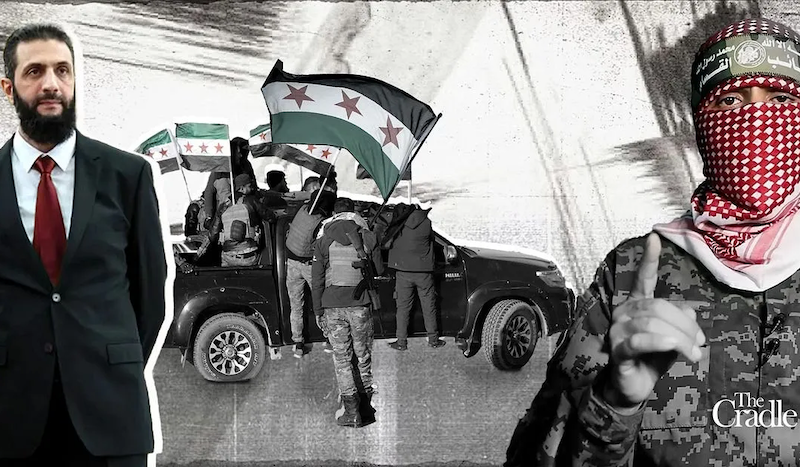
Abu Mohammed al-Golani, the militant leader whose stunning insurgency toppled Syria’s President Bashar Assad, has spent years working to remake his public image, renouncing longtime ties to al-Qaida and depicting himself as a champion of pluralism and tolerance. As he entered Damascus behind his victorious fighters Sunday, he even dropped his nom de guerre and referred to himself with his real name, Ahmad al-Sharaa.

Syria’s Civil War: The Descent Into Horror

The civil uprising against the longtime rule of the Assads deteriorated into protracted civil war. Here’s a look at the elements that have deepened Syria’s tragedy.

Twelve years after protesters in Syria first demonstrated against the four-decade rule of the Assad family, hundreds of thousands of Syrians have been killed and nearly thirteen million people—more than half the country’s prewar population—have been displaced. Today, the country is fractured by actors with apparently irreconcilable interests: in areas beyond the regime’s control, extremists promoting a Sunni Muslim theocracy have eclipsed opposition forces fighting for a democratic and pluralistic Syria, while regional powers have backed various local forces to advance their geopolitical interests on Syria’s battlefields.

US patience with Turkey tested again over Syria, attacks on Kurdish partners

The Pentagon chief, the top US military general, and the top US diplomat all spoke to their Turkish counterparts this week

Shortly after the fall of the Assad regime in Syria, the US military conducted one of its largest attacks on ISIS in years. Part of the reason for the timing and ability to strike over 75 ISIS targets with B-52 bombers, F-15s and A-10s was because Russia’s military – invited to Syria to prop up the now-deposed Bashar al-Assad – was sent packing. Israel and Turkey, both with strategic interests in Syria, also took swift military action.

Syrie : Gagnants et perdants ou les deux

Il est désormais très probable que le pays se désagrège. Les acteurs extérieurs et intérieurs tenteront de s’emparer et/ou de contrôler autant de parties du cadavre qu’ils le pourront.

Il s’ensuivra des années de chaos et de conflits.

The Geostrategic Importance Of Syria: Geography, Power, And Global Influence – Analysis

Syria has long been regarded as one of the most geostrategically significant nations in the Middle East. Its importance extends far beyond its borders, influencing regional power dynamics, global geopolitics, and the strategies of major international players. Understanding Syria’s prominence requires a deep dive into its geographic location, historical role as a crossroads of civilizations, and its place in contemporary strategic theories.

Why Arabs and Muslims ‘Betrayed’ Hamas

As far as Hamas leaders are concerned, the involvement of Iran’s other proxies in the Jihad against Israel has been insufficient. Hamas leaders were hoping to see Arab and Muslim armies march on Israel and fulfill their dream of replacing it with a jihadist terror state.

G7 leaders aranging virtual summit on Dec 13 over Russia, Middle East

The Group of Seven nations are arranging to hold a virtual summit on Dec 13 to discuss Russia’s war in Ukraine and the situation in the Middle East, Japanese government and diplomatic sources said.

The meeting, likely to be attended by Japanese Prime Minister Shigeru Ishiba, comes ahead of the January return to the White House of U.S. President-elect Donald Trump, who has cast doubt on the effectiveness of multilateral frameworks like the G7.