What does the Deraa surrender mean for Iran and Russia in Syria?

BEHIND THE LINES: In the southwest, the outside powers of relevance are Iran and Russia. The arrangement in place from July 2018 until now was the product of an uneasy standoff between them.

In a new ceasefire agreement that may bring an end to a 75-day Assad-regime siege on the Syrian town of Deraa al-Balad, Syrian rebels have, with few alternatives, made far-reaching concessions to the Syrian government. The siege and the subsequent agreement bring an end to an anomalous situation that had pertained in Deraa al-Balad since the area’s reconquest by regime, Russian and Iranian forces in July 2018.

Since that time, Russia had underwritten a situation in which former rebels were able to hold light weapons and maintain security inside the town. The regime, meanwhile, did not attempt to establish checkpoints or impose its rule in Deraa al-Balad.

The regime offensive under way since June was intended to terminate this situation and reimpose direct rule, as part of President Bashar Assad’s effort to reconquer all parts of Syria currently outside of government control. In Deraa al-Balad, this objective now looks well on the way to being achieved. The siege has been brutal, in the usual Assad manner. Food and medical supplies have been kept out of the area, in which around 50,000 people are resident. Electricity supplies, patchy even before the siege, were cut off.

The shifting balance of power in this southwestern Syrian province matters to Israel, because Deraa province borders the Golan Heights. It is the location of an Iranian strategic project to establish and deploy forces under its control in the area, with the intention that these may be used in a future clash between Jerusalem and Tehran, or Iran’s local proxy, Hezbollah.

Iran controls the border crossing at Abu Kamal, further east, linking Syria to Iraq. The Iranians have freedom of movement across the south of the country. They have built a number of facilities close to the border crossing, including the large Imam Ali base.

From Israel’s point of view, the main obstacle to the consolidation and entrenchment of this Iranian project, other than Israel’s own military actions, has been the Russian presence in the area. The Russians do not support the Iranian project to build a capacity for aggression against Israel in southwestern Syria. Their own project of limited cooperation with former rebels appeared indeed to be pushing in the other direction.

The apparent Russian shift toward acquiescence to Iranian desires reflected in the Deraa agreement will thus not be welcomed in Jerusalem. Going together with increasing signs of Russian impatience with Israel’s air campaign against Iranian targets in Syria, it is an indication that any Israeli hopes that Russia might play a role in limiting Iran’s influence in Syria may have to be revised.

At present, around 30% of Syria remains outside regime control. The main areas outside Damascus’s remit in Syria are currently invulnerable to incursions because they are guaranteed by external powers. These are the Kurdish-dominated Autonomous Authority of North and East Syria (AANES) – whose continued existence is currently underwritten by the presence of US forces on its soil, and the Turkish-occupied area in Syria’s northwest.

In the southwest, the outside powers of relevance are Iran and Russia. The arrangement in place from July 2018 until now was the product of an uneasy standoff between them.

Moscow chose to align itself with former rebel commander Ahmed Oda and his comrades. These were re-mustered as the 8th Brigade of the 5th Corps of the Syrian Army, a Russian-created structure. The 8th Brigade was for a time directly under Russian command. Russian officers played a role in it at various levels.

The recent regime offensive constituted a direct Iranian attempt to challenge this Russian project head on. The offensive was spearheaded by the 4th Division. This formation is often described as one of the Assad regime’s “Praetorian” units. It is majority Alawite in composition and is staffed by professional soldiers, rather than conscripts. Commanded de facto by Maher Assad, the president’s brother, the 4th Division today works closely with the Islamic Revolutionary Guard Corps and is a key component of Iran’s efforts to blur the distinction between “regime” forces and Iranian proxies. Air Force Intelligence and the Republican Guard are additional elements working closely with Tehran.
The 4th Division’s offensive against Deraa al-Balad, beginning in late June, progressed slowly. Indeed, it is testimony to the very limited capacities of this supposedly “elite” division that it has taken it more than two months to pacify an area controlled by (albeit experienced) fighters armed only with light weapons.

The key aspect in Deraa al-Balad’s surrender was the Russian decision to abandon ambiguity and make clear that it would support further regime action against the area if the former rebel fighters did not agree to regime demands.
As of now, the former rebels have agreed to terms in the Russian-mediated negotiations, which represent their complete surrender to the demands of the regime. The agreement, according to reporting from the Syrian Observatory for Human Rights, will see the establishment of 10 security points and checkpoints inside Deraa al-Balad, under Russian military police supervision, where the Russian flag and the Syrian regime flag will be raised. In addition, individuals wanted for mandatory military service will need to “regularize” their situation with the regime. All individuals wishing not to conform to these terms will have to depart for the Turkish and Islamist-rebel controlled area in the northwest.
Abdullah Al-Jabbassini, a Syrian researcher who monitors the southwest, noted in addition that the agreement will include the surrender of light weapons by the fighters in Deraa al-Balad. Jabbassini also recorded that according to the agreement, Russian military police will be involved in direct contact with the community, including checking identification cards at checkpoints, and that local notables will accompany the security forces.

These two latter elements are clearly intended to soften the blow for the former rebels, and to reduce as far as possible the friction that would result from direct contact between them and Assad’s security forces. But what has taken place is a significant achievement for the Iran-aligned element within the official Syrian security forces. It also represents an abandonment by the Russians of the stance they sought to maintain since July 2018 – namely, the effort to maintain the status quo established by the reconciliation agreement of that time.

Why has this happened now? Tensions in this area are not new and have smoldered ever since the regime’s return in 2018. But the latest events reflect growing Iranian confidence, which itself appears to derive from a fading Russian commitment to the status quo. The latter element is the crucial point, creating the space for change, which the most Iran-aligned element of the regime has now exploited.

The reason for this apparent shift in Russia’s position is less clear, but the direction appears unmistakable. It may well be that the sense of an American weakening in the region also contributes to Iranian boldness, and Russian disregard of the concerns of local US allies. The result will be the further advance of the Iranian interest in southwestern Syria. This interest is woven into the decrepit structures of the Assad regime. It represents ambitions, strategy and priorities determined in Tehran, not in Damascus. And it is currently extending all the way to the border with Israel.

Syrian jihadist group works to attract tribes in Idlib

Hayat Tahrir al-Sham has been paying more attention to Arab tribes and clans to benefit from them in expanding its influence in social circles and in recruitment processes.

Hayat Tahrir al-Sham (HTS), which controls Syria’s northwestern province of Idlib, seeks to attract Arab tribes and clans in its areas of control and is working to build friendly ties with them.

Erdogan heralds massive military complex to coordinate military, security agencies

A planned joint complex to house Turkey’s top military bodies is touted as a move to enhance the army’s coordination and interoperability, but political and economic motivations also lurk behind the project.

Turkey has launched the construction of the massive military complex, the Crescent and Star, named after the symbols of its national flag, to bring the Defense Ministry, the chief of General Staff, and the headquarters of the land, air and navy forces under a single roof, with the stated aim of enhancing coordination between military institutions and their operational effectiveness.

Twenty Years After 9/11: The Fight for Supremacy in Northwest Syria and the Implications for Global Jihad

Abstract: Over the past decade, nowhere in the world has exerted as profound and transformative an impact on the global jihadi landscape as Syria. For al-Qaida, Syria had once been the source of its greatest hope, where dozens of its most experienced leading operatives were dispatched to enhance prospects of building a jihadi state. But in recent years, al-Qaida’s Syrian affiliate distanced itself and then broke away altogether, establishing a new locally oriented movement: Hayat Tahrir al-Sham (HTS). In pursuit of local dominance and ultimately survival, HTS has broken one jihadi taboo after another, including turning against al-Qa`ida and the Islamic State and dealing crippling defeats to both in Syria’s northwest. The implications and consequences of these developments are manifold. On the one hand, not only does HTS no longer represent the international terrorism threat that its predecessor once had, it has also almost entirely squashed the global threat posed by its more extreme rivals and played a role in maintaining the longest ceasefire in a decade of war in Syria. On the other hand, however, HTS’ de facto rule of northwestern Syria threatens to ‘mainstream’ a local jihadi model that looks set to experience a substantial boost by the Taliban’s surge to power in Afghanistan. Should conditions dramatically change, it could also come to represent a strategically significant terrorist safe haven once again—on Europe’s doorstep.

Syrian tribe forms Shura Council in Idlib with blessing from jihadist group

Hayat Tahrir al-Sham in Idlib demanded all the tribes in the areas it controls to coordinate with it to form separate Shura councils, with the aim of controlling the decisions taken by these tribes and expanding its popular base.

During its inauguration conference Aug. 28, the Arab Bakara tribe announced the establishment of a Shura Council in Syria’s northwestern city of Idlib, which is under the control of Hayat Tahrir al-Sham (HTS).

Humanitarian aid entering via conflict lines stirs controversy among Syrian opposition

The Syrian opposition fears the cross-border humanitarian aid mechanism will be replaced by cross-line aid deliveries amid accusations leveled at Hayat Tahrir al-Sham of trying to normalize ties with the Syrian regime and its allies.

The entry of humanitarian aid into Idlib via the Miznaz-Maarat al-Naasan crossing, which marks the frontier between territories held by the Syrian regime and Hayat Tahrir al-Sham (HTS) areas in the northwest of Syria, sparked widespread controversy among the opposition’s popular quarters. The move triggered fear of the cross-border humanitarian aid mechanism being replaced by cross-line aid deliveries. The opposition even accused HTS of betrayal and complicity with the regime and its allies for harming the revolution.

SDF transfers extremist IS women to Roj camp in Hasakah

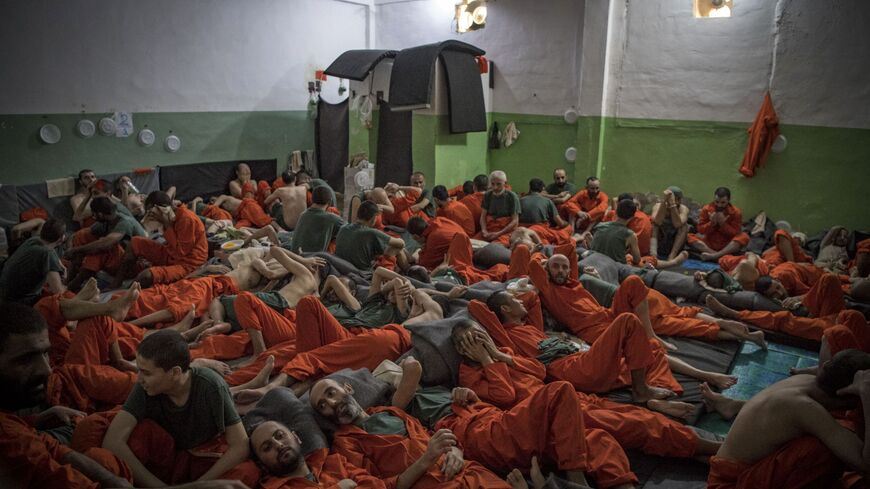
The Syrian Demographic Forces moved 300 families of extremist women from al-Hol camp to Roj camp in Hasakah countryside, to confine them to one camp and control security in al-Hol camp.

The Syrian Democratic Forces (SDF) began transferring 300 families of extremist women and wives of Islamic State (IS) members, Syria 24 reported.

Will Russia be able to maintain the status quo in Syria’s Daraa despite Assad and Iran?

The Russian-brokered cease-fire agreement is evidence of Moscow’s complex positioning in southwest Syria.

On the evening of Tuesday, Aug. 31, a cease-fire agreement was reached between the so-called “reconciled rebels” in the rebel-held city of Daraa al-Balad and the government of President Bashar al-Assad. The agreement provides for government forces to lift the monthslong siege on the city, which in recent days has been attacked and shelled by Assad’s forces in an attempt to take control of it.

The terms of the agreement allow the Russian military police and a security committee linked to the Syrian regime to travel to the area to consolidate the cease-fire.

At the same time, the new demands of the Assad regime, put forward on Friday, Sept. 3, which may have been put forward under pressure from Iran, may again aggravate the situation.

Representatives of the regime demanded the complete surrender of weapons, the establishment of security checkpoints in residential areas and a mass search of houses. The opposition has rejected these conditions and insists on the evacuation of the settlement to Turkey or Jordan.

Nevertheless, it can be assumed that Russia will continue its efforts to preserve the status quo, since for Moscow this is also largely a matter of prestige.

Following a military operation in the country’s southwest against local opposition groups in the summer of 2018, Russia agreed to grant these rebels, mainly from the Southern Front, a special status. Agreements that the armed opposition units could remain and would not be completely disarmed were reached — even before the start of the 2018 offensive — during consultations with the participation of Russian, American, Jordanian and Israeli diplomats in Amman. The presence of opposition forces in this region, albeit in a reduced format, created a kind of buffer zone along the border with Israel and Jordan. The decisive word in the management of this region began to belong not to Damascus or its Iranian allies, but to Russia, which did not allow the deployment of Iranian proxy forces along the borders with Israel.

Russia was able to implement this decision and defend it before Damascus, despite serious opposition from the Assad regime. Subsequently, the Syrian authorities have repeatedly tried to regain control of these areas in order to then transfer them to pro-Iranian formations, but each time this was prevented by Russia. Therefore, over the past three years the position of these rebel-held enclaves has practically remained unchanged.

According to the latest agreement, not only the Syrian flag but also the Russian flag was raised over the city. Also in Daraa al-Balad, while regime security offices reopened and other government agencies will resume, Russian police will also be present and monitor their activities.

In addition, the forces of the 8th brigade of the 5th assault corps, formed by Russia from among the reconciled rebels, entered this enclave along with the Russian military. This is of particular importance, since this brigade, which has the unofficial name Liwa Usud al-Harb, is only formally linked to the Syrian armed forces. Representatives of the Damascus government have called it a “bandit formation” and expressed dissatisfaction with the fact that Russia was creating such units from Syrian opposition fighters. The brigade repeatedly came into conflict with government forces, preventing them from entering the areas of its control and not allowing repression and cleansing there. Also, fighters of the 8th brigade participated in attacks in May of this year on the offices of the security services, where they freed detainees.

At the same time, although Moscow managed to impose its own agenda in the end, the current agreements with Damascus were not easy to come by.

On the one hand, Assad put pressure on the Russian command about the need to continue military operations in Idlib. However, for the Russian military the beginning of new military campaigns — whether in the Syrian northwest or northeast — is extremely risky due to the threat of a direct military clash with Turkey or the United States, whose armed forces are present in these regions.

Then Damascus tried to transfer operations to the south of Syria in order to demonstrate that it does not intend to interrupt the “liberation of Syria to the last inch” campaign that was proclaimed by Assad. But here, too, the Syrian regime could not find Russian support. The Russian military did not help government forces to launch an offensive against Daraa al-Balad. On the contrary, each time Moscow tried to force the parties to sit down at the negotiating table.

At the same time, Assad also had personal motives to retake control of these enclaves in the south of the country since their residents refused to participate in his re-election in May 2021 or to open polling stations. This, of course, greatly complicated Moscow’s argument in support of preserving the special status for these areas.

Yet while settlements controlled by the 8th brigade (where elections were also not held) were under the direct protection of Russia, for others whose status was not fully settled — including Daraa al-Balad — Russian security guarantees in full were not distributed. These other areas were targeted for attacks by Bashar’s brother and the commander of the 4th division of the Syrian army, Maher al-Assad, in June of this year.

Moscow’s intransigence to Damascus was also affected by the need for the Kremlin to demonstrate its ability to be faithful to its obligations to other countries in the region — namely Jordan and Israel. Therefore, for Russia it was also a matter of prestige.

In this context, an important role was played by the visit of Jordanian King Abdullah II to Moscow on Aug. 23 and his meeting with President Vladimir Putin, where one of the main topics of discussion was the situation in Daraa al-Balad. Some sources claim that following the summit talks, Russia and Jordan agreed on the need to resolve the conflict between the southerners and government forces trying to pacify them, primarily by resolving the humanitarian crisis. According to this information, Amman is ready to provide appropriate economic assistance to the areas that formally returned to the control of Damascus in 2018 but actually retained their autonomy.

Moreover, Moscow would not want to risk its relations with Israel. Russia faces uncertainty about how to build interaction with the new Israeli government. In the event that the regions of southern Syria are transferred under the full control of Assad, pro-Iranian formations will immediately appear, which in fact are the real force behind the operation in Daraa. This will lead to a new aggravation in the region and attacks by the IDF on the positions of pro-Iranian forces near their borders. Russia, of course, would not like to open a new page in relations with Israel on this note.

How will Taliban’s return affect jihadi movements in Turkey, Syria?

Salafi-jihadi groups in Turkey and neighboring Syria may look for inspiration from the Taliban’s takeover of Afghanistan, but their prospects appear rather limited at present.

The Taliban’s takeover of Afghanistan has raised complex questions over the future of Salafi-jihadi movements, including in Turkey and neighboring Syria where the threat from such groups has been largely contained. Whether the risks heighten down the road will depend largely on how the Taliban shape their relationship with jihadi groups in Afghanistan.