
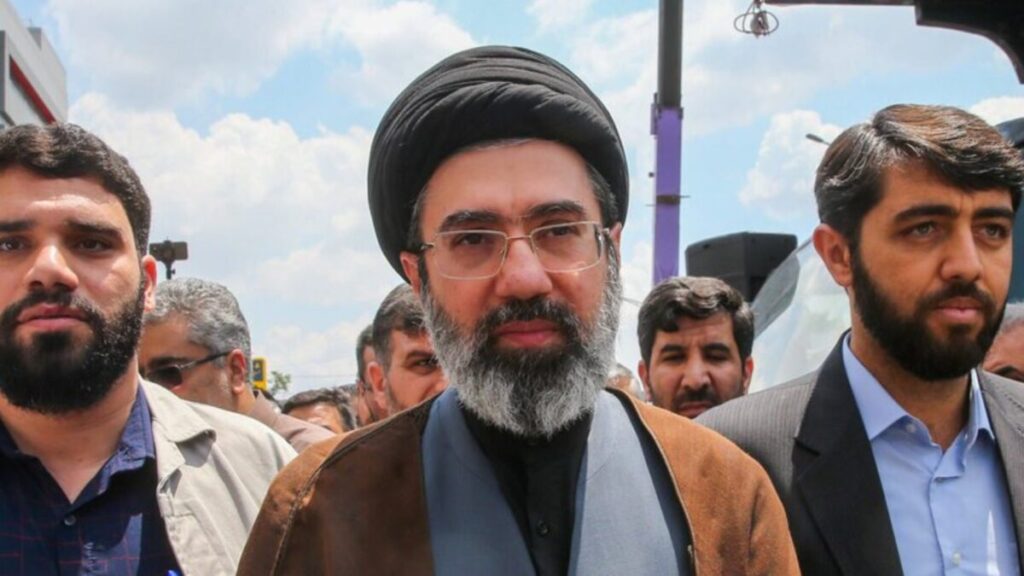
Mojtaba Khamenei, the second son of Iran’s late supreme leader Ayatollah Ali Khamenei, has been selected as the country’s new supreme leader following his father’s death in attacks on Tehran, Iranian state media reported.
Ali Khamenei was killed on the first day of strikes launched by the United States and Israel against Iran on Feb. 28. Iranian media reported that Mojtaba Khamenei’s mother, wife and one of his sisters were also killed in the attack, though Mojtaba himself was not present at the compound.
Iran’s Assembly of Experts, the 88-member clerical body responsible for appointing the country’s supreme leader, confirmed that Mojtaba Khamenei had been selected to succeed his father.
In a statement carried by state media Sunday, the assembly said he was chosen by a “decisive vote” and called on Iranians to maintain unity and support the new leadership.
Mojtaba Khamenei, 56, has never held elected office but has long been considered an influential figure within Iran’s political and religious establishment. For years he has been closely associated with his father’s inner circle and is believed to have strong ties with the paramilitary Islamic Revolutionary Guard Corps.
Speculation about Mojtaba Khamenei succeeding his father had circulated for years, particularly as Ali Khamenei’s health and age became a subject of public discussion.
Ali Khamenei served as Iran’s president from 1981 to 1989 before becoming supreme leader in 1989, a position he held for more than three decades.
Debate over succession
The announcement of Mojtaba Khamenei’s appointment followed several days of speculation in Iran about who would succeed the late leader.
Iranian media reported that the Assembly of Experts held discussions in secure locations to determine the country’s next leader, though details about the selection process remain limited.
Some conservative politicians voiced support for Mojtaba Khamenei as a successor, while others criticized what they described as a rushed decision during wartime.
Critics inside Iran have also raised concerns that his appointment could resemble a dynastic transfer of power, drawing comparisons with the hereditary rule of the Pahlavi monarchy that ended with the 1979 Islamic Revolution.
Early life and background
Mojtaba Khamenei was born on Sept. 8, 1969, in the northeastern city of Mashhad. He is the second of six children of Ali Khamenei.
He attended the Alavi religious school in Tehran before pursuing clerical studies in the city of Qom, one of the main centers of Shiite scholarship.
Iranian media reports say he took part in several short deployments during the Iran-Iraq war while still a teenager.
He later continued his religious education in Qom and is reported to teach advanced religious courses in Islamic jurisprudence, the highest level of study in Shiite seminaries.
Despite his position within Iran’s clerical establishment, Mojtaba Khamenei has largely maintained a low public profile. He rarely appears in public speeches or media interviews, and relatively little is known about his personal views on domestic or foreign policy.
Political influence
Mojtaba Khamenei’s name first emerged prominently in Iranian politics during the 2005 presidential election, when some political figures accused him of backing certain candidates.
His name also resurfaced during the disputed 2009 presidential election, when protesters alleged he had played a role in the political response to the demonstrations that followed the vote.
Over the years, some Iranian politicians and analysts have suggested he could become a future leader because of his close connections to Iran’s political, religious and security institutions.
Others, however, have warned that selecting the son of the previous leader could raise questions about hereditary rule within the Islamic Republic.
Leadership during wartime
Mojtaba Khamenei’s selection comes as Iran faces ongoing military confrontation and heightened tensions in the region.
Under Iran’s constitution, the Assembly of Experts is responsible for selecting the country’s supreme leader and can appoint an interim leadership council if the position becomes vacant.
The assembly’s decision to appoint Mojtaba Khamenei ends days of uncertainty following the death of his father and places him at the top of Iran’s political and religious hierarchy during a period of war and regional instability.
US President Donald Trump had earlier dismissed reports that Mojtaba Khamenei might succeed his father, saying anyone who became Iran’s next leader would face severe pressure.
Mojtaba Khamenei has not publicly commented on his appointment or outlined his policies toward the United States, Israel or other regional issues.