
Key Takeaway:
Turkey. Turkey has recently advanced economic and security ties with Niger and Somalia, viewing both countries as its African anchor states through which it can further its strategic interests in Africa. These partnerships aim to address several domestic concerns, such as patronage and energy security, and bolster Turkey’s international standing vis-à-vis global competitors.
Assessment:
Turkey
Author: Liam Karr and Michael DeAngelo with Anahita Asudani
Turkey has expanded its economic and security ties with Somalia since late 2025, building on agreements from recent years. Turkey has recently operationalized maritime resource and security agreements with Somalia. The two counties signed a deal on March 29 to regulate fishing within Somalia’s Exclusive Economic Zone (EEZ) through SOMTURK—a joint Somali-Turkish company established in a December 2025 agreement that a Turkish military-linked entity manages.[1] A Turkish deepwater oil-drilling vessel additionally arrived at Somalia’s EEZ in late March to begin initial drilling on offshore Somali wells.[2] Somali President Hassan Sheikh Mohamud and Turkey’s energy and natural resources minister held a welcoming ceremony for the vessel in Mogadishu on April 10.[3] A Turkish exploration vessel discovered up 20 billion barrels of commercially viable oil during exploration activities in 2025, and Turkey deployed three warships to Somali waters in February 2026 in anticipation of the commencement of drilling.[4] These actions build on February 2024 agreements in which Turkey assumed responsibility for managing and protecting Somalia’s EEZ while it helped rebuild the defunct Somali navy in exchange for 30 percent of EEZ revenues.[5]
Turkey is bolstering its long-term military presence in Somalia through the deployment of advanced weaponry and exploration of new aerospace and naval bases. Turkey deployed F-16 fighter jets to Somalia for the first time in January 2026, with the aircraft performing a flyover during a Somali military commemoration on April 12.[6] Turkey also deployed tanks to Somalia in February to reportedly secure a planned Turkish aerospace base, which is intended for missile and satellite launches.[7] Turkey began construction on the base, which the Somali outlet Garowe Online reported is located just northeast of Mogadishu, with Somali approval in December.[8] Somalia and Turkey have reportedly come close to a separate deal for a Turkish naval base in North East state, with the United Kingdom-based, pro-Turkish outlet Middle East Eye reporting that the base may have been a discussion point during a January meeting between Mohamud and Turkish President Recep Tayyip Erdoğan, although CTP has not tracked further discussions in 2026.[9] Turkey supported the Federal Government of Somalia’s (FGS’s) inauguration of North East state in January despite a lack of consensus from Somali federal member states and the de facto independent Somaliland region disputing the claim.[10]
Figure 1. Turkey Plans New Military Bases in Somalia
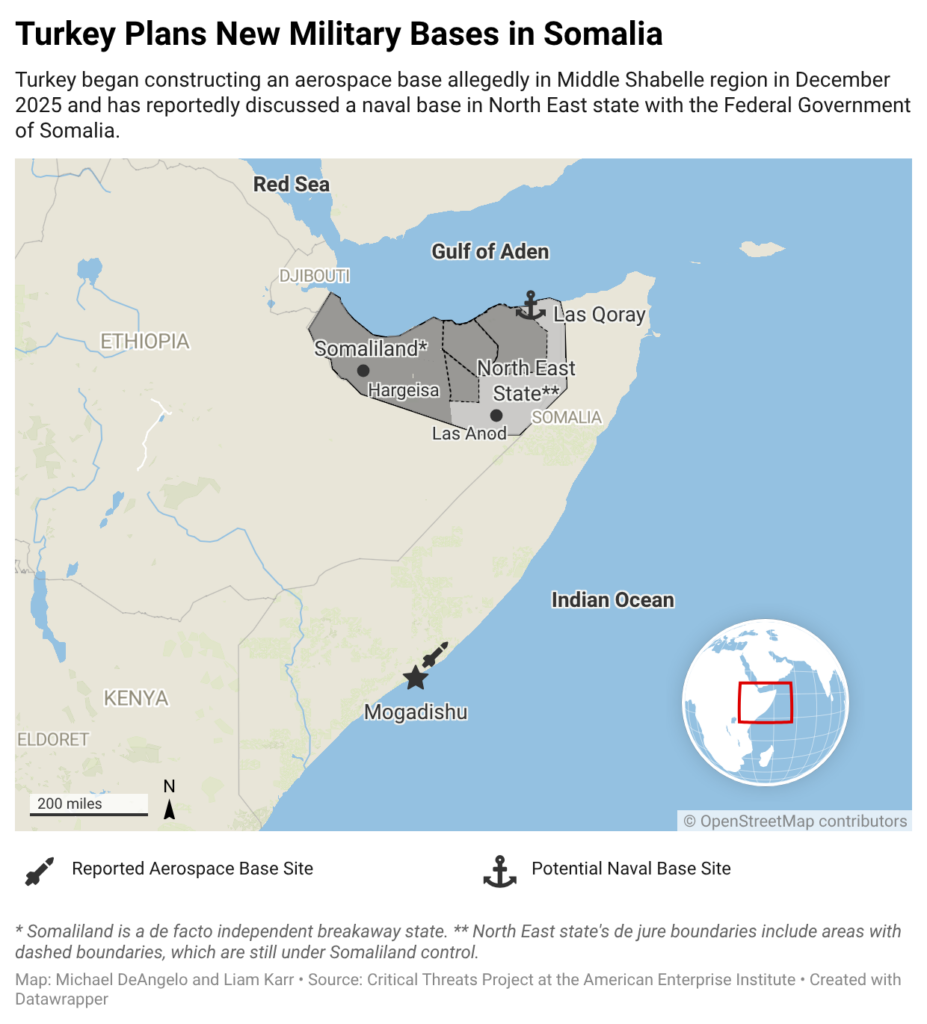
Turkey’s deployments and basing plans expand its already growing military footprint in Somalia. Turkey has supplied and trained the Somali military for about a decade.[11] Turkey established the TURKSOM military base in Mogadishu in 2017 as Turkey’s first overseas military base.[12] TURKSOM has served as the hub of Turkish efforts to train the Somali military, with Turkey having trained at least 16,000 Somali troops, including specialized Gorgor commando units.[13] Turkey increased its own troop presence in Somalia from roughly 400 to 800 troops in early 2025, and the Turkish parliament has approved the deployment of up to 2,500 troops.[14] Turkish forces play a key role in protecting Turkish investments—including the aerospace base site near Mogadishu—and have conducted drone strikes against al Shabaab since at least late 2022.[15] Somalia’s defense minister stated in February 2026 that Turkish military support to Somalia had reached its highest levels ever, and Mohamud highlighted the importance of Turkish military support at the commemoration of the Somali military on April 12.[16]
These moves reinforce Somalia as Turkey’s anchor state in the Horn of Africa as Turkey competes for favorable positioning near the Red Sea and access to emerging economic markets. Somalia has been Turkey’s regional anchor state since 2011. Turkey transitioned from being an important provider of humanitarian aid to a key backer of the Somali military and the leading investor in Somali infrastructure projects over the past 15 years.[17] Turkey developed and now manages the Mogadishu airport and seaport, which the World Bank ranked as fourth-highest-performing seaport in Africa in 2024.[18] Somalia provides opportunities for Turkey to exert influence over Africa-Middle East supply chains and key waterways, such as the Bab el Mandeb Strait.
Turkey has taken advantage of efforts to recognize Somaliland to further its close relationship with the FGS at the expense of the United Arab Emirates (UAE) since 2024. Ethiopia and Somaliland signed a memorandum of understanding in January 2024 in which Ethiopia would gain naval access near Berbera—Somaliland’s main port—in exchange for recognizing Somaliland as an independent state.[19] The UAE reportedly backed the deal.[20] The FGS denounced the deal as a violation of Somali sovereignty and downgraded diplomatic relations with Ethiopia.[21] Turkey backed the FGS’s sovereign claims over Somaliland and leveraged its strong relations with Ethiopia and the FGS to mediate a deal that would give Ethiopia commercial sea access via southern Somalia rather than Somaliland.[22] This arrangement would benefit Turkey because Ethiopian supply chains would potentially flow through Turkish-managed ports in Somalia rather than the Emirati-managed port of Berbera, although the deal has stalled due to practical challenges securing trade routes from Ethiopia to southern Somalia that go through al Shabaab territory.[23] Turkey also used the diplomatic fallout from the Ethiopia-Somaliland deal to sign the security-for-access agreement in Somalia’s EEZ with the FGS in February 2024, a deal that gave Turkey effective control of the Somali coastline and led to Turkey’s recent investments.[24] Middle East Eye reported that the UAE had been discussing a similar deal with the FGS prior to the Ethiopia-Somaliland port dispute.[25]
Turkey has separately advanced plans to deploy forces to Niger, its anchor state in the Sahel. The Nigerien defense minister signed a memorandum of understanding for Turkish troops to deploy to Niger to train Nigerien forces when meeting his Turkish counterpart in Ankara, the Turkish capital, on April 7.[26] Middle East Eye initially reported in September 2025 that the agreement would involve “at least four battalions,” mostly consisting of veterans from Turkish deployments in Iraq and Syria, providing training and adviser support.[27]
The deployment of Turkish regular forces to Niger is a first for Turkey in the region, highlighting Turkey’s view of Niger as a likely hub for Turkish influence in West Africa. Turkey sent six TB-2 Bayraktar drones, two Hürkuş-C close air support training aircraft, and armored vehicles to Niger between 2021 and 2022.[28] Multiple sources also claimed in 2024 that Turkey had deployed Turkish-managed Syrian mercenaries from the Turkish SADAT International Defense Consultancy to Burkina Faso and Niger to protect Turkish economic interests.[29] Niger and Turkey had signed a military financial cooperation agreement, which aims to help Niger acquire Turkish drones, other weapons, and Turkish trainers, in July 2025 after several high-level meetings in 2024.[30]
Turkey also has substantial economic and aid-related ties with Niger. Turkey is pursuing greater cooperation on uranium mining with Niger, as Turkey seeks to develop its domestic nuclear energy program to bolster its energy independence.[31] Several Turkish investment projects have focused on religious sites, and Turkey has also pursued other soft-power efforts within a religious framing, such as education and humanitarian work.[32]
Turkey has used a similar engagement approach in Niger and Somalia and views both countries as strategic investments that help address key domestic concerns and advance Turkey’s global influence as a leader of the Islamic world and an indispensable partner. Turkey’s partnerships with Niger and Somalia support domestic objectives, including patronage and energy independence. Turkish trade ties with Somalia have bolstered the Turkish economy, as Turkish management of the airport and seaport in Mogadishu has contributed to a significant one-sided increase in Turkish exports to Somalia, which reached $424 million in 2023.[33] Economic engagement has also created patronage opportunities for loyal businesses and allies, with the Turkish government giving preferential tax exemptions, credit, and other incentives to Turkish businesses in Africa that are loyal to Erdoğan’s party.[34] Turkish defense sales and mercenary deployments also directly support Erdoğan allies, including his son-in-law, who runs the Baykar Defense drone company, and another close associate who runs the Turkish SADAT private military company.[35] Separate efforts to secure Nigerien uranium and Somali oil aim to boost Turkey’s energy security and independence.[36]
Figure 2. Turkish Engagement with Africa
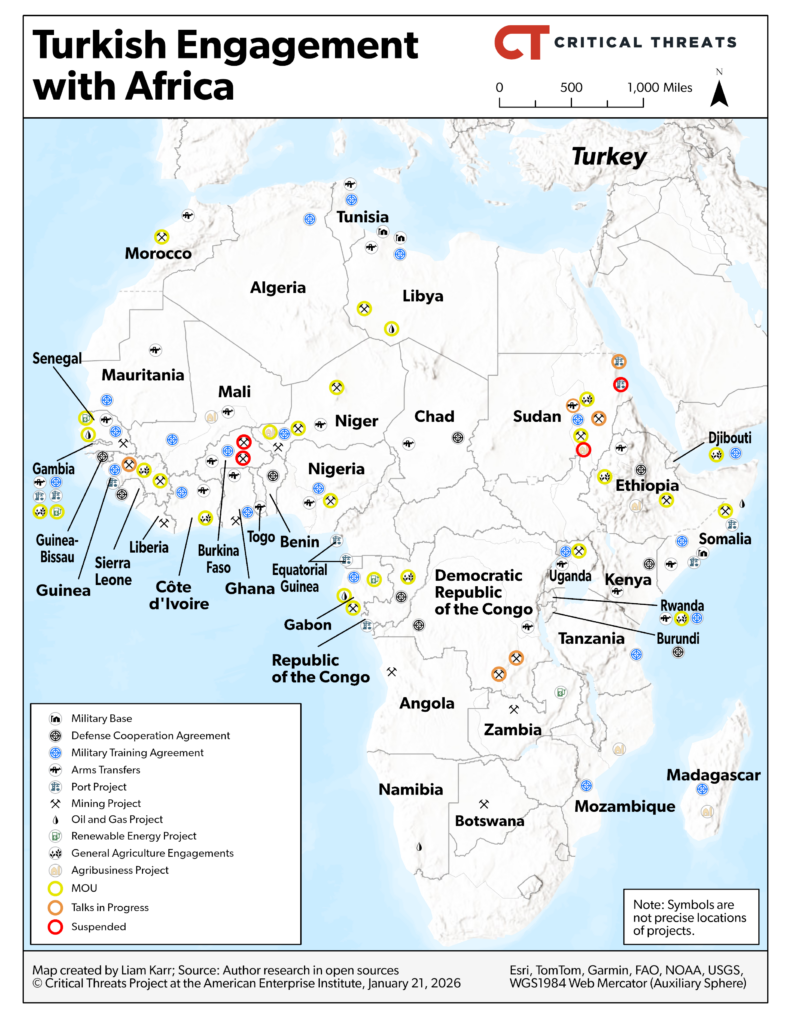
Turkey’s partnerships with Niger and Somalia bolster Turkey’s international clout as an Islamic alternative to Chinese, Russian, and Western partnerships. Experts have branded Turkey’s foreign policy outlook in Africa as “neo-Ottoman,” as it aims to cultivate influence in areas with Ottoman-era ties and a shared Muslim identity, both of which apply to Niger and Somalia.[37] Turkey uses soft-power tools to spearhead its entry into these countries to capitalize on shared cultural ties before expanding cooperation to include substantial state-led investment and eventual defense ties. Turkey initially entered Somalia in 2011 to provide famine relief, proceeded to secure long-term contracts in 2013 that have made it the leading foreign investor in Somalia’s main trade and transportation infrastructure, and then operationalized defense ties in 2015, which led to its first overseas base in 2017.[38] Turkey similarly entered Niger through soft-power efforts in the 2010s, slowly grew economic ties and defense ties, and is now deploying troops to Niger.
Turkey’s relationships in Niger and Somalia position it to contribute to international counterterrorism cooperation, generating significant leverage with countries that share these interests. European leaders view the Salafi-jihadi insurgency in the Sahel as a significant threat to its southern flank, the United States remains interested in monitoring the insurgency and protecting American personnel and business interests in the region, and insurgents have increasingly targeted Chinese workers and businesses in the region.[39] The United States has increased the rate of drone strikes in Somalia and supported locally led operations in northern Somalia against Islamic State Somalia Province since the Trump administration took office in 2025.[40] Turkey is positioned to be a key partner for all of these actors, especially given China’s hesitance to become directly involved in counterinsurgency operations, the departure of Western forces from the Sahel since 2022, and US efforts to increase burden-sharing with allies and partners to combat terrorism.[41]
Turkey has also enhanced its position in Somalia as part of its rivalry with Israel following Israel’s recognition of Somaliland in December 2025. Israeli recognition of Somaliland helps contain Turkish influence south of the Red Sea and Bab el Mandeb, whereas Turkey views its agreements with Somalia as extending to the entirety of Somalia’s de jure boundaries. Turkey denounced Israel’s recognition of Somaliland and has since signaled that it aims to counter Israeli influence.[42] Turkey’s deployment of F-16 fighter jets and exploration of a naval base in Somalia’s North East state, which is in disputed territory that Somaliland claims as its own, positions Turkey to contain Israel’s presence in Somaliland and deter further recognitions of Somaliland. Erdoğan implicitly warned Ethiopian Prime Minister Abiy Ahmed to refrain from recognizing Somaliland during a visit to Ethiopia in February 2026.[43]