
The British government has a new policy promoting weapons exports to Syria, whose regime is led by former Al-Qaeda operatives
The UK government has issued new guidance to businesses outlining “opportunities” to export British arms to the country.
The document, issued by the government’s trade department, notes: “There is a demand in Syria for UK defence, cyber and physical security sector equipment and expertise”.
It identifies “opportunities for UK businesses in Syria” and “a pipeline of new commercial opportunities to come” after the regime in Damascus introduced a new law incentivising international investment.
Syria’s government is headed by former Al-Qaeda operatives whose militant force, Hayat Tahrir Al-Sham (HTS), seized power in December 2024.
New president Ahmed al-Sharaa founded and led Al-Qaeda’s affiliate in Syria, Jabhat Al-Nusra, to fight against the regime of Bashar Assad. His current foreign minister, Asaad al-Shaibani, is a former spokesperson for Al-Nusra and head of its media office.
To seal deals, UK arms exporting companies will probably need approval from Syria’s new defence minister, Murhaf Abu Qasra, who previously led the military wing of HTS.
With Qasra as its military chief, HTS conducted hundreds of military operations against Assad regime targets, including numerous suicide bombings.
In July, Qasra held a meeting with Britain’s chief military adviser in the Middle East, Vice Admiral Edward Ahlgren.
The export drive is taking place months after Syria’s defence ministry was accused by the UN Syria Commission of involvement in mass killings.
Over 1,400 people from the Alawite community were killed in a pogrom in coastal and western central Syria in March.
The UK government is prioritising a rise in arms exports around the world and has just announced a record £20bn in such sales in 2025.
Export drive
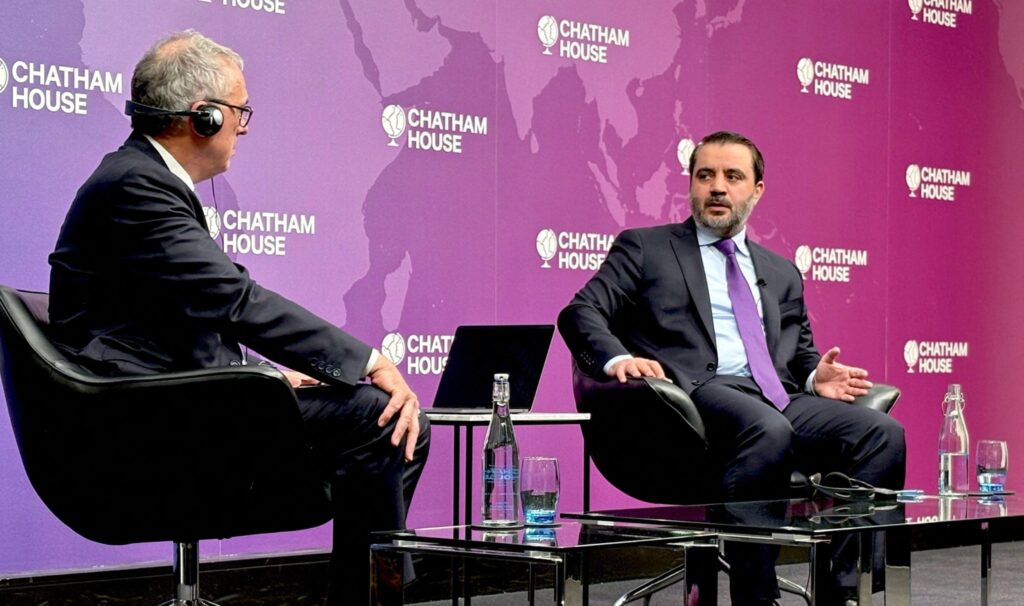
The new policy coincides with the launch of a Syrian-British Business Council (SBBC) at events in London and Damascus in November. Al-Shaibani personally attended the London event during a visit which saw him give a speech to the establishment think-tank Chatham House.
A key role in the SBBC meeting in Damascus was played by former British diplomat, Jon Wilks, who told Syrian media the council was “crucial for strengthening economic relations between Syria and Britain after years of decline”.
Wilks, who served as British ambassador to Yemen, Iraq, Qatar and Oman between 2010-13, also mentioned plans for an upcoming trade conference in Damascus.
Wilks is the senior policy adviser to the SBBC and no stranger to Syria. From 2012-14 he served as then prime minister David Cameron’s special representative to the country.
His role was routinely described in the media as “special envoy to the Syrian opposition” since it involved meeting rebel military commanders and leading Cameron’s plan to organise opposition forces which were intent on overthrowing Assad.
In November 2012, Wilks was quoted as saying: “There is an opportunity for Britain, for America, for Saudi Arabia, Jordan and like-minded allies to come together and try to help shape the opposition, outside Syria and inside Syria, and try to help them achieve their goal, which is our goal of a Syria without Assad.”
It is not clear which Syrians Wilks met as Cameron’s envoy but they were likely to be those associated with the ministers with whom he is now courting business.
Getting around the UN
The UK government lifted some of its Syria sanctions in April and de-proscribed HTS as a terrorist group in October.
However, HTS still remains subject to counter-terrorism sanctions imposed by the United Nations which, the British government recognises, “continue to have effect in UK law”.
To get around this and trade with the new regime, the government argues in its guidance on Syria issued earlier this month that HTS and the Syrian government are “separate entities”.
However, it is clear that HTS overthrew the Assad regime and formed the government. The UK government’s country note on Syria, released last June, observes that sources for the document “may refer interchangeably to Hayat Tahrir Al-Sham (HTS), or the interim or de facto government or authorities”.
Another revealing section of the most recent guidance states: “HMG is committed to ensuring that counter-terrorism legislation is applied in an effective manner that is proportionate to risk and without compromising other HMG priorities”. This suggests that trade interests will override the UN sanctions on HTS.
The government says that “Syria offers a potentially high return market in which to do business despite a challenging and high-risk context”. However, it adds that some items are still subject to export sanctions, notably “internal repression goods and technology”.
The SBBC will act as a lobby group, aiming “to strengthen the private sector in Syria” and “to analyse and communicate the political, diplomatic and security environment affecting business risk and opportunity.”
The business group is headed by Baroness Emma Nicholson, a Conservative peer who served as the party’s party vice chair under Margaret Thatcher, and Labour MP David Taylor.