
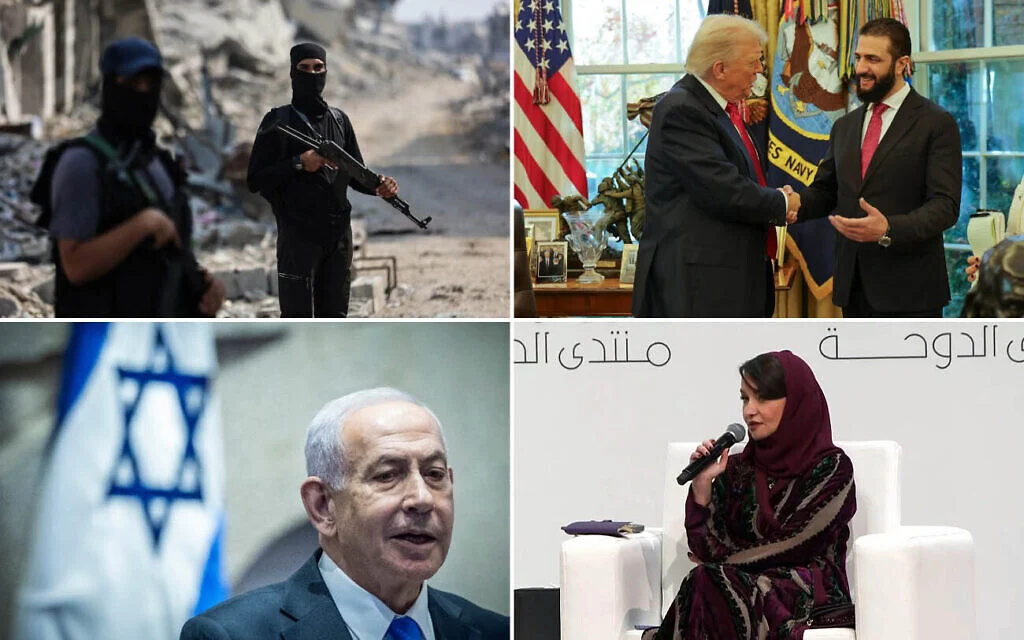
Our enemies are down but not out; potential regional allies are moving away; global and notably US public and political mindsets are changing for the worse; and we are again riven inside. This is not a time for complacency
Perhaps the best single-word summation of the reasons for Israel’s catastrophic failure to recognize that Hamas was about to invade 26 months ago, and thus to prevent the ensuing massacre, is hubris.
All the evidence was there, in the months, weeks, days and hours before the onslaught, but Israel’s political and military chiefs refused to accept it. Instead, they convinced themselves that Hamas wanted calm and stability, convinced themselves that this assessment was more accurate than the facts, convinced themselves that the enemy was incapable of carrying out the brutal rampage it so horrifically executed. Hubris at its most cataclysmic — excessive pride, unfounded overconfidence, consequent disaster.
Twenty-six months later, with Hamas much degraded, Hezbollah radically set back and Iran battered, Israel risks falling back into that same devastating hubris.
“Israel today is stronger than ever. It is the strongest power in the Middle East,” Prime Minister Benjamin Netanyahu proudly asserted in the Knesset on Monday. And we know what comes after pride.
The IDF and the intelligence services have probed their own multiple failures before, on and after October 7, and begun to implement the lessons learned. But Netanyahu’s refusal to sanction a full-fledged state commission of inquiry means that the full picture of what went wrong has yet to be drawn and internalized, and thus, by definition, at least some essential steps that must be taken to avoid a repetition have yet to be recognized, much less implemented.
Crucially, for instance, the interaction between the political and military echelons has not been examined independently. No internal IDF or Shin Bet probe did or could probe that interaction. And therefore, nobody has established whether, while the IDF had engaged in deep operational planning for the prospect of major conflict with Hezbollah and Iran, it neglected Gaza in part because of assurances from the political leadership that, with Qatari cash flowing into the Strip, Hamas was disinterested in warfare.
The October 7 IDF chief, Herzi Halevi, is on record as saying Gaza was the frontier he was least worried about. He was emphatically a prisoner of the misassessment. But was his complacency shaped by the misplaced confidence conveyed by the political leadership that Hamas was not a threat? Only an empowered state commission of inquiry can look into that aspect of what went so terribly wrong, and draw up recommendations to ensure a more effective interaction between the political and military echelons from here on.
Indefatigable enemies
Israel is today indeed unquestionably stronger than it was on October 8, 2023. But it thought itself immensely strong on October 6.
Hamas is a shadow of its former self, but the threat it poses has not been eliminated. It fired 4,000 rockets at Israel on October 7, 2023; 20 rockets on the first anniversary; and two on the second. It is believed to possess hundreds of projectiles — mostly short-range mortars — and perhaps dozens or fewer, hidden since October 7, that could reach Tel Aviv. It is unlikely that it could currently stage a major attack catching Israel unawares.
But it has reasserted control in the half of Gaza from which Israel withdrew two months ago. It is refusing to disarm, and says it won’t do so except en route to a Palestinian state. And it has thus far deterred all other international players from taking it on militarily.
It evidently decided to release all 20 living hostages, hitherto regarded as the most effective leverage in its determined effort to survive and devastate Israel again, because it had been assured that US President Donald Trump would prevent Israel from re-escalating the war against it. To date, it can reasonably regard its decision as vindicated. Were the US to now seek to push ahead with elements of Trump’s phase two plan — potentially including the introduction of the so-called International Stabilization Force (ISF) to gradually replace the IDF in parts of non-Hamas Gaza, and the start of reconstruction in non-Hamas areas — that would be further vindication, since it would allow Hamas to gradually resurrect itself undisturbed.
Clearly, Netanyahu’s trip to the US to meet Trump at the end of this month will grapple with this and other such issues. Clearly, too, this is no time for complacency.
In Lebanon, meanwhile, Hezbollah may be down but it’s not out. It retains several hundred long-range projectiles that could reach Tel Aviv, compared to over 200,000 missiles, rockets and other projectiles before the war. It has thousands of trained operatives, though no longer at the border poised to invade.
But it, too, is resisting disarmament, and the Lebanese state is proving unsurprisingly unable and/or unwilling to expedite the process. And therefore, an escalation of the IDF’s ongoing strikes at Hezbollah targets seems inevitable.
So long as the ayatollahs retain power in Iran, furthermore, that regime will return to its avowed goal of engineering Israel’s destruction. It retains an estimated 1,000-plus ballistic missiles, and has begun to revive manufacturing. The IAEA assesses that it retains its stockpile of 60 percent enriched uranium, and, for all that Trump posits that it will not seek to revive its nuclear program, the Israeli assessment is that it will, if it hasn’t already.
And as for Syria, the prospect of some kind of security arrangement, ostensibly sought by both sides, would appear to be receding. Its Assad-ousting President Ahmed al-Sharaa stepped up his rhetoric against Israel at the Doha Forum this week. And Israel is apparently starting to treat the southern Syria border area as something akin to the West Bank, with arrest raids into villages and no prospect of an Israeli withdrawal from the border buffer zone, least of all from the unique vantage point atop the Syrian side of Mount Hermon.
Warm allies of Trump, bitter critics of Israel
More broadly, the Doha Forum was remarkable for the series of vicious denunciations of Israel issued by leaders and delegates not only from Syria, but also Turkey and Egypt (castigating Israel for “daily violations” of the Gaza ceasefire), Saudi Arabia (sniping that, with this Israeli government, “We don’t see that we have a partner for peace, not even a partner for a sustainable ceasefire”), and Qatar itself (demanding that Israel fully withdraw from Gaza and declaring that it will not fund the reconstruction of a territory that Israel “flattened”).
Strikingly, these are all allies of the US under Trump. They all took very public positions deeply antagonistic to Israel. And several of them pushed for the introduction of the ISF not in order to tackle Hamas but primarily to rein in Israel.
All of this is unfolding, moreover, amid growing international hostility to Israel’s government in particular and Israel generally.
In an era, too, when a realistic assessment — given the negative evolution of American public opinion, and the ongoing shifts in both the Republican and Democratic parties — would indicate that Trump could prove the last robustly Israel-supporting US president for the foreseeable future.
And a time when Israel under a remorseless Netanyahu is again riven — two years after its enemies were emboldened by its internal divisions — with debilitating rifts over everything from ultra-Orthodox non-service in the IDF, the government’s concerted determination to subjugate the judiciary and law enforcement to its will, moves to impose government oversight over the media, and the prime minister’s imperious demand for a presidential pardon.
Manifestly, then, there can and should be absolutely no room for hubris, no more insistent and ruinous blindness, not only as regards enemy threats in the region, but in the regional and global diplomatic context, and internally.
And yet, back that hubris creeps.
Current IDF Chief Eyal Zamir, in between battling Defense Minister Israel Katz for the right to actually run the IDF, has twice in recent days highlighted his determination to prepare the army for a “surprise war” erupting at any time in the coming years.
That sounds eminently sensible, but also long overdue and hampered by the absence of that state commission of inquiry. On October 7, 2023, after all, Israel learned that its hubris had prevented it from preparing for the worst “surprise war” in its modern history.