Failure to air footage of Israeli soldiers executing unarmed Palestinians shows the corporation’s true bias
When it was revealed in November 2025 that a BBC programme edited a section of Donald Trump’s speech on 6 January 2021 to reinforce the idea that the freshly deposed president was calling on his supporters to take violent action at the US Capitol, both the director general and head of news resigned and the corporation immediately apologised for its behaviour.
Shortly after this, the BBC was guilty of a far less dramatic, but equally revealing dodgy edit that will lead to no resignations and no apology because, far from undermining the BBC’s editorial values, it’s an everyday expression of the corporation’s deployment of “due impartiality” when it comes to reporting Israeli violence.
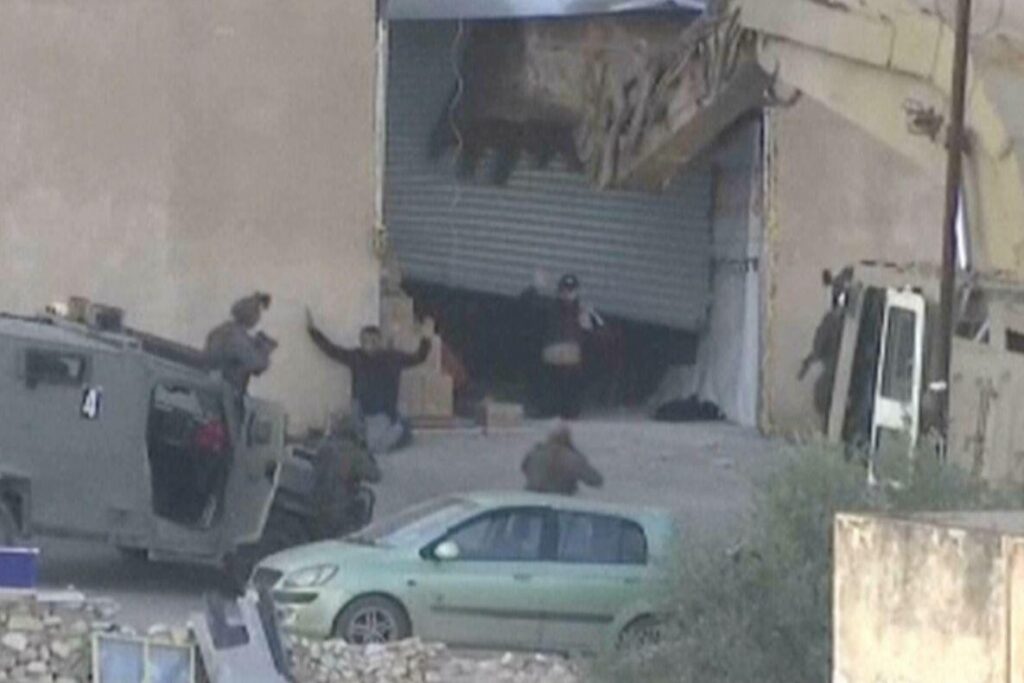
On 27 November, Israeli forces executed two unarmed Palestinian men in Jenin in the occupied West Bank, an event captured in full on CCTV and replayed on headlines across the globe.
The BBC reported the story across all its news platforms, including on its main TV news bulletin that night. Yet the BBC cut away just before the soldiers opened fire. “We’re going to lose the pictures at this moment,” reporter Jon Donnison said on air.
The BBC didn’t “lose the pictures”; it decided deliberately not to show them. Its own guidelines say: “In the immediate aftermath of an event involving death, suffering or distress, the use of more graphic material may be justified to provide a reasonable account of the full horror.”
Moreover, Donnison went out of his way to qualify the actions of the soldiers saying that the men “appear to be surrendering” and then “appear” to be ordered back into a building from where “Israeli soldiers appear to open fire and shoot them dead at point-blank range”.
Other news outlets, however, transmitted pictures of the whole assassination and even inside Israel itself, Haaretz used far more direct language in its reporting: “Israeli Border Police officers were filmed on Thursday, fatally shooting two Palestinians in the West Bank city of Jenin after they had surrendered”. Neither the word “appear”, nor any conditional phrases are used anywhere in the story.
The dossier
That the BBC’s shameful coverage of the execution came immediately after the top-level resignations is no accident. This is because the dossier, written by former Sunday Times journalist Michael Prescott that claimed to expose the BBC’s deep-rooted liberal bias, was in part focused on alleged anti-Israeli content at the BBC’s Arabic service.
Of course, Prescott’s dossier makes no mention whatsoever of the various reports – not least the very comprehensive studies of BBC reporting by the Centre for Media Monitoring, let alone regular analysis by Declassified UK – that have identified a systematic bias against Palestinian perspectives and a significant privileging of Israeli lives over Palestinian ones.
It makes no reference to the role of prominent board member Sir Robbie Gibb, the former director of communications for Conservative prime minister Theresa May and former owner of the pro-Israel Jewish Chronicle.
According to Ben de Pear, the producer of Gaza: Doctors Under Attack, the documentary that was originally commissioned and then dumped by the BBC for not meeting its editorial values around impartiality, Gibbs’ influence has been decisive in ‘distorting’ the corporation’s coverage of Israel and Gaza.
In reality, far from being pro-Palestinian, the BBC, along with government more generally, is far more comfortable with the geopolitical role and status of Israel as a long-standing ally of the West than it is with Palestinian resistance. Its coverage reflects this lack of impartiality.
But it is also terrified of antagonising Israeli officials.
Culture of fear
Writer Daniel Trilling spent months interviewing BBC journalists for his detailed study of the corporation’s coverage of Gaza and found plenty of evidence amongst editors and middle managers of “an intense desire not to offend the Israelis”. Trilling quotes one senior reporter saying that the BBC is “terrified of the pro-Israel lobby and of [UK] government criticism”. Another journalist tells him that, in the early days of the genocide, editors and managers were arguing: “But what else is Israel supposed to do?”
This is not a position welcomed by ordinary BBC staff, many of whom have been outraged by the BBC’s coverage of Gaza. For Karishma Patel, a 5 Live presenter who resigned in protest at the corporation’s output, many of her colleagues were pressured into remaining silent. “Working at the BBC on Gaza over many months, I watched many journalists make crucial decisions within this culture of fear…I watched too many gently dislocate from the critical journalistic burden of speaking truth to power,” she said. Trilling, too, writes that a “culture of fear permeates everything. People are scared of losing their jobs”.
Back in 2004, the Glasgow University Media Group argued that reporting of the region was “dominated by Israeli accounts” and that BBC journalists spoke to them of ‘“waiting in fear for the phone call from the Israelis” (meaning the embassy or higher), of the BBC’s Jerusalem bureau having been “leant on by the Americans”, of being “guilty of self-censorship” and of “urgently needing an external arbiter”’.
Little has changed. One producer told Trilling that the Israeli embassy “are just bastards to [BBC] staff, bullying them”, and added – just as the Glasgow researchers had warned – that “if a story critical of Israel went out on the BBC’s rolling news channel, the embassy would be on the phone within minutes to complain.” As the journalist Peter Oborne recently told Declassified UK, the BBC remains “paralysed by Israeli pressure”.
Coverage drops off
For a time earlier this summer, the BBC was prepared to be more critical of the actions of the Israeli government. This was in line with the UK government’s increasing frustration with Israeli Prime Minister Benjamin Netanhayu’s unwillingness to stop the genocide and a recognition that Israel was far from a stable or reliable ally.
Yet once the “ceasefire” was signed on 10 October, the BBC then lost interest in following up any criticism of Israel. Like many other mainstream news organisations, it dutifully reports the fact that 70,000 people have been “killed in Gaza” since 7/10 (of course still noting that this is according to the “Hamas-run health ministry”). It even reports that Israeli strikes continue to kill Palestinians while simultaneously observing that “[b]oth sides have accused each other of violating the ceasefire deal” as if there is some kind of equivalence between Israeli and Palestinian forces.
What it is far more reluctant to do is to scrutinise Israel’s conduct and to seek to hold Netanhayu’s regime to account for its genocidal behaviour. This is illustrated by the sharp decline in the number of stories focused on what the Israeli embassy would not want the BBC to talk about.
While the total number of stories in UK media in the six weeks before and after the start of the “ceasefire” has remained remarkably stable (33,910 versus 33,830 according to the Nexis database), BBC coverage in some key areas has fallen dramatically in relation to overall trends.
For example, the number of stories on ‘Israel’ and ‘genocide’ has fallen by 50% in UK media since 10 October, yet stories on BBC World have declined by 81% (from 297 to 56) and on the BBC News Channel by 75% (from 262 to 64).
Reports that mention “killed in Gaza” have declined by 20% across UK media. On BBC World, however, they have fallen by 63% (from 52 to 19) and on BBC News by 41% (from 41 to 24).
Stories focused on “Israel” and “war crimes” have decreased by only 7% across UK media in general according to Nexis. Yet they have dropped by 60% on BBC World (from 58 to 23) and by 62% on BBC News (from 48 to 18).
In those areas most damaging to the Israeli government, the figures show that BBC coverage is decreasing significantly faster than the average rate of decline.
Happy to move on
At one level, this isn’t a surprise given that mainstream news, where it covers the conflict at all, is likely to fixate on more “dramatic” aspects of the conflict – on starving bodies, wrecked hospitals and perilous queues for food. So even though Palestinians are still being killed throughout Gaza and the West Bank, you might expect ratings-driven news to “look away” after the signing of the “ceasefire”.
But this is also further evidence that leading news organisations like the BBC are simply following the government’s agenda – of turning their attention to other conflicts with “higher” priority for the west. It’s no accident that while there have been just nine press releases on Israel/Gaza issued by the Foreign Office since 10 October, there have been 29 releases focused on Russia/Ukraine.
A rigorous and impartial news organisation would be asking some tough questions of the protagonists of genocide and occupation, even – in fact, especially – after a highly fragile ‘ceasefire’.
Instead, we have a news and current affairs landscape which, apart from the very occasional insightful or heartbreaking report, is happy to move on to the next conflict and to resume business as usual: turning away from any systematic analysis of Israeli atrocities.