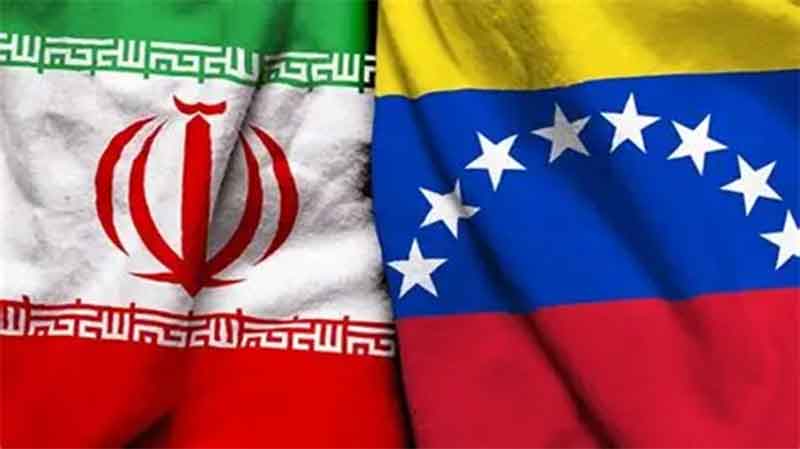
The U.S. capture of a tanker accused of carrying Venezuelan and Iranian oil was not an isolated action. It was an escalation—another step in Washington’s long campaign to strangle the Bolivarian People’s Socialist Democratic Revolution and to punish Iran for refusing submission to U.S. diktat. Within hours, Tehran answered in kind. The Islamic Revolutionary Guard Corps seized a tanker in the Gulf of Oman, once again signalling that the era of one‑way maritime coercion is over. The IRGC boarded the Phoenix, a foreign oil tanker sailing under the flag of the Cook Islands. Iran affirms that the ship lacked proper documentation and was involved in smuggling 2 million litres of diesel fuel. The 17 crew members on board are reportedly from India, Sri Lanka and Bangladesh.
Earlier, a few days ago, the U.S. had hijacked a Venezuelan Oil Tanker carrying around 2 million litres of crude oil, heading for Cuba. The ship, the VLCC Skipper – formerly Adisa, was earlier sanctioned by the U.S. in 2022, as they believed that it was part of a shadow fleet of Iranian-linked fleet carrying Iranian oil including crude.
This article follows from my earlier examination of Washington’s hijacking of Venezuelan oil on the high seas. What has changed since then is not the logic of empire but the balance of resolve. Venezuela and Iran—two countries with long histories of resisting Western colonialism—are no longer isolated targets. They are nodes in a growing network of political, economic, and military cooperation that now stretches from South America to West Asia, anchored by deepening ties with China and Russia.
Sanctions as Warfare by Other Means
Sanctions are meant to weaken and break societies, weaken the will of the people to resist and eventually bring about the downfall of popular governments that refuse to align and surrender to the West. In practice, they function as collective punishment and economic warfare destroying the economy of entire nations, devastating millions of lives. The seizure of tankers carrying Venezuelan or Iranian crude—often far from U.S. territorial waters—pushes sanctions into openly piratical territory. As Prof. Jeffrey Sachs has argued, unilateral sanctions violate international law and devastate civilian populations while entrenching hardline politics in the targeted states. “Economic strangulation,” Sachs notes, “is a form of warfare that kills silently.”
For Caracas, the oil tanker seizures are part of a familiar script. Since Hugo Chávez first challenged U.S. hegemony, Washington has backed coups, funded
opposition networks, frozen assets, and attempted to throttle Venezuela’s primary source of revenue. Yet the Bolivarian project endures, precisely because it is rooted in mass politics. Elections continue. Communal councils and social programs survive and empowers the masses. The state refuses to bend and does not break.
Iran’s experience is parallel. Since the 1979 revolution, Tehran has lived under varying intensities of sanctions, sabotage, assassinations, and covert war. The response has been strategic patience combined with steady investment in self‑reliance, in developing, diversifying the national economy — and particularly in defence and technology.
Fearless Retaliation and Deterrence
Iran’s seizure of a tanker in the Gulf of Oman was not mere tit‑for‑tat. It was deterrence. As retired U.S. Army Colonel Douglas Macgregor has repeatedly warned, Washington underestimates both Iran’s capabilities and its willingness to defend its interests. Iran today fields one of the most sophisticated missile forces in the world, encompassing short, medium, and long‑range systems. During the recent 12‑day war, Iranian retaliatory strikes on Israeli targets and on the U.S. Al‑Udeid base in Qatar exposed the limits of missile defence and the fragility of escalatory dominance.
Whatever Western media attempted to obscure, the outcome was unmistakable: Israel sought a cessation of hostilities. Airports were closed to prevent a mass exodus. As journalist Chris Hedges has observed, states that rely on permanent war to sustain legitimacy are uniquely vulnerable when their populations lose faith in the promise of security.
Venezuela–Iran: A Partnership of the Sanctioned
Under pressure from successive U.S. regimes, Venezuela and Iran have moved closer. Their cooperation spans energy swaps, refining technology, shipping, industrial production, banking alternatives, and defence. Iranian technicians have helped rehabilitate Venezuelan refineries crippled by sanctions. Caracas, in turn, has provided diplomatic backing and strategic access in the Western Hemisphere.
This is not a relationship of patron and proxy. It is a partnership forged in resistance. George Galloway has framed it bluntly: “The crime of Venezuela and Iran is not dictatorship; it is independence.”
Russia, Iran and China – the RIC Axis
The broader context is the emergence of the Russia‑Iran‑China (RIC) axis. Russia provides energy coordination, arms cooperation, and diplomatic cover at the UN. China brings advanced technology, trade, infrastructure, finance, and an alternative development model free of IMF conditionalities. Together, the three are knitting a lattice of economic corridors, technology sharing, and military coordination that challenges U.S. and NATO influence from West Asia to Latin America.
Iran’s accession to BRICS and the Shanghai Cooperation Organisation has accelerated this shift. These forums are no longer symbolic. They are becoming platforms for de‑dollarization, settlement in local currencies, and coordinated development—trends that terrify a sanctions‑dependent empire.
Regime Change Fantasies
Despite mounting evidence to the contrary, Washington and Tel Aviv continue to bet on regime change. The Trump‑Netanyahu axis appears increasingly desperate: Venezuela is threatened with invasion rhetoric while suffering ongoing economic siege; Iran is encircled, provoked, and demonized.
Yet both governments retain substantial popular support, not least because external pressure discredits domestic opposition aligned with foreign powers. Anya Parampil has documented how U.S. regime‑change operations repeatedly misread social realities, mistaking online dissent and elite disaffection for mass revolt.
The likely trajectory in Venezuela is not invasion—an act that would ignite continental backlash—but continued economic warfare, asset seizures, and maritime interdictions. These are cheaper politically, though no less brutal in human cost.
Israel’s Escalation Ladder
Meanwhile, Israel continues to bomb southern Lebanon, provoking Hezbollah—a close ally of Iran and not a proxy, as is pejoratively stated. Israel’s long‑term objective is clear: expand the war, manufacture a casus belli against Iran, and drag the United States in. Alone, Israel lacks the capacity to confront Iran. Its last direct exchange demonstrated that starkly.
Israel’s ongoing genocide, ethnic cleansing, and war crimes in Gaza and the West Bank have led to unprecedented global revulsion and anger. Billions spent on narrative management have failed to stem the tide of outrage. From university campuses to trade unions, from the Global South to sections of Western public opinion, Israel’s moral capital is exhausted.
False Flags and Manufactured Consent
As Israel’s position weakens, suspicions grow that it may resort to false‑flag operations—spectacular acts of terror blamed on Hamas or Hezbollah—to reshape public opinion and force U.S. intervention. History offers precedents, from the Lavon Affair to more recent covert actions. Whether such operations materialize or not, the danger lies in the willingness of desperate elites to gamble with mass casualties to preserve power.
This danger is compounded by the fragility of U.S. domestic politics. Donald Trump, weakened by economic turbulence, the Epstein revelations, and serial electoral defeats—including the recent Miami loss—faces a looming 2026 midterm disaster. His MAGA base is fractured, increasingly hostile to foreign wars, and sceptical of blank‑check support for Israel.
A World at the Brink
As 2026 approaches, the crisis of the U.S.‑led order deepens. From seized tankers in the Caribbean to missile exchanges in West Asia, the message from Caracas and Tehran is unmistakable – sovereignty will be defended. As the hitherto US/Western dominated unipolar world order withers away and a multipolar world emerges, the US regime dominated by a predatory Oligarchy, will continue to conserve its fast-declining power and this will create further turbulence and worse – wars.
The Global South, the Global Majority will continue to resist and march ahead to defend its freedom & sovereignty from decades of imperial overreach. Whether Washington adapts to this reality or doubles down on coercion will shape the next decade. What is certain is that the age of uncontested U.S. maritime, financial, and military dominance is ending—and the tankers seized on distant seas are among its clearest symbols.