
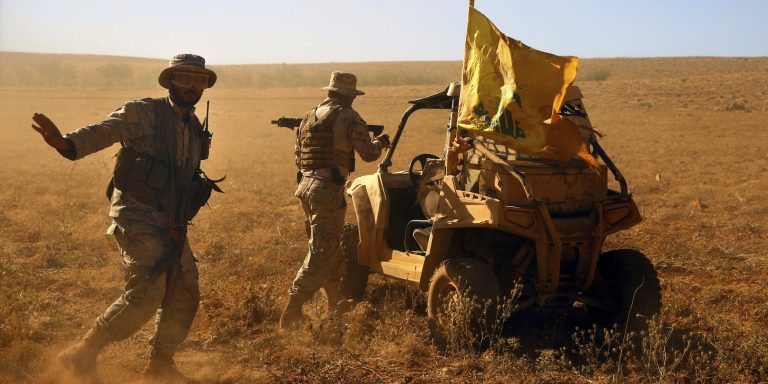
Syria’s Interior Ministry has announced a new string of foiled Hezbollah assassination plots against high-level figures, attacks on minority figures and civilian targets, and weapons transfers, alleging the group and Iran-backed actors are seeking to undermine local security across the country.
The nature of alleged Hezbollah network raids and planned attacks have evolved significantly since the fall of the Assad regime in December 2024, shifting from borderland clashes to coordinated networks operating within Syrian territory.
The announced plots call into question Hezbollah’s capacity to conduct operations deep into Syrian territory given its weakened position in Lebanon amidst continued Israeli strikes.
Hezbollah has denied any direct presence in Syria, following the fall of the Assad regime, and has insinuated the announced interdictions represent an attempt by the Syrian government to incite conflict between Lebanon and Syria.
On Tuesday, specialized units and officers from the Syrian Ministry of Interior (MoI) and the General Intelligence Directorate conducted a series of raids across several Syrian provinces against what the MoI claims to be Hezbollah cells operating inside Syrian territory. The Syrian administration and media outlets reported that these networks were actively plotting attacks against several Syrian targets and governmental officials, stockpiling ammunition, grenades, improvised explosive devices (IEDs), rocket-propelled grenade (RPG) launchers, and other specialized equipment reportedly sent from Lebanon. State media reported that authorities arrested 11 individuals that had organized into five separate cells positioned across Aleppo, Homs, Latakia, Tartus, and the Damascus suburbs to carry out several attacks, stating that some had received specialized training in Lebanon before establishing presence in neighboring Syria.
Hezbollah has denied its involvement, with Al Jazeera reporting the group issued a statement that rejected the plot as “false.” The group further insisted it did not have any presence inside Syrian territory and insinuated that the Syrian government sought to “ignite tensions and strife” between Syria and Lebanon.
Before the regime’s fall in December 2024, Hezbollah and Iran-backed militias deepened their influence and presence in Syria to support the Assad regime and its security apparatus. Hezbollah’s presence in Syria acted as a buffer zone and strategic launchpad against its primary adversary, Israel, and offered a route to facilitate the flow of weapons, drugs, and financial resources that could generate alternative revenue for the organization. Hezbollah enhanced its physical presence in Syria shortly after the outbreak of the Syrian Civil War starting in 2012, working with Iran-backed and pro-regime forces to aid the regime’s fight against the opposition, protect regime assets, counter adversaries like Israel and the United States, and facilitate the trafficking of illicit goods like arms and drugs. Hezbollah’s intervention in Syria’s civil war became a critical lifeline for the Assad regime, particularly through its cooperation with the regime’s paramilitary force, the Fourth Armored Division. When the regime was able to recapture swaths of lost territory in strategic areas like eastern Homs and southern Daraa starting in 2018, Hezbollah was able to expand its influence with greater regime presence and control, staging forces along the border region with Israel, facilitating an exchange of fighters, weapons, and financial flows between its strongholds in Lebanon and regime-controlled Syria.
The sudden and unexpected collapse of the Assad regime against the Hay’at Tahrir al-Sham-led (HTS) opposition offensive — combined with repeated Israeli strikes on Hezbollah leadership and military infrastructure in Lebanon — has eliminated one of Hezbollah’s top regional partners and weakened the group’s capacity in Syria. However, there have been mounting claims by Syrian agencies that the group has attempted to build a direct presence, counter the new administration, and cultivate discord within Syrian post-regime civil society.
Clashes first ensued along the Lebanese-Syrian border between alleged Hezbollah militants and Hezbollah-aligned armed groups against former HTS militants and Syrian military forces, contesting control over strategic checkpoints and smuggling corridors and resulted the death of three Syrian and seven Lebanese militants. Later in the year, starting in May 2025, the Syrian government began reporting a string of thwarted Lebanese strike attempts, established networks, and weapons trafficking schemes from rural warehouses that included stockpiled IEDs, automatic rifles, drones, artillery rockets, and Explosively Formed Penetrators (EFPs), buttressed by intelligence provided by the U.S. and regional partners.
In 2026, the Syrian Interior Ministry stated that the reported plots indicated a clustered-cell model deployed by Hezbollah, along with a broadened range of reported targets beyond governmental figures. Beginning in March, the Syrian government announced that Hezbollah operatives were now targeting governmental facilities and assets well outside of the capital of Damascus, such as a plot to attack local government offices in Tartus, as well as targeting civilian religious and activist figures, such as Rabbi Michael Houri in Damascus in April. Furthermore, the Syrian government announced its forces had thwarted a rocket attack — planned to launch into Israeli territory — in Quneitra by an alleged Hezbollah-aligned operative on April 19.
The announced Hezbollah interdictions both call into question Hezbollah’s capacity to conduct extraterritorial operations outside of Lebanon to carry out its imperative to counter Israel and the U.S., and its ability to continue its role as a key proxy of Iran. This development also raises important questions about the vulnerability of Syria’s security landscape. While the group has a strong imperative to establish a buffer zone in Syria and reclaim its lost influence as a hedge against Israel and the new government led by Ahmed Al-Sharaa, Hezbollah’s reduced resources, command-and-control, and political capacity has, thus far, prevented the organization from fomenting a considerable threat against the Syrian government. That said, reported Hezbollah activity accompanies additional reports of insurgency and assassination plots posed by the Islamic State, its offshoot Ansar Al-Sunnah, regime loyalists and, to an extent, disenfranchised foreign fighters and jihadist elements formerly a part of HTS and Al-Nusra. This collectively shapes an increasingly complex threat landscape — one that calls into question long-term stability in Syria and the already-fragile position of Ahmed Al-Sharaa’s government.