
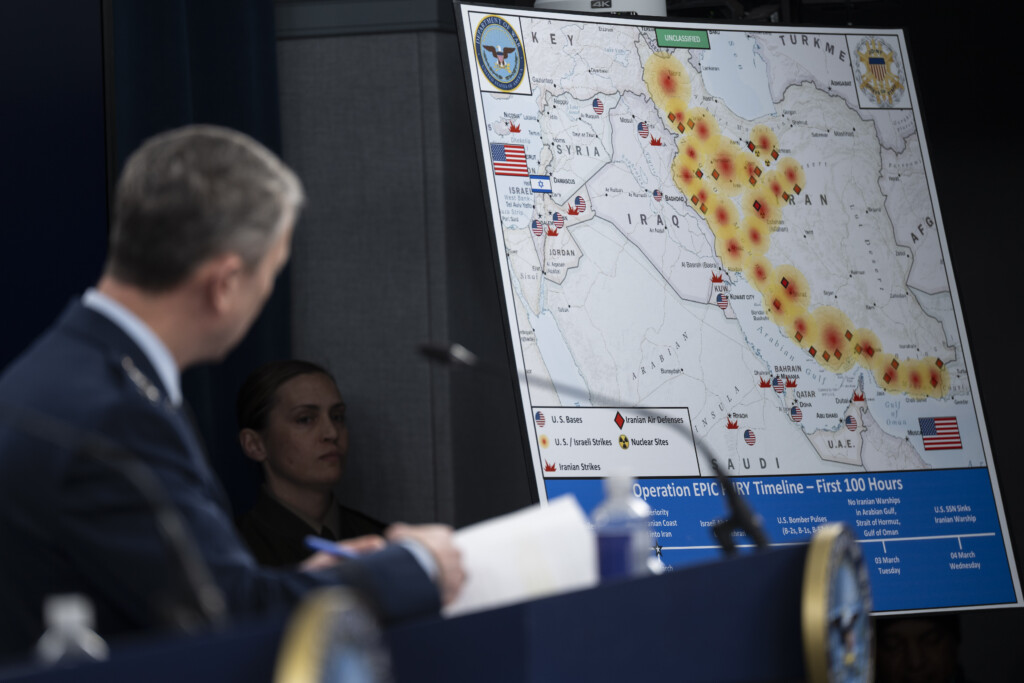
Four strikes on Iranian nuclear facilities during the current U.S.-Israeli military campaign underscore both allies’ determination to eliminate Iran’s remaining pathways to nuclear weapons.
The attacks — apparently Israeli — targeted a covert nuclear weapons development site known as Minzadehei, enrichment facility entrances at Natanz, nuclear complex structures at Isfahan, and an apparent laboratory in the Lavisan 2/Mojdeh complex housing facilities operated by the administrative arm of Iran’s nuclear weapons program, SPND.
Although the United States and Israel inflicted severe damage on Iran’s nuclear program during the June 2025 12-Day War, both remain committed to eradicating reconstituted threats and remaining activities. Israel may be leading these operations, as U.S. Central Command (CENTCOM) has not so far announced strikes on the targeted nuclear sites.
The 4 Nuclear Facilities Targeted During Current Military Campaign
Of the four apparent strikes, Israel has publicly confirmed only the attack on Minzadehei — an underground site northeast of Tehran where Jerusalem concluded Iran was secretly developing a critical nuclear weapons component. The Israel Defense Forces stated that following the June 2025 campaign, Iran began relocating nuclear weapons-related infrastructure to Minzadehei, a location where Israel had tracked Iranian nuclear scientists. A knowledgeable source told FDD that Israel had been aware of the facility prior to June.
Independent satellite imagery analysis by the Institute for Science and International Security identified damage at Natanz, Mojdeh, and Minzadehei, while the International Atomic Energy Agency (IAEA) confirmed strikes on Natanz and Isfahan. Although satellite imagery of the Isfahan strike is not yet available, the United States and Israel inflicted massive destruction there in June, striking key uranium conversion, metal, and fuel production buildings.
On the penultimate day of last June’s war, the United States struck the Natanz enrichment plant with two massive ordnance penetrators, likely rendering the underground portions inoperable.
On March 1, Israel targeted three of Natanz’s entrances — two for personnel and one for vehicles — possibly to block access by Iranian officials or to prevent recovery of assets in the event of regime collapse. Tehran filed a formal complaint with the IAEA regarding the Natanz strike on March 2.
The Institute for Science and International Security assessed the destruction of the laboratory-like building at Lavisan 2/Mojdeh, which houses facilities belonging to the administrative leadership of SPND and which Tehran had recently begun rebuilding. During the 12-Day War, Israel eliminated several SPND sites at the separate Nour complex, including SPND’s headquarters.
These latest strikes followed Israeli media reports that Iran was attempting to salvage whatever assets it could from nuclear sites.
What Else Might the U.S. and Israel Target?
As the United States and Israel continue to degrade the remnants of Iran’s nuclear weapons facilities and activities, they should turn their attention to additional, more substantial elements of Iran’s nuclear infrastructure.
Potential targets include the Pickaxe Mountain site adjacent to the Natanz complex. Buried up to 100 meters underground, Western intelligence assesses that Iran could use it to construct a new enrichment plant. Construction at the site has continued since last June’s war. Neutralizing it would likely require U.S. massive ordnance penetrators delivered by B-2 bombers or, alternatively, commando teams capable of infiltrating and destroying the facility from within.
The United States should also revisit the Isfahan tunnel complex, whose entrances Washington collapsed with Tomahawk missiles in June 2025. The regime had stored a portion of its highly enriched uranium there in easily transportable canisters and was building a new enrichment facility at the site. Tehran has recently taken steps to reinforce the tunnel entrances against future strikes, presumably to protect any surviving assets from the earlier attacks.
Another candidate is Taleghan 2, a facility associated with nuclear weaponization experiments that Israel struck in October 2024. Iran has nearly completed rebuilding the site, installing a new high-explosives containment vessel and burying it to withstand aerial bombardment.
In addition, Washington and Jerusalem should target any remaining, undisclosed assets — including centrifuge manufacturing, enrichment, and weaponization capabilities — to ensure Iran’s nuclear weapons pathway is thoroughly eliminated.