
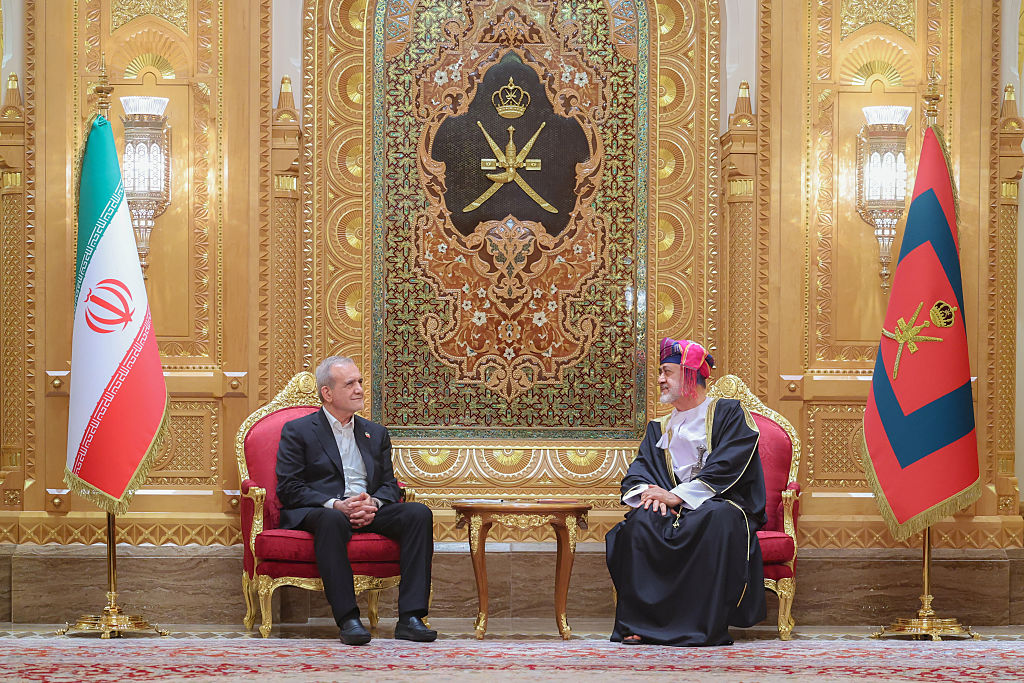
Even as his country was under threat from Iran, Oman’s ruler congratulated the Islamic Republic’s new supreme leader, Mojtaba Khamenei, on his appointment, expressing his “best wishes for success in assuming his leadership responsibilities.” Less than 48 hours later, Iranian drones struck Oman’s Salalah Port, hitting the fuel tanks. On March 13, an Iranian drone attack killed two people in the coastal city of Sohar.
The strike was not an isolated incident. On March 2 and March 3, Iran targeted the ports of Duqm and Salalah multiple times. And, despite Iranian President Masoud Pezeshkian’s apology to Arab states and Foreign Minister Abbas Araghchi’s claim that the Islamic Revolutionary Guard Corps’ attacks on Oman were “not our choice,” Iran continues to target the country.
Oman’s Ties to Iran Are Particularly Strong Compared With Other Arab States
Oman was the first Arab country to congratulate Mojtaba Khamenei on his appointment as Iran’s supreme leader, and the only Gulf Cooperation Council state to do so, sending its message within hours of the announcement. Oman’s grand mufti — the country’s religious leader — also welcomed the appointment, writing on X that, “We beseech God for the new Leader to achieve success and divine guidance,” and expressing hope that he would follow his predecessor in championing the Palestinian cause and confronting what he called “fading Zionism.”
None of this is out of character for Muscat. Oman is also the only GCC country to condemn the American-Israeli campaign against Iran. Historically, Oman has maintained friendlier ties with Tehran than its Gulf neighbors. While other GCC states have hedged their relations with Iran, few have facilitated Tehran’s financial and commercial activities to the extent Oman has.
Muscat’s close relationship with Tehran appears to have skewed its assessment of the conflict. Omani Foreign Minister Badr al-Busaidi recently claimed that one of the objectives of the war was to “prevent the establishment of a Palestinian state and weaken every state or institution that stands with or supports the project of establishing a Palestinian state.”
Hedging With Tehran Does not Guarantee Security
Oman is not alone in learning a lesson about the Iranian regime’s duplicity. Despite years of engaging with the Islamic Republic, while balancing ties to the West, Gulf states are now bearing the brunt of Iranian attacks. Iran is targeting civilian areas and energy infrastructure, causing casualties, severe disruptions to daily life, and delays to oil and gas production. It is exactly what the Gulf states had hoped to avoid through conciliatory policies.
Part of Oman’s caution toward Iran is geopolitical. The two countries sit on opposite sides of the Strait of Hormuz and jointly control access to one of the world’s most critical maritime chokepoints. A rupture between them could complicate navigation through the strait and undermine Oman’s role in regional trade. Yet years of accommodation have bought little security. Despite Muscat’s conciliatory approach, Iran has repeatedly threatened to close the strait and is now attacking Oman itself.
Washington Should Pressure Oman To Stop Enabling Tehran and Its Proxy Networks
Iranian financial institutions sanctioned for supporting terrorism — including Bank Saderat and Bank Melli — have continued to operate in Oman, allowing Tehran to retain channels into the international financial system. At the same time, Yemen’s Houthi terror group — an Iranian proxy — maintains a political office in Muscat led by their chief negotiator, Mohammed Abdulsalam, a U.S.-designated terrorist. Successive rounds of U.S. sanctions have revealed that the Houthis use Oman as a hub for financial transactions and weapons procurement.
The United States should make clear to Omani leaders that they must end financial and commercial relationships with Iran and other sanctioned entities. If Muscat declines to do so, the United States should begin investigating Omani individuals and financial institutions for potential sanctions-evasion activity.