
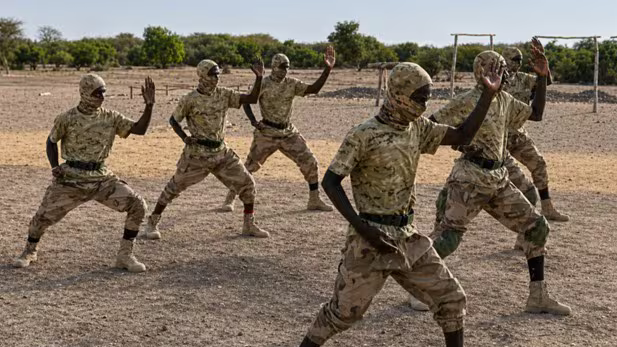
They came from the wilderness, conquering and purifying the land, and imposing “the True Faith” on the infidels and the lax and corrupt. It was Ghana, Mali, Songhai, Macina, and Tukuler, the conquests of Sundiata Keita, Askia Muhammad Ture the Great and many others. For over a thousand years the pattern has repeated itself. We Moderns, especially in the West, tend to have short memories about such things.
The week-old events in the modern-day Republic of Mali caught much of the world by surprise.[1] First of all, Africa almost always seems to catch the world by surprise because it is so often ignored. Secondly, much of the world’s attention is on the Middle East, particularly the Iran War. But even though Mali has been at war for over a decade and there are Jihadist insurgencies ranging across a dozen African countries for years now, it was still a shock.[2]
The Jihadist Jama’at Nusrat Al-Islam wal-Muslimin (JNIM) – abbreviated in French as the GSIM – succeeded in repeatedly defeating the Malian Army (FAMa) and their Russian mercenary allies across Northern Mali, overrunning some towns and bases, while using suicide bombers to kill several leading figures in the Bamako regime.[3] Even more surprising was that JNIM had allied with their old rivals, the non-Jihadist Tuareg rebels in the north of the country. In 2012, Tuareg rebels seized Mali’s north, declared an independent Tuareg state (Azawad), but were then attacked by Jihadists who took away most of the Tuareg’s gains only to be defeated in turn by the French. This time the two – JNIM and the Azawad Liberation Front (FLA) – were working together. The FLA reportedly agreed to JNIM demands that it impose some level of Islamic law on its territories.[4]
JNIM itself is a multi-ethnic jihadist organization, allied to Al-Qaeda, whose head is also a legendary Tuareg figure, the visionary Iyad Ag Ghali.[5] Other senior JNIM leaders are Fulani Africans, other Tuaregs or Algerian Arabs. The group’s spokesman, Abu Hudeifa Al-Bambari (Bina Diarra), communicates in Bambara, the main African language used by most Malians.[6] JNIM’s propaganda capacity expanded in 2025 producing content in Bambara, Mooré, Fulfulde, and Arabic, “indicating a deliberate, multi-ethnic recruitment strategy.”[7] Mooré is the lingua franca of neighboring Burkina Faso, Fulfulde is the language of the large Fula/Fulani ethnic group, spoken by 40 million people from Senegal to Nigeria.
JNIM also announced a siege on the Malian capital of Bamako, a city of over three million people, in order to bring down the Russian-backed military junta.[8] An April 30 press release in French by JNIM calling for a “peaceful transition” of power seemed very carefully written to allay fears by Malians (and foreigners) of a bloody Jihadist takeover.[9] The statement called on all Malian patriots to unite against the military regime and spoke in nationalist language about one country, Mali, rather than in the name of a transnational Muslim nation or Ummah.
Should Mali fall to JNIM and its allies it would be the third Jihadist takeover of a country in the past five years. In 2021, the Taliban reconquered Afghanistan while in December 2024, HTS succeeded in overthrowing the Assad regime in Syria. A comparison between the three cases is instructive.
Both the Taliban and HTS in Syria were largely representative of majorities in their country. The Taliban were, mostly, Pashtuns and their movement was deeply intertwined with Pashtun group feeling. HTS became the party of Syrian Sunni Arab Muslims, a majority which had long chafed under Assad Alawite rule. Both the Taliban and the HTS had foreign connections – and foreign fighters. The Taliban sheltered Al-Qaeda chief Ayman Al-Zawahiri while HTS had hundreds of foreign fighters in its ranks. But both groups were also about “Jihadism in One Country,” promoting nationalist feeling in Islamist garb at home while giving lip service to the Islamist cause worldwide beyond their borders.
JNIM is a much more heterogenous group internally, let alone in alliance with the nationalist Tuareg of the FLA, than its Syrian and Afghan counterparts. And unlike the Afghans and Syrians, JNIM is not only working to overthrow the regime in one country – in Mali – but is actively fighting in neighboring states, in Burkina Faso (where it is the dominant Jihadist group), in western Niger (where it is overshadowed by its rivals in the Islamic State terrorist group), in northern Togo and northern Benin, and (since late 2025) in northwestern Nigeria.[10] JNIM’s loose regional network of influence is even broader.
Does JNIM want an Islamist-ruled republic in Mali or does it dream of an Islamist empire across the Sahel and eventually reaching the sea? Of course, it dreams of the latter but how realistic is that dream? Can this ethnically diverse group hold together based solely on its ideology? Will its alliance with the turbulent Azawad Tuareg also hold?
Despite its astonishing advances over the past week, JNIM has not conquered Mali yet. And despite severe reverses, the Malian military and the Russians are still fighting back. JNIM is close to victory in Mali but not quite there yet. It was created, however, with a much more expansive vision, with an “imperial playbook” in mind.[11]
Focusing on Mali alone and speaking of uniting all other Malian patriots is a way for the JNIM to try to create a broad, Islamist-led, political front internally.[12] It also signals to the West that the group is perhaps not so extreme or so unreasonable – the Syrian HTS model – to be an existential threat that could somehow trigger French or American direct intervention.
Both in Syria and Afghanistan, the insurgents signaled that their cause was not an open-ended, transnational, anti-Western one. JNIM has not quite done this, everyone knows that they are fighting elsewhere, but the hints are there.[13] The group has demonstrated impressive planning and flexibility as a “well-structured shadow army.”[14] JNIM and allies even facilitated the withdrawal of Russian troops from some isolated northern outposts. As happened in Afghanistan and Syria, should JNIM actually succeed it will have to defeat its bitter rivals in the Islamic State.[15] The latter have bitterly condemned JNIM’s alliance with the “secular” Tuareg FLA.[16]
While JNIM’s allies in Al-Qaeda celebrate that “Mali is the land of Jihad,” it seems that much more of Western Africa is in danger of becoming the “land of Jihad” as rival Jihadists advance on different fronts while struggling for supremacy.[17]
[2] Reuters.com/graphics/MALI-SECURITY/SAHEL/zgvolldmopd, May 1, 2026.
[4] Tamamedia.com/article/mali-jihadistes-du-jnim-et-rebelles-touaregs-enquete-sur-leur-projet-dunion-contre-le-pouvoir-militaire-de-bamako, June 4, 2025.
[5] Wsj.com/world/africa/iyad-ag-ghali-al-qaeda-leader-west-africa-85afbca0?msockid=106e9c3bff4c6dc012f993e7fe1e6c65, March 31, 2025.
[6] X.com/FranceAfrique23/status/2049122343549587944, April 28, 2026.
[7] Africansecurityanalysis.org/reports/escalation-of-jnim-operations-in-mali-and-burkina-faso, November 22, 2025.
[8] Lopinion.fr/international/au-mali-lalliance-contre-nature-de-groupes-rebelles-qui-a-fait-trembler-la-junte, April 29, 2026.
[9] X.com/BrantPhilip_/status/2049957819835707573/photo/1, April 30, 2026.
[10] Adf-magazine.com/2025/12/jnim-attack-represents-grave-threat-to-nigerian-security, December 23, 2025.
[11] Ctc.westpoint.edu/aqims-imperial-playbook-understanding-al-qaida-in-the-islamic-maghrebs-expansion-into-west-africa, April 29, 2022.
[12] Guineematin.com/2026/04/28/mali-limam-mahmoud-dicko-reclame-la-demission-de-la-junte-et-une-transition-civile, April 28, 2026.
[13] Iciprod.e4a.fr/articles/1319845/le-gsim-au-sahel-du-jihad-arme-a-l-ambition-politique, July 4, 2025.
[14] Lediplomate.media/terrorisme-le-gsim-regne-presque-sans-partage-sur-le-sahel-central, January 30, 2025.
[17] Storymaps.arcgis.com/stories/05e4e0c6979a4f3a85170d43e6a5e703, April 29, 2026.