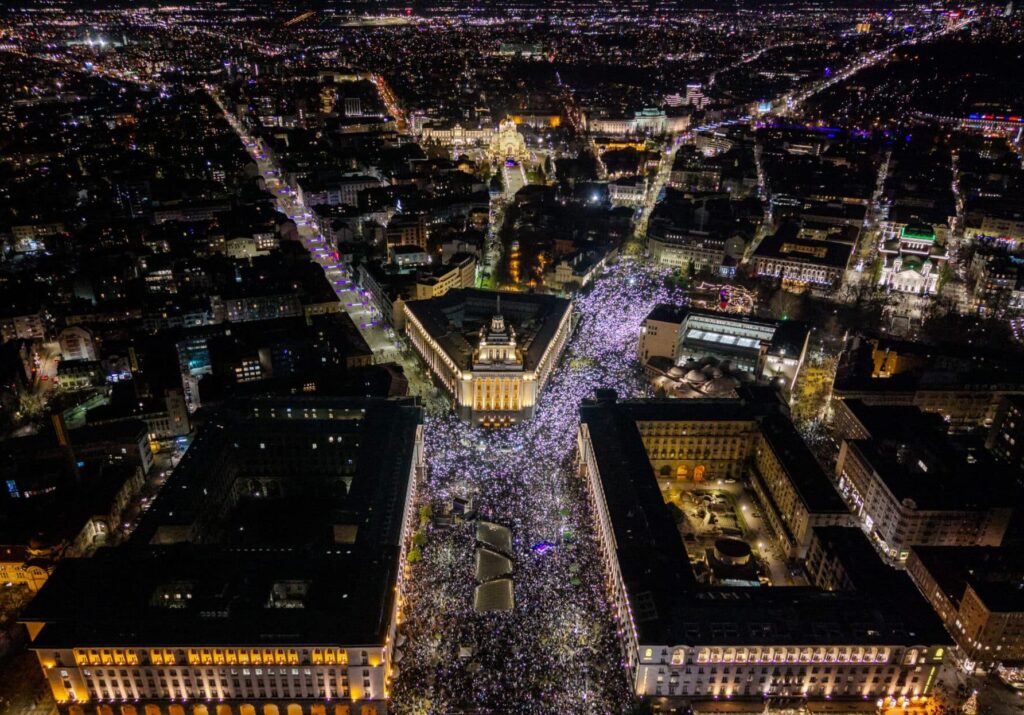
Huge crowds took to the streets of the capital Sofia and other major cities on Monday night to protest against the governing coalition of centre-right populists GERB, the pro-Russia Bulgarian Socialist Party and nationalist party There’s Such a People, backed by tycoon Delyan Peevski’s New Beginning.
The protests were some of the biggest for years, possibly since the 1990s, participants claimed. Sofia mayor Vassil Terziev described the demonstration in the capital as “the most well-attended in the last decade”.
Young people who have been organising themselves via TikTok and Instagram were a major presence. Some held placards with slogans like “Gen Z is coming for U” and “Give us a reason to stay” – a reference to emigration.
Thousands of people also filled the streets in cities like Plovdiv, Varna, Burgas and Veliko Tarnovo, where the demonstrations were also the biggest in recent years. The turnout reflected thirst for change in areas outside Sofia where GERB has remained the dominant force even as the opposition has gained support in the capital.
The current wave of protests erupted on November 26 in reaction to the proposed state budget, which introduces tax hikes on private businesses to fund state-sector wage rises, seen as a government tactic to increase its tight grip on state institutions, mainly the public administration and the police.
But protesters are also concerned about the relations between the GERB-led coalition government and controversial tycoon Peevski and his party New Beginning, which guarantees its parliament majority.
Although Borissov has said that the coalition is ready to revise the budget plan, Peevski is adamant that the current version should pass, making him the main target of the protesters – and widely ridiculed on home-made placards and banners.
The current demonstrations echo previous waves of protest in 2013-14 and 2020-21, which were also triggered by concerns about the political influence of Peevski.
Clashes with the police erupted near the headquarters of Peevski’s New Beginning party, predominantly caused by youths dressed in black hoodies and masks. Some suspected the clashes were staged to discredit the protest, as police did not intervene to stop them causing damage to an abandoned former GERB office in the city centre, while other protesters were subjected to bag checks.
Sofia mayor Terziev criticised the police for not reacting when there were “clear signs beforehand” that provocateurs would try to overtake the protest. “We won’t let a small group of hooligans to change the city’s outlook,” he added.
There were also claims that provocateurs tried to initiate clashes with the police in other towns.
Some protesters booed reporters from local TV stations for interviewing the radicals as legitimate protesters and recording footage at the points when city squares were emptier at the end of the night.
Protesters’ suspicions were also sparked by a power cut during the peak point of the protest for more than an hour, which the authorities blamed on a fire.