
Key Takeaways:
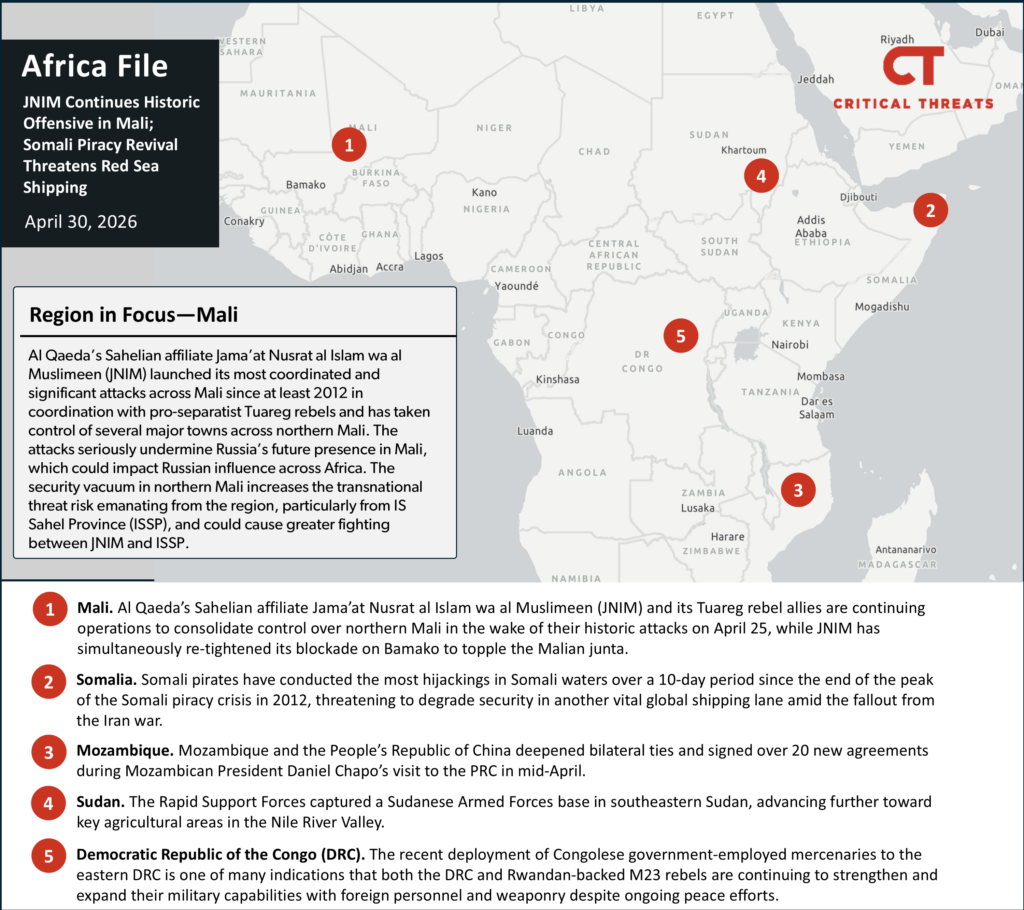
Mali. Al Qaeda’s Sahelian affiliate Jama’at Nusrat al Islam wa al Muslimeen (JNIM) and its Tuareg rebel allies are continuing operations to consolidate control over northern Mali in the wake of their historic attacks on April 25, while JNIM has simultaneously re-tightened its blockade on Bamako to topple the Malian junta. IS Sahel Province (ISSP) has also sought to consolidate control of its area of influence in northern Mali, although JNIM and Tuareg rebel encroachment on ISSP-dominated areas could fuel infighting between the two rivals. For full analysis and forecasting of JNIM’s initial April 25 attacks and their broader implications, read CTP’s recent special edition “Fall of Kidal—What JNIM’s Latest Offensive Means for Mali’s Future.”
Somalia. Somali pirates have conducted the most hijackings in Somali waters in a 10-day period since the end of the peak of the Somali piracy crisis in 2012. Sustained piracy off the Somali coast would degrade security in another vital global shipping lane amid the fallout from the Iran war and create opportunities for al Shabaab to benefit financially and further its ties with the Houthis.
Mozambique. Mozambique and the People’s Republic of China (PRC) deepened bilateral ties and signed over 20 new agreements during Mozambican President Daniel Chapo’s visit to the PRC in mid-April. The expanded PRC-Mozambique partnership framework reinforces a broader trend of African countries prioritizing sustainable growth and domestic value creation in their engagements with the PRC.
Sudan. The Rapid Support Forces (RSF) captured a Sudanese Armed Forces (SAF) base in southeastern Sudan, advancing further toward key agricultural areas in the Nile River Valley. The SAF recaptured an operationally significant crossroads town in the area, however, disrupting RSF efforts to flank SAF positions.
Democratic Republic of the Congo (DRC). The recent deployment of Congolese government-employed mercenaries to the eastern DRC is one of many indications that both the DRC and Rwandan-backed M23 rebels are continuing to strengthen and expand their military capabilities with foreign personnel and weaponry despite ongoing peace efforts.
Figure 1. Africa File, April 30, 2026
Assessments:
Mali
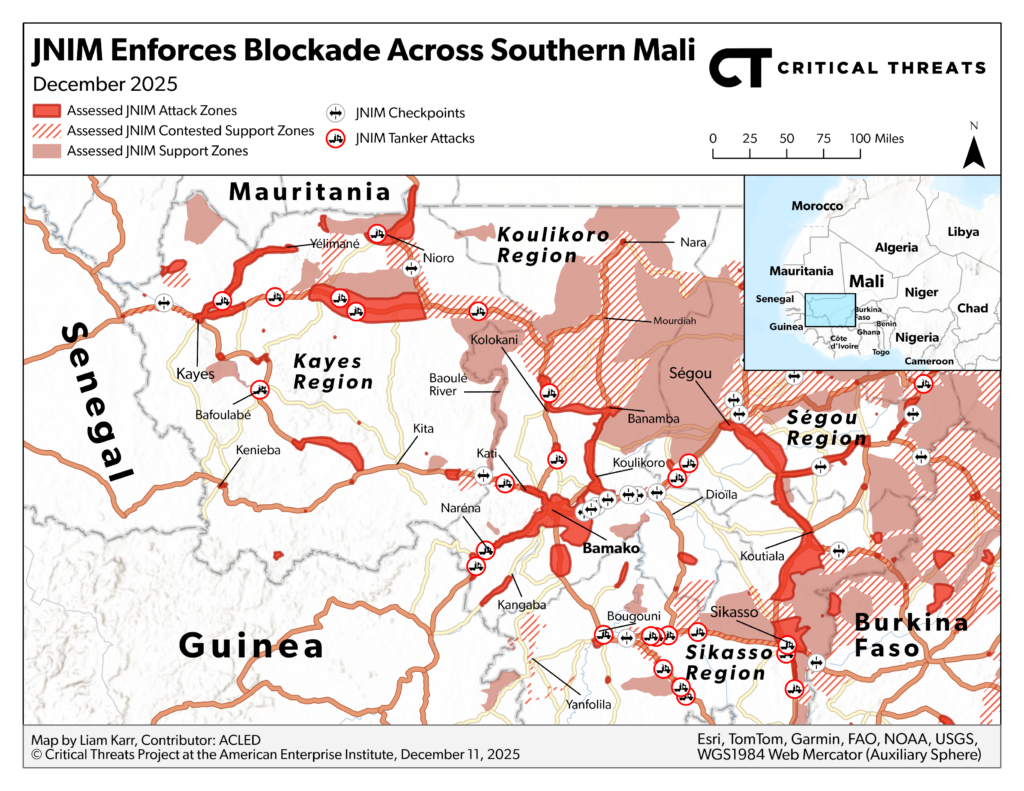
Al Qaeda’s Sahelian affiliate Jama’at Nusrat al Islam wa al Muslimeen (JNIM) announced that it was reimposing a full blockade in Bamako on April 28, as it seeks to capitalize on the overstretched and paralyzed Malian forces and topple the junta after launching a historic offensive on April 25. JNIM spokesperson Abu Hudheifah al Bambari, who is also known as Bina Diarra, announced on April 28 that JNIM was imposing a full blockade on Bamako.[1] Al Bambari framed the blockade as retaliation against Bamako civilians who helped Malian armed forces capture and kill JNIM attackers on April 25.[2] The group used this same rationale to justify blockades on towns in southern and western Mali in 2025.[3] Videos on social media showed JNIM halting several civilian passenger buses attempting to travel to Bamako from around Mali, including Ségou city, on April 29.[4] Radio France Internationale cited locals who said there were roadblocks 55 miles west of Bamako in Soribougou, 55 miles southwest of Bamako in Naréna, and 50 miles south of Bamako in Ouélessébougou.[5]
Figure 2. JNIM Blockades Bamako
JNIM is resuming a blockade that it launched in September 2025 that caused massive fuel inflation and rolling blackouts through early 2026. The blockade initially targeted supply corridors from Senegal and Côte d’Ivoire, which carry nearly 95 percent of Malian petroleum imports, and it eventually expanded to target the eastern supply corridor from Niger.[6] JNIM had destroyed more than 300 tankers by late 2025, causing fuel prices to more than double, closing gas stations across Mali, and leaving citizens waiting for hours in line at the stations that were still operable.[7] The diversion of limited fuel resources to the Malian army and the state-owned electricity provider Énergie du Mali forced many businesses and institutions to remain closed between late October and mid-November, while most major towns dealt with rolling blackouts or were left without power for several weeks.[8] The junta had eased the blockade in early 2026 through negotiations with JNIM and heightened military pressure, although JNIM’s decreasing efforts as it prepared for the April 25 attacks presumably played a partial role.[9] The global fuel shortages and inflation caused by the Iran war will only amplify the impact of the resumed blockade.
Figure 3. JNIM Enforces Blockade Across Southern Mali
The blockade likely aims to push the already fragile Malian junta to collapse. JNIM’s attacks on April 25 killed Malian Defense Minister Sadio Camara, seriously wounded the Malian intelligence chief, and targeted junta leader Assimi Goita, who disappeared from public for several days.[10] Several regional journalists and researchers reported that the attacks sparked a political crisis, with substantial elements of the Malian armed forces and government supporting General Malick Diaw, who leads the junta-controlled transitional parliament, to take over the Malian transitional council.[11] Goita reappeared publicly on April 28, meeting with a Russian delegation, visiting those affected by the attacks, and giving a public address to the nation, and has continued to attend events since.[12] A Malian officer told French outlet Jeune Afrique that “rivalries and attempts at repositioning among the coup leaders” were hindering military operations.[13] CTP has previously assessed that JNIM’s ongoing offensive across the country aims to topple the junta so that the group could engage more favorable authorities to expand its influence and de facto shadow governance across the country.[14]
The pro-separatist Tuareg rebel group Azawad Liberation Front (FLA) and JNIM are pressuring the remaining encircled Malian and Russian forces in Gao and Kidal regions and are expanding operations into the Timbuktu region as they seek to consolidate control over northern Mali. Malian and Russian forces have already withdrawn from at least six towns in northern Mali, with negotiations and discussions for further withdrawals ongoing. Militants have negotiated the withdrawal of Malian and Russian forces from Kidal city and Tessalit in the Kidal region, Ber and Léré towns in the Timbuktu region, and Intahaka and Tessit towns in the Gao region since April 25.[15] An FLA spokesperson said on April 28 that there were ongoing negotiations and preparations for the withdrawal of Russian and Malian forces from Aguelhok.[16] Rebels have also been negotiating the withdrawal of security forces from Gao city since capturing the town and confining security forces to their base on April 25.[17] Security forces unilaterally withdrew from Labbezanga, which is a town in IS Sahel Province’s area of influence near the Niger border.[18] Regional expert and journalist Wassim Nasr told France24 that there were rumors that Russian forces could withdraw from all of their positions in northern Mali to consolidate forces in central and southern Mali.[19]
Figure 4. Insurgents Take over Northern Mali
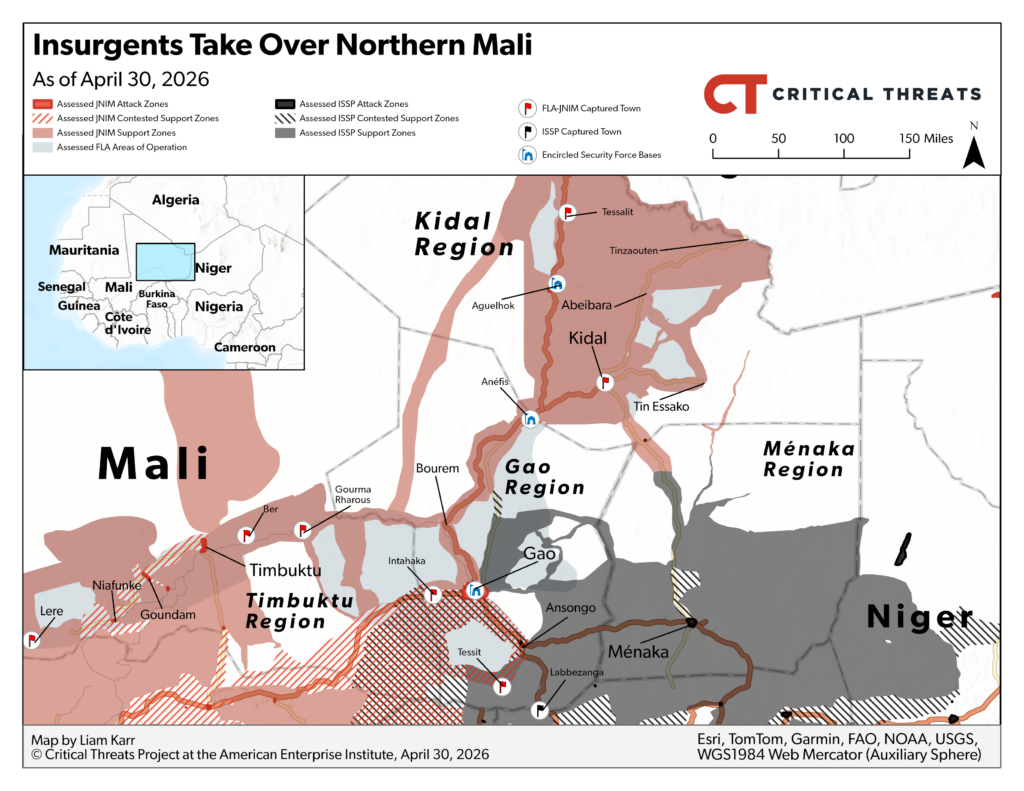
FLA and JNIM are now expanding attacks into the Timbuktu region, which was not targeted in the initial attacks on April 25, and these groups may seize Timbuktu city in the coming days or weeks. An FLA spokesperson told Agence France-Presse that “Gao, Timbuktu and Ménaka will be our next objectives to liberate” on April 28.[20] The FLA reportedly overran Malian forces based in Gourma-Rharous, a district capital 70 miles east of Timbuktu city on the southern bank of the Niger River, on April 29 and had consolidated control of the town by the next day.[21] The coalition already controls Ber, which is 30 miles east of Timbuktu city and lies on the main highway to Timbuktu along the northern bank of the Niger River. JNIM also overran a Malian army base near Hombori, which is the last major village in central Mali’s Mopti region along the highway to Gourma-Rharous and Gao city, on April 30.[22]
Figure 5. JNIM Launches Offensive Across Mali
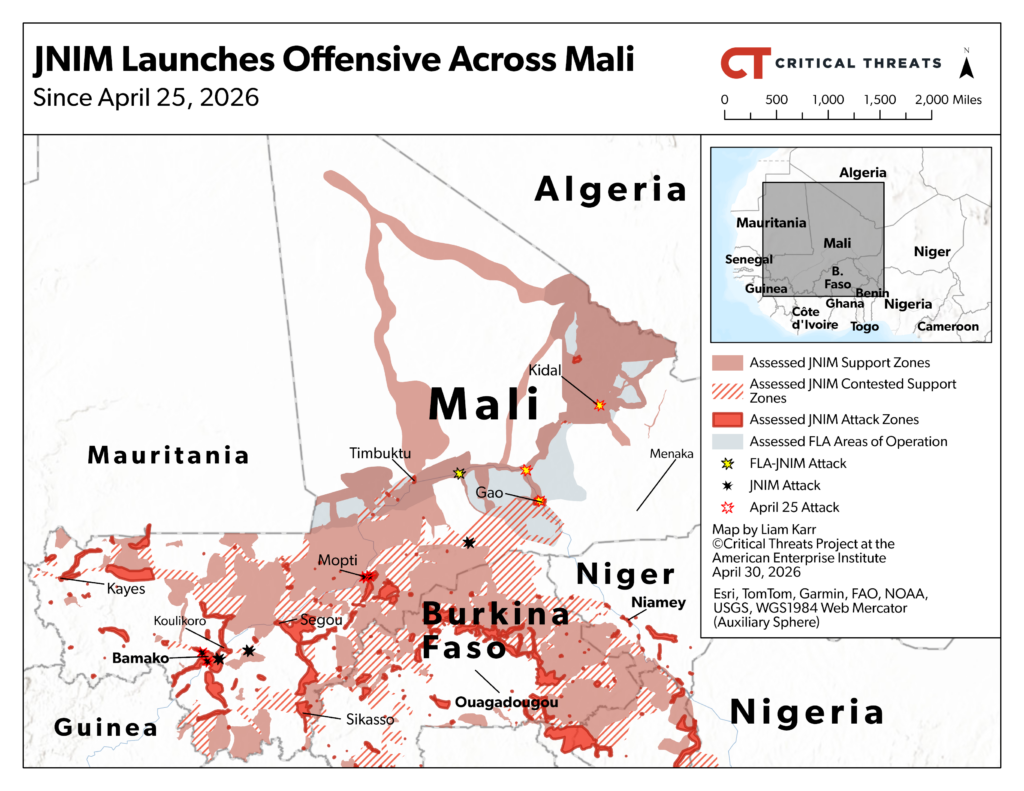
IS Sahel Province (ISSP) has attempted to consolidate full control of its area of influence in northern Mali to fill the emerging security vacuum, which will create conditions for increased infighting between ISSP and JNIM. ISSP militants took control of Labbezanga after security forces withdrew from the area on April 27.[23] ISSP then temporarily seized the regional capital Ménaka the night of April 28.[24] Malian and Russian forces returned to Ménaka town the morning of April 29 after withdrawing to their base on the town’s outskirts the night of April 28.[25]
CTP has previously assessed that the security vacuum in northern Mali could increase infighting between ISSP and JNIM. An FLA spokesperson listed Ménaka among the group’s objectives.[26] ISSP has besieged Ménaka, which is firmly in its sphere of influence, for years. Other parts of Gao and Ménaka regions are ISSP-dominated, including Tessit, which the FLA took over after negotiating the withdrawal of security forces. The two groups engaged in their most intense period of fighting in 2022 and 2023 as they sought to exploit the vacuum left by the withdrawal of French forces from northern Mali.[27] Countering ISSP has been a key aspect of JNIM’s cooperation with Tuareg groups as well, especially since ISSP, which is more closely affiliated with Fulani communities in this part of the Sahel, pushed JNIM and allied Tuareg rebels out of the Ménaka region and massacred Tuareg communities.[28]
Somalia
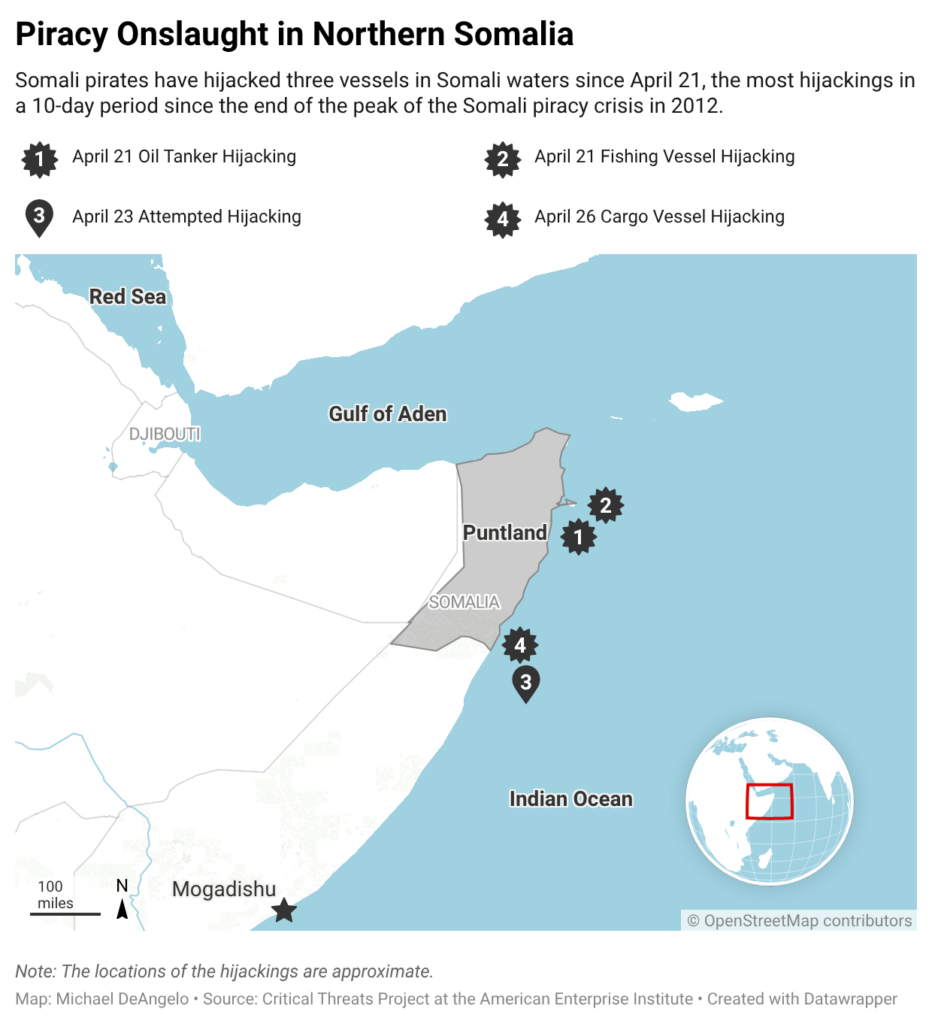
Somali pirates have conducted more hijackings in Somali waters in the past 10 days than they have in any other such period in more than a decade. Somali pirates have hijacked three vessels and attacked another since April 21.[29] Six pirates hijacked a Pakistani-owned oil tanker off the coast of Hafun—a district capital in Puntland state, which is the piracy hub of Somalia—on April 21.[30] The tanker has 17 South Asian crewmembers and 18,500 barrels of oil aboard.[31] The pirates proceeded to navigate the tanker 77 nautical miles south along the Somali coastline.[32] The same pirates may have been involved in another hijacking, as a group of the same size hijacked a Somali-flagged fishing vessel near Hafun on April 21.[33] Two pirate boats separately attacked a cargo vessel off the coast of southern Puntland on April 23, but the vessel repelled the attack.[34] At least nine pirates then hijacked a St. Kitts and Nevis–flagged cement cargo vessel traveling from the Suez Canal to Kenya’s Mombasa port off the coast of Gar’ad—a town in southern Puntland—on April 26.[35] The pirates navigated the vessel, which has 15 Indian and Syrian crewmembers aboard, toward the Somali coastline.[36] A Puntland security official said that a new pirate group made up of youth from an impoverished area is driving the increase in hijackings.[37]
Figure 6. Piracy Onslaught in Northern Somalia
The hijacking rate is at its highest level since 2012. Somali piracy reached its peak of almost weekly hijackings in the early 2010s, leading to tens of millions of dollars in annual earnings for pirates and approximately $7 billion in damages for the global economy in 2011, according to a US-based piracy research organization.[38] The European Union (EU), North Atlantic Treaty Organization, and United States led multilateral efforts to create international task forces in the Gulf of Aden and Indian Ocean to address the threat.[39] The elevated naval presence helped drastically reduce piracy in Somali waters, with only one hijacking from 2014 to 2022.[40] Piracy gradually increased from 2023 to 2026, although there were only scattered hijackings until April 2026.[41] A US-led multinational maritime security organization increased the threat level for the Somali coast to “substantial” on April 26, indicating that attacks are now a “strong possibility.”[42] The EU’s maritime security center in the Indian Ocean additionally recommended on April 28 that vessels exercise “a heightened level of vigilance” along the Somali coast.[43]
Sustained piracy off the Somali coast would degrade security in another vital global shipping lane amid the fallout from the Iran war. Up to 30 percent of global container traffic uses the Red Sea route, but past security threats in the Red Sea have caused increased insurance costs and reliance on less efficient, and therefore more expensive, alternate routes.[44] Somali piracy increased shipping costs by approximately 8 percent in the early 2010s, due to higher insurance rates and increased spending on vessel security.[45] Some vessels consequently rerouted around southern Africa’s Cape of Good Hope, a longer and more costly route.[46] Houthi drone and missile strikes on vessels from late 2023 to late 2025 likewise raised insurance costs by hundreds of thousands of dollars per shipment.[47] The Houthi strikes reduced shipping through the Red Sea by 75 percent, while shipping around Africa’s southern tip through the Cape of Good Hope more than doubled, according to the World Bank.[48]
The Iran war has already led to costly global supply disruptions, particularly in African and Asian countries, which rely on fertilizer and fuel imports from the Persian Gulf.[49] The Strait of Hormuz, which accounts for large shares of global gas and oil shipments, has alternated from being partially closed to completely closed since late February 2026.[50] The World Bank has projected a 31 percent increase in global fertilizer prices and 24 percent increase in global fuel prices in 2026.[51] Multiple African governments have introduced fuel subsidies and requested public rationing to offset disruptions, but countries such as Ethiopia are still facing fertilizer and fuel shortages.[52]
Al Shabaab could leverage its ties to reactivated piracy networks to establish alternative revenue streams and facilitate dealings with the Houthis. Al Shabaab’s primary revenue streams come from domestic tax collection, although al Shabaab took advantage of piracy from the early 2000s to the early 2010s.[53] Al Shabaab helped arm pirates and charged them a fee to operate in al Shabaab-influenced areas.[54] The United Nations (UN) has reported that al Shabaab has also increased ties with the Houthis through weapons smuggling and training, with al Shabaab militants even traveling to Yemen for training.[55] One UN member state reported that al Shabaab reportedly offered to increase piracy off the Somali coast in exchange for advanced Houthi weaponry and training during meetings in 2024.[56] A Puntland security official said that the new pirate group “will evolve into” al Shabaab or the Islamic State Somalia Province if governments fail to contain it.[57]
Mozambique
Mozambique and the People’s Republic of China (PRC) deepened bilateral ties and signed over 20 new agreements during Mozambican President Daniel Chapo’s visit to the PRC in mid-April. Chapo led a Mozambican delegation to China from April 16 to 22, which was his first state visit to the PRC and his first major trip abroad since taking office in January 2025. Chapo met with Chinese Communist Party General Secretary Xi Jinping in Beijing on April 21.[58] The Mozambican finance minister and other officials also held several meetings with PRC representatives.[59] Mozambican officials hailed the visit as ushering in a “new era” in relations between the two countries.[60] Chapo’s trip was the first state visit by a Mozambican president to the PRC since 2016, despite Mozambique having long-standing ties with the PRC.[61] The PRC backed Mozambique’s ruling party during Mozambique’s independence movement and the subsequent civil war that began in the late 1970s, and China is now one of Mozambique’s largest foreign investors and trading partners.[62]
The PRC upgraded diplomatic relations with Mozambique during Chapo’s trip. The PRC elevated Mozambique’s status to a partnership for the “new era” and in a “community with a shared future.”[63] The PRC often uses these phrases, which signify close cooperation and support for the PRC’s vision of global governance, in its diplomatic engagements, particularly with countries from the Global South.[64] The PRC had already designated Mozambique a comprehensive strategic cooperative partner, the highest partnership grouping outside of a handful of special accolades, which involves emphasis on the full pursuit of cooperation and development.[65]
The two countries signed over 20 new bilateral agreements during Chapo’s visit. Chapo and Xi announced in a joint statement that they had signed deals to strengthen cooperation in six main sectors: Belt and Road Initiative coordination, the Global Security Initiative, economy and trade, people-to-people exchanges, health care, and news media.[66] The deals include initiatives to facilitate PRC investment in an industrial park and Special Economic Zone near Mozambique’s capital.[67] The PRC agreed to invest in Mozambique’s mining sector and help Mozambique map deposits of high-value minerals in the country’s insurgent-afflicted northern region.[68] Mozambique is endowed with large reserves of graphite, lithium, and rare earth elements. The PRC also agreed to expand cooperation with the Mozambican military, including personnel training, equipment and technology transfers, and joint exercises.[69] Mozambique is already set to benefit from duty-free exports to the PRC beginning on May 1, as part of a new tariff regime that Xi Jinping announced with 53 African countries in early 2026.[70] The PRC agreed to supplement this zero-tariff policy by increasing Mozambican agricultural imports and expanding cooperation in the agricultural sector.[71]
The expanded PRC-Mozambique partnership framework reinforces a broader trend of African countries prioritizing sustainable growth and domestic value creation in their engagements with the PRC. The PRC historically engaged African countries with aid and through lopsided “resource-for-infrastructure” deals, trading state-backed investment in large-scale infrastructure projects for preferential access to natural resources. African countries are increasingly seeking “win-win” partnerships and to industrialize and retain more local value within global supply chains, however, with countries such as Ethiopia, Nigeria, and Senegal securing more PRC support for initiatives aimed at boosting local production and job creation in recent years.[72]
The expanded PRC-Mozambique partnership reflects this shift, emphasizing cooperation through initiatives such as knowledge transfers and improved market access for both countries.[73] Chapo said that global development should move from an “aid-centered model” to a “partnership-based model” on the sidelines of his state visit.[74] The PRC committed to finance new vertically integrated projects that help build Mozambique’s domestic industrial base, notably the development of local manufacturing and processing facilities, rather than mainly exporting raw materials, as part of the framework.[75] The PRC also committed to provide noncombat security assistance for counterterrorism efforts in northern Mozambique’s Cabo Delgado province, which continues to face the Islamic State Mozambique Province insurgency, as part of the expanded partnership.
Sudan
The Rapid Support Forces (RSF) captured a Sudanese Armed Forces (SAF) base in southeastern Sudan, advancing further toward key agricultural areas in the Nile River Valley. The RSF overran SAF positions in al Keili—located 90 miles south of Ad Damazin, the state capital of Blue Nile—on April 25.[76] Al Keili lies just to the east of the main north–south highway connected to Ad Damazin and the largest dam in Blue Nile. SAF units reportedly retreated to Dindiro, a town approximately 25 miles north of al Keili on the main highway.[77] The RSF and allied Sudan People’s Liberation Movement-North al Hilu militia has also tried to capture Sali—a town on the main highway west of al Keili—twice since April 25, but the SAF repelled both attempts.[78]
The RSF’s capture of al Keili strengthens its supply lines from western Ethiopia, which have enabled the group’s offensive toward the Nile River Valley since January 2026. The United Arab Emirates—the RSF’s primary backer—has significantly increased suspected weapons shipments to the RSF via RSF bases in western Ethiopia since November 2025.[79] Al Keili is approximately five miles from the Ethiopian border on one of three main roads leading from western Ethiopia into lower Blue Nile. The RSF had already captured a key border town on one of the other roads on March 26.[80] The RSF began drone strikes on the last border town—Geisan—in February and has since mobilized forces in Geisan district.[81] An RSF advance on Geisan from Sudanese territory would likely rely on side roads accessible via SAF-controlled Dindiro, however, as the other roads into Geisan originate in western Ethiopia.
Figure 7. RSF Offensive in Southeastern Sudan
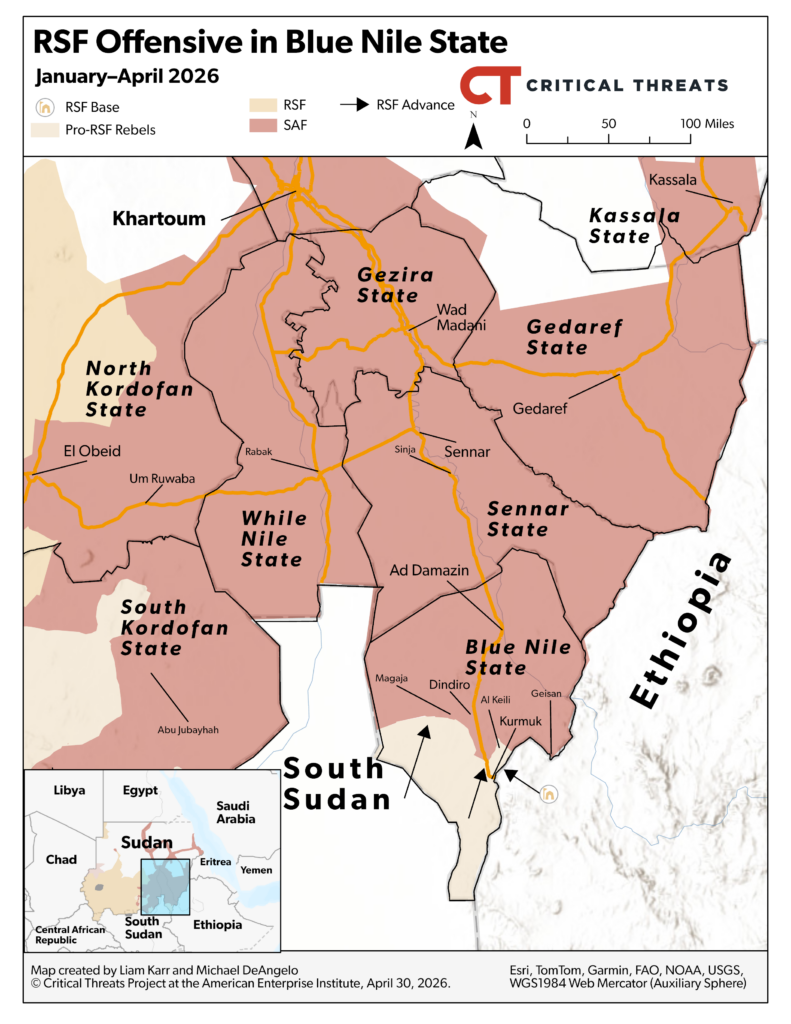
The SAF recaptured an operationally significant crossroads town in Blue Nile, however, reconnecting its supply lines between the Baw and Geisan districts. The SAF recaptured Magaja on April 20, after the RSF had taken control of town on March 26.[82] Control of Magaja connects SAF positions in Baw district near the South Sudanese border to Dindiro on Blue Nile state’s main highway, disrupting RSF efforts to flank SAF positions on either side.[83] The RSF has tried capturing SAF bases in al Silak and Malakan in Baw district as part of its offensive.[84]
Democratic Republic of the Congo
A new contingent of Latin American mercenaries employed by a company based in the United Arab Emirates (UAE) and linked with US sanctioned activities in Sudan reportedly deployed to the eastern Democratic Republic of the Congo (DRC) to support the Congolese government in its war against Rwandan-backed M23 rebels. The Paris-based investigative outlet Intelligence Online reported on April 22 that operatives linked to the UAE-based private military company Global Security Services Group (GSSG) have been recruiting Latin American first-person view (FPV) drone pilots operating in Kyiv, Ukraine, to fight against M23 in the DRC.[85] The report said that an initial contingent of contractors recently deployed to the Kivu region in the eastern DRC.[86]
The GSSG is reportedly backed by the Emirati government and has engaged Colombian private military contractors (PMCs) to support the Rapid Support Forces (RSF) against the Sudanese Armed Forces in Sudan’s civil war since late 2024.[87] The Conflict Insights Group assessed that Colombian PMCs linked to the GSSG were involved in mass atrocities committed during the RSF’s siege and capture of El Fasher, Sudan, in October 2025.[88] The US Treasury Department levied two rounds of sanctions on recruitment networks of Colombian companies and individuals, including a UAE-based retired Colombian colonel with ties to GSSG, related to the Sudan conflict in December 2025 and April 2026.[89]
The latest deployment of PMCs in the eastern DRC conflict further indicates that the Congolese government is relying heavily on foreign military support. The Congolese president began further increasing reliance on PMCs and allied militaries in December 2025, when the DRC suffered a major military setback after M23 captured Uvira town in South Kivu province with Rwandan army (RDF) support.[90] Algerian, Colombian, Israeli, and Turkish PMCs have reportedly been present at the Congolese army’s (FARDC’s) main airbase at Kisangani in the central DRC since late 2025.[91] Contractors linked to Erik Prince, a US PMC based in the UAE and informal adviser to US President Donald Trump, then deployed to South Kivu to help the FARDC reassert control of Uvira after M23 withdrew unilaterally under US diplomatic pressure and have since supported pro-Congolese government forces against M23’s coalition in South Kivu.[92]
Recent reporting indicates that Congolese government-employed PMCs continue to directly support the FARDC in kinetic military operations against M23.[93] Colombian PMCs are reportedly involved in drone operations against M23 in North and South Kivu.[94] These contractors could be participating in one-way attack (OWA) drone operations against M23-aligned militia fighters around Minembwe town in the South Kivu highlands—an area about 50 miles southwest of Uvira—which have increased significantly since early 2026. Lawrence Kanyuka, M23’s political spokesperson, claimed on three occasions that pro-Congolese government forces conducted attacks on M23 coalition positions around Minembwe using OWA drones, possibly Chinese-made FPV drones, in late April.[95] Kanyuka also accused the DRC of using Chinese-made CH-4 medium-altitude long-endurance drones, likely operated by DRC-employed PMCs from Kisangani, in an attack in eastern Walikale district in North Kivu and another strike in South Kivu in mid-April.[96] The FARDC reportedly bombed M23-aligned militia positions around Minembwe using a Czechoslovakian-made L-39 fighter jet in mid-April.[97] The UN had reported in July 2025 that Algerian PMCs maintained and operated two L-39 jets based in Kisangani.[98]
Figure 8. M23 and Allies Activity in South Kivu
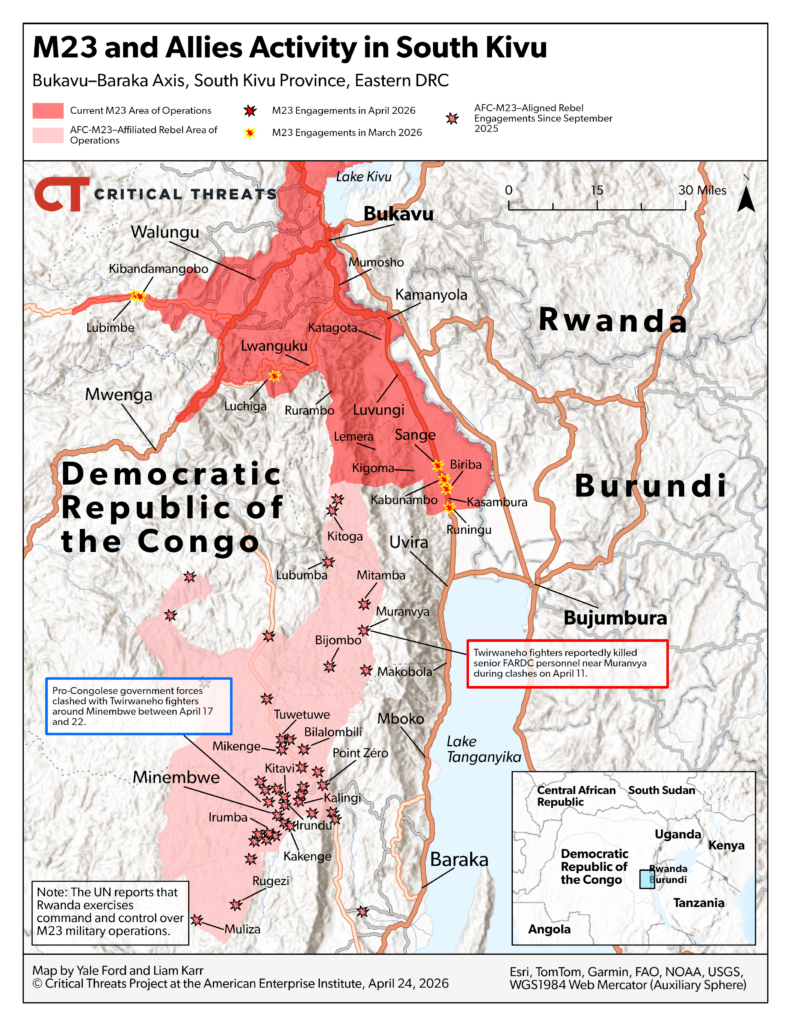
M23 is also continuing to strengthen its aerial warfare capabilities using foreign-supplied personnel and weaponry. M23 or M23-aligned militia fighters targeted FARDC and pro-Congolese government Wazalendo force positions in the South Kivu highlands using drones for the first time in March.[99] Congolese government-aligned media sources have claimed on several occasions since mid-April that M23 and the RDF conducted attacks in the South Kivu highlands using Turkish-made TB2 drones deployed from Rwanda.[100] The FARDC claimed that it shot down two fixed-wing M23 drones supplied by the RDF around Minembwe in late April.[101] The OWA drones allegedly used by M23 in the operation resemble the Turkish-made Yiha III variant, which M23 had reportedly used in at least two attacks on Kisangani in late January and early February.[102] The Congolese government accused the RDF of establishing a military base about 10 miles south of M23-controlled Bukavu, the South Kivu provincial capital, in mid-April.[103] Pro-Congolese government accounts on social media accused the RDF and M23 of collaborating with Chinese nationals to manufacture and test drones and other munitions at an airport near Bukavu in late April.[104] CTP is unable to verify this claim. The French outlet Le Monde had cited a “well-informed observer” in early February who said that “foreign trainers” had been present in Goma and at M23’s main military base, likely to help with drone operations.[105] Kanyuka implied in early February that M23 was using drones and mercenaries.[106]
Efforts by both sides to expand their operational capabilities are undermining the political process supported by the United States and its partners to secure a ceasefire and a negotiated peace settlement. The DRC and M23 signed a Qatari-brokered peace framework agreement with eight separate negotiating tracks in November 2025, which charted a path toward reaching a comprehensive, long-term deal.[107] No ceasefire took root, however, and the security situation on the ground continues to deteriorate, despite M23’s withdrawal from Uvira and efforts to allow international and African bodies to support the implementation of a ceasefire. Peace talks have remained largely deadlocked due to procedural disputes, mutual distrust, and deep-seated disagreements, and CTP assessed in late March 2026 that the DRC and M23 continue to pursue a military-first approach to the standoff.[108] The two sides reconvened for a ninth round of peace talks in Switzerland in mid-April for the first time since early February and signed several new technical agreements to help implement the first two pillars—including a prisoner exchange—which they had initially resolved in late 2025.[109] The Congolese government is reportedly delaying the prisoner exchange process, however, and several disagreements reportedly blocked progress on reaching a deal on the third pillar in Switzerland, as the two sides continue trading accusations of ceasefire violations.[110]