
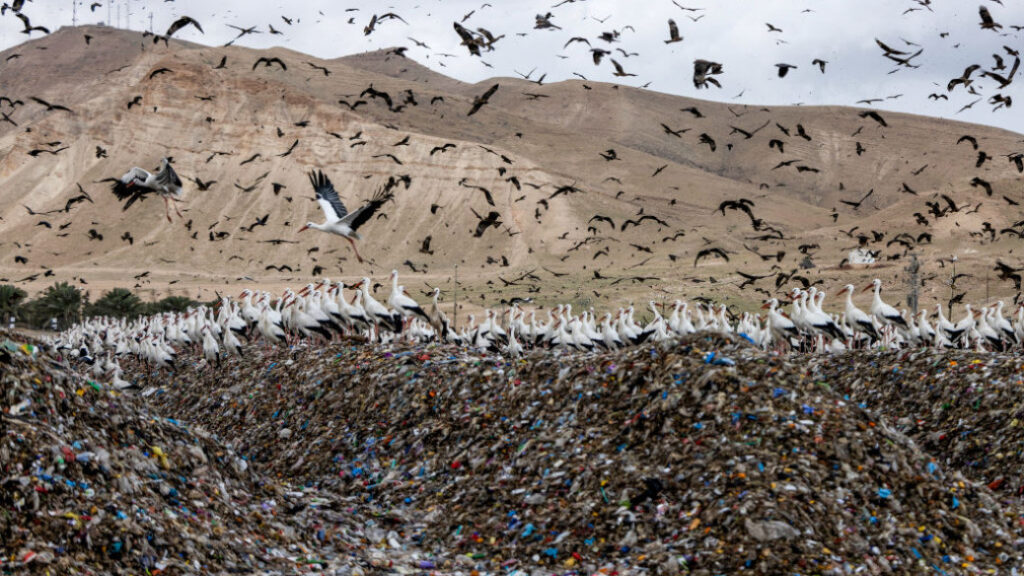
This new military law appears, on the surface, to be environmentally friendly, but its essence is dangerous: it continues the policy of land confiscation.
Residents of the town of Ni’lin, west of Ramallah, were surprised by an Israeli military order to confiscate a plot of land under the recently issued Israeli anti-pollution law enforced over the occupied West Bank.
This new military law appears, on the surface, to be environmentally friendly, but it is merely a continuation of the policy of land confiscation, disguised as “greenwashing”.
Israeli Defence Minister Yisrael Katz and Finance Minister Bezalel Smotrich claim that illegal waste burning in the West Bank poses a threat to national security and announced a national emergency plan following an urgent meeting with local authority heads, according to a report in The Times of Israel on 18 December.
According to a statement issued by the Israeli Ministry of Defence, the plan will include strict measures to combat fires, the administrative confiscation of Palestinian waste trucks, large-scale waste removal, and the establishment of a new waste disposal site in the central occupied West Bank.
At the same time, the Israeli Civil Administration announced the closure of four waste-burning sites covering an area of 45 dunams.
Unjustified confiscation
A day after the military order “Combating Pollution” was issued, the municipality of Ni’lin was informed that the Israeli army would confiscate several dunams of the town’s land to establish a landfill.
Youssef al-Khawaja, the mayor, told The New Arab that Ni’lin is clearly the first victim of this decision, as land would be confiscated without justification to establish a landfill.
A landfill already existed in the area, but the Israeli army filled it in after realising that the burning waste was emitting fumes towards the homes of the illegal Israeli Modi’in settlement, built on Ni’lin land.
“We were only informed of the confiscation decision for the purpose of building a road leading to the landfill. We don’t know whether this will stop here or extend to other lands. We are frankly worried,” al-Khawaja said.
The landfill that the Israeli army previously closed was initially an illegal dumping ground for hazardous solid waste transported from inside the 1948 boundaries by Israeli trucks to be disposed of in Palestinian towns in the West Bank, including Ni’lin.
According to al-Khawaja, the municipality has been trying to close it since its establishment due to the health and environmental risks it poses to the town’s residents, especially since it contains hazardous waste transported from Israeli factories and hospitals to areas in the West Bank.
“The foul odours, smoke, and gases emitted from the landfill, in addition to the constant disturbance caused by the trucks entering residential areas, especially at night, all cause significant harm to the town’s residents and the entire region,” the mayor explained.
Part of annexation?
According to Palestinian environmental sources, agricultural lands in the occupied West Bank have been transformed into dumping grounds for Israeli waste containing chemical compounds and heavy metals.
Israel operates 15 solid waste facilities on Palestinian land, including six designated for hazardous waste.
It appears that the cost of disposing of this waste within Israel is high, prompting it to transport it to the occupied West Bank, where dumps are cheaper and operate without any oversight.
This has caused severe repercussions, including the destruction of agricultural land, soil contamination with heavy metals, the seepage of pollutants into groundwater, and the emission of toxic gases that directly affect the respiratory systems of Palestinians.
Jamal Juma, coordinator of the “Stop the Wall” campaign and a researcher on Israeli settlements, told TNA that the problem of these dumps began during the First Intifada in the 1990s when Israel sealed off West Bank cities and prevented waste trucks from reaching the dumps. As a result, many cities and villages were forced to create makeshift dumps within their own urban areas.
Juma opines that Israeli settlements are the primary source of pollution in the occupied West Bank, such as the discharge of wastewater into springs and plains, like in Wadi Bruqin near Salfit, originating from the Ariel settlement, or via chemical waste from factories in the settlements, which runs into agricultural lands, through valleys, and pollutes springs and groundwater.
“The recent issue of landfills is part of the annexation process and the control over Palestinian decision-making, stripping the Palestinian Authority and municipalities of their powers. Israel has prevented the establishment and expansion of many landfills, such as the one in Al-Bireh,” he said.
Juma added that much of the chemical waste from within Israel is buried in the Jenin and southern Hebron areas, thus using the environment as a weapon to restrict Palestinian space and establish a form of sovereignty for the settlements.
“The talk is that the settlements will begin dumping their waste in Palestinian landfills to consolidate their control over key areas of the West Bank, stripping Palestinians of any form of decision-making power, shrinking their land, and making all aspects of their lives subject to the Israeli Civil Administration,” he said.
According to data from the Palestinian Central Bureau of Statistics, illegal Israeli settlements in the occupied West Bank, which lack adequate wastewater treatment facilities, produce approximately 40 million cubic meters of sewage annually.
Studies conducted by the Bureau note that about 90% of this waste, or approximately 35 million cubic meters, is discharged untreated into the Palestinian territories.
Research conducted by the Italian humanitarian organisation CESVI also spotlighted that settlers produce more solid waste per person than Palestinians. While the average Palestinian in the West Bank produces 0.9 kilograms of solid waste per person per day, the average Israeli settler produces 1.9 kilograms per person per day. Based on this, the settlements are estimated to produce approximately 1,200 tons of solid waste per day.