
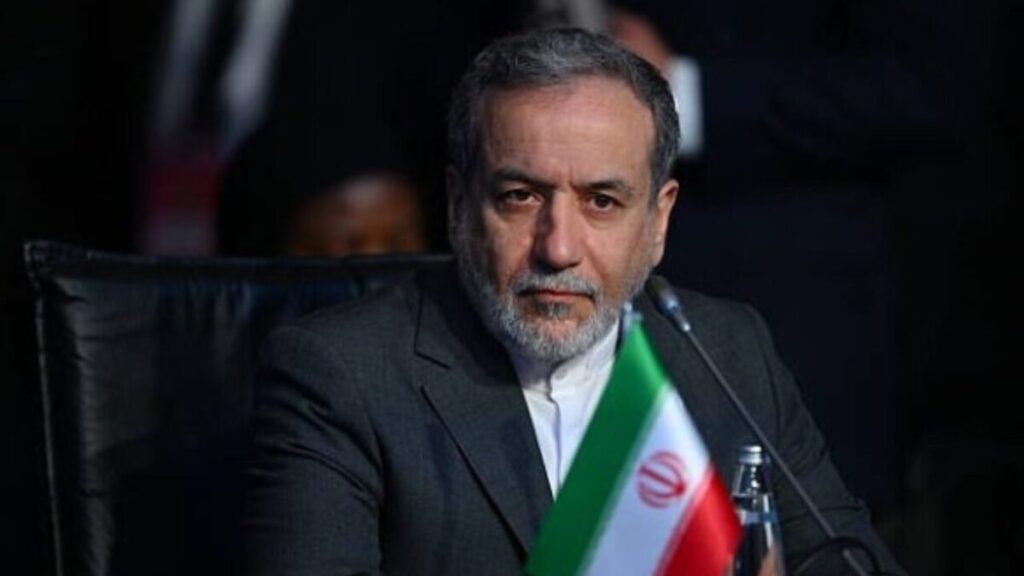
Iran’s foreign minister said Tuesday that “good progress” had been made in indirect nuclear talks with the United States in Geneva, describing broad agreement on guiding principles for a potential deal even as tensions between the two countries remained high.
The negotiations, mediated by Oman, took place in Switzerland against a backdrop of military maneuvers by both sides in the Persian Gulf.
“Ultimately, we were able to reach broad agreement on a set of guiding principles, based on which we will move forward and begin working on the text of a potential agreement,” Foreign Minister Abbas Araghchi said on Iranian state television after the talks.
Compared with an earlier round held in Oman this month, he said, “good progress” had been made. “We now have a clear path ahead, which I think is positive.”
Araghchi cautioned that narrowing the remaining gaps would take time. Once draft texts are prepared by both sides, he said, they would be exchanged and a date for a third round of talks set.
In Washington, Vice President JD Vance offered a more measured assessment. In an interview with Fox News, he said the talks had gone well in some respects, noting that the sides had agreed to continue discussions. But he added that President Trump had set “red lines” that Iran was not yet prepared to acknowledge.
“We’re going to keep on working it,” Vance said. “But of course, the president reserves the ability to say when he thinks that diplomacy has reached its natural end.”
Iran has long sought relief from sweeping American sanctions, including restrictions on its oil exports. Tehran has said the talks should focus on its uranium enrichment program and that any agreement must provide tangible economic benefits while preserving Iran’s sovereignty.
The United States has demanded that Iran forgo uranium enrichment on its own soil and has sought to broaden the negotiations to include nonnuclear issues, such as Iran’s missile program. Iranian officials have rejected a “zero enrichment” demand and have said their missile capabilities are not open for negotiation.
The diplomatic effort has unfolded amid heightened military posturing. The United States has deployed two aircraft carriers to the region, including the USS Abraham Lincoln, positioned hundreds of miles from Iran’s coast, placing fighter jets within striking range. A second carrier was dispatched over the weekend.
Iran’s supreme leader, Ayatollah Ali Khamenei, warned Tuesday that the country had the ability to sink a US warship. “A warship is certainly a dangerous weapon,” he said, “but even more dangerous is the weapon capable of sinking it.”
At the same time, Iran’s Islamic Revolutionary Guard Corps began military exercises in the Strait of Hormuz, citing preparations for “potential security and military threats.” Iranian state media reported that parts of the waterway were temporarily closed as a precaution during the drills.
Iran has repeatedly threatened to shut the strait — a critical artery for global oil shipments — in retaliation for any attack, a move that could disrupt roughly a fifth of the world’s oil supply and drive up prices.
A previous diplomatic effort collapsed last year after Israel launched surprise strikes on Iran in June, touching off a 12-day conflict in which the United States briefly joined Israel in bombing nuclear sites at Natanz, Fordow and Isfahan.
Ali Vaez, director of the Iran project at the International Crisis Group, said there appeared to be room for compromise on nuclear issues because Iran’s program had been significantly degraded during the conflict. But he said Tehran was unlikely to make major concessions on regional policies or its missile program.
Iranian President Masoud Pezeshkian reiterated in an interview published Tuesday that Tehran was “absolutely not seeking nuclear weapons” and said Iran was open to verification. But he insisted that Iran would not accept restrictions preventing it from using nuclear technology for civilian purposes.
Iran is a signatory to the Nuclear Non-Proliferation Treaty, which allows civilian nuclear energy programs under international monitoring. Israel, which has not signed the treaty, neither confirms nor denies possessing nuclear weapons.
The Geneva talks, though described as constructive by Iranian officials, leave substantial differences unresolved — and the threat of further escalation still looming.