
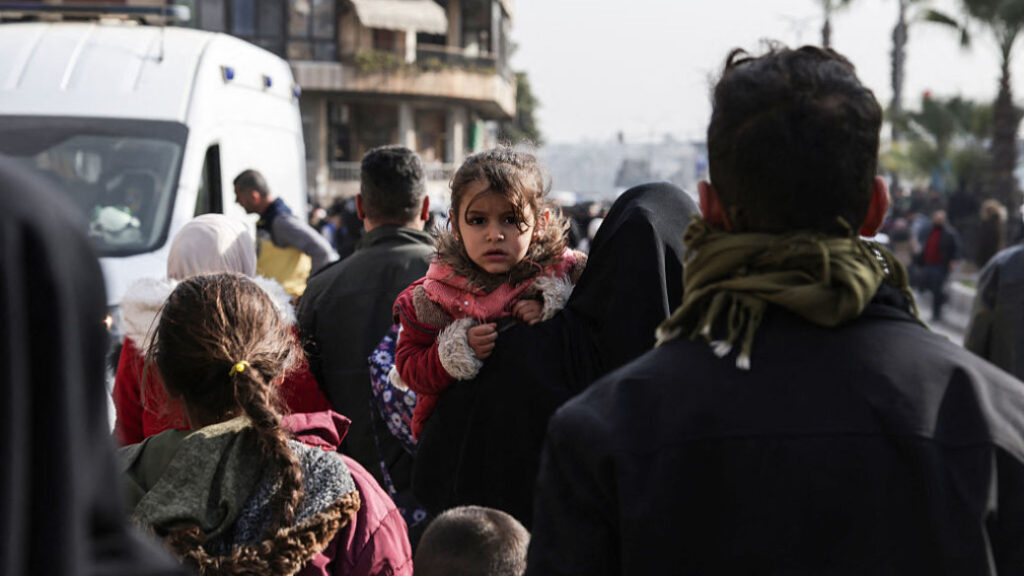
What began as clashes in Aleppo’s Kurdish neighbourhoods is now reshaping life in Iraqi Kurdistan, from street protests to media shifts and refugee tensions.
Clashes between Syrian government forces and Kurdish armed groups in Ashrafia and Sheikh Maqsoud, Kurdish-populated neighbourhoods of Aleppo, have notably altered the political and social dynamics within Iraqi Kurdistan.
These developments encompass public demonstrations, shifts in Kurdish media coverage, the cancellation of a Syrian trade fair, and incidents of violence targeting Syrian refugees living in the region.
Masoud Barzani, leader of the ruling Kurdistan Democratic Party (KDP), condemned the attacks on Syrian refugees and advocated for restraint and peaceful coexistence.
Barzani called for an end to what he described as “illegal campaigns” against Arab Syrian residents in the Kurdistan Region, labelling them as “inappropriate behaviour.” He stated that such actions are inconsistent with Kurdish values and the region’s institutional policies.
On Sunday, hundreds of Sulaymaniyah residents protested in the city centre against the displacement of Kurds from Aleppo’s Sheikh Maqsoud and Ashrafia districts. Comparable demonstrations occurred in Erbil on Friday and in Halabja province.
Kurdish-language media, predominantly owned by the KDP and the Patriotic Union of Kurdistan (PUK), have offered extensive coverage of the Aleppo clashes and have been openly critical of both Syrian authorities and Turkey-backed militias.
Responding to public pressure, Erbil Governor Omed Khoshnaw cancelled a Syrian trade fair that was scheduled for later this month.
After the clashes, Shams TV, an Arabic-language channel affiliated with the KDP, abruptly cancelled a televised interview with Syrian President Ahmed al-Sharaa.
Fethullah Husseini, who represents the Autonomous Administration of North and East Syria (AANES) in the Kurdistan Region, told The New Arab that after attacks by the Syrian army and Turkey-backed militias on Kurdish-populated areas in Aleppo, several injured individuals are now receiving treatment in hospitals in the Iraqi Kurdistan region, mainly in Duhok province.
He expressed appreciation for the Kurdistan Regional Government’s (KRG) position. Addressing reports of mistreatment of Syrian refugees, al-Husseini condemned such actions and emphasised that the KRG should prevent any mistreatment of Syrians in the region.
Husseini also acknowledged the solidarity demonstrated by the people of the Kurdistan region and commended Kurdish media for exposing the “massacre” in the two neighbourhoods. In contrast, he criticised Arabic media channels, including Al Jazeera, Al Arabiya, and Al Hadath, as “very bad” and “unprofessional”.
Tensions have also led to isolated attacks on Syrian refugees, most of whom live in camps or major cities.
Kurdish security forces have made several arrests and reported that these incidents were limited to five or six cases throughout the region.
Kifah Mahmoud, media adviser to Barzani, told Al-Araby Al-Jadeed, TNA’s Arabic language sister website, that the incidents constituted abuses by Syrian Kurds against Syrian Arabs, noting that many Syrians in the region have family ties to Aleppo. He explained that emotions regarding the events in Aleppo influenced actions and reactions, prompting regional leaders to reiterate calls for coexistence and a zero-tolerance policy toward abuse based on ethnic or national identity.
Mahmoud denied that these reactions represent an official political stance, emphasising that the regional government opposes such violations and will hold perpetrators accountable. He stated that Syrian refugees of all backgrounds are protected by both the government and the Kurdish public, and that incidents of violence and hate are closely monitored.
According to the UN High Commissioner for Refugees, Iraq hosts approximately 341,000 refugees and asylum seekers, with over 90 per cent being Syrians. Approximately 85 per cent of these individuals reside in the Iraqi Kurdistan Region, while the remaining 15 per cent are located in central and southern provinces.
Barzani’s message represents an official effort to reduce inflammatory rhetoric and maintain social unity in the Iraqi Kurdistan Region, which has hosted large numbers of Syrian refugees for over a decade despite ongoing regional tensions.