
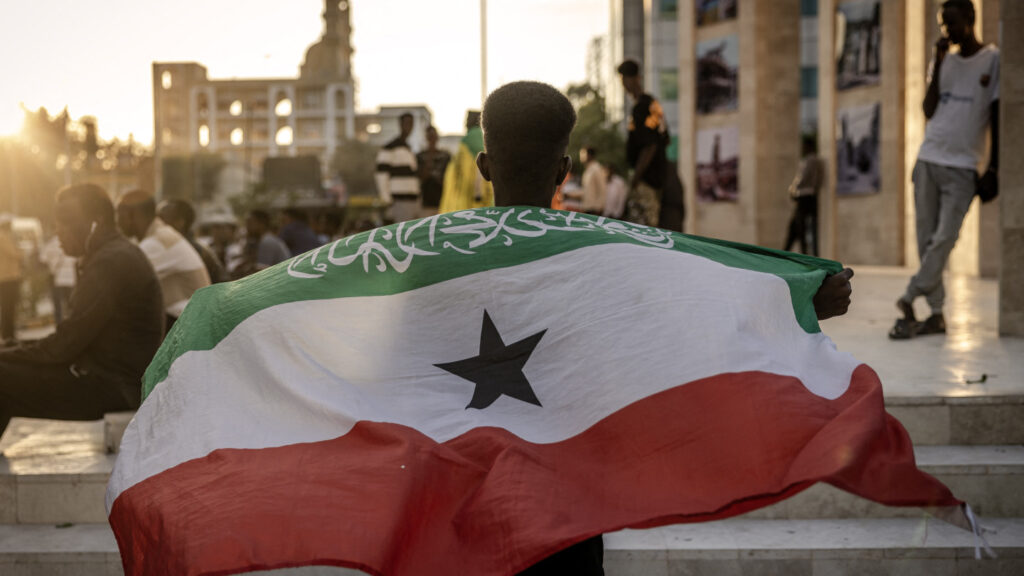
Late last year, Israel broke new diplomatic ground by becoming the first country to formally recognise the independence of Somaliland, a self-declared republic existing within Somalia’s internationally recognised territory.
Perched along the southern coast of the Gulf of Aden, extremely close to the strategically vital Bab al-Mandab strait, Somaliland has spent more than three decades seeking international legitimacy after declaring independence in 1991.
Tel Aviv’s decision marked a historic turning point for the breakaway state, conferring unprecedented recognition from a UN member and instantly transforming a long-frozen question of sovereignty into a matter of regional and global consequence.
Somaliland’s president, Abdirahman Mohamed Abdullahi, welcomed the development as a “historic moment.” In a phone call with Abdullahi, Israeli Prime Minister Benjamin Netanyahu said that Tel Aviv was recognising Somaliland’s “right of self-determination,” a step he argued would create “a great opportunity for expanding” Israel’s ties with the breakaway republic.
Israel has pledged to deepen its cooperation with Somaliland across a wide range of sectors, including agriculture, economics, health, and technology.
Nonetheless, officials in Somalia’s government in Mogadishu swiftly and forcefully condemned Israel’s decision. Analysts now warn that Tel Aviv’s recognition of Somaliland could reverberate within Somalia itself, aggravating long-standing political fault lines and inflaming tensions that remain far from resolved.
“Recognition of Somaliland is a highly sensitive issue both within Somaliland and across Somalia, seen by many as a further division of the Somali territories of the Horn of Africa,” Dr Nisar Majid, research director for the PeaceRep (Somalia) programme at the London School of Economics, told The New Arab. He also stressed that “no incumbent national president in Mogadishu wants to be known as having ‘lost’ Somaliland under his watch”.
Dr Majid told TNA that many Somalis see Tel Aviv’s recognition of Somaliland as a “precursor” to more countries making that same decision, which could risk “damaging a spirit of reconciliation that has re-emerged regularly over the past two decades, and which will play into the hands of anti-federalists and centralists who advocate for a centralised state”.
He further cautioned that the move is likely to sharpen internal divisions within Somaliland, particularly in the eastern region of Sanaag and the western region of Awdal.
In response, both Djibouti and the Federal Government of Somalia (FGS) may feel compelled to step up political and material support for unionist areas, while deliberately distancing themselves from the separatist leadership in Hargeisa.
According to Dr Majid, such dynamics carry a serious risk of sparking armed conflict within Somaliland itself. At the same time, he noted, Puntland and Jubbaland are likely to exploit the situation to intensify pressure on the president of FGS.
Beyond Somalia’s borders, Israel’s recognition of the semi-desert territory in the Horn of Africa has sparked widespread controversy. Many governments, particularly across the Arab and Islamic world, fear that a formalised Israel-Somaliland relationship could carry far-reaching repercussions that extend well beyond the realm of diplomacy.
Several months ago, multiple news outlets reported that Israel had approached Somaliland about the potential resettlement of Palestinians forcibly displaced from Gaza. Israel declined to comment on these reports, while Somaliland insisted that any Israeli decision to recognise its independence would be entirely unrelated to the Palestinian issue.
Nevertheless, both Somalia and the Palestinian Authority have suggested that Tel Aviv’s recognition of Somaliland could be linked to a broader plan to displace Palestinians.
Speaking to his parliament, Somalia’s president categorically rejected this possibility, declaring, “Somalia will never accept the people of Palestine to be forcibly evicted from their rightful land to a faraway place”.
Strategic flashpoint: Somaliland and the Horn of Africa
Somaliland’s largest port, located in Berbera, also features an extensive runway, making it a strategically significant hub in the region. For years, officials in the breakaway statelet have leveraged these facilities to cultivate closer ties with foreign powers.
Recent speculation suggests that Israel may seek to establish a military presence in Somaliland, although Hargeisa – the capital and largest city of the self-declared republic – has maintained that no such plans are underway.
States across the broader region swiftly condemned Israel’s recognition of Somaliland, each citing reasons tied to their own national interests.
Highlighting the range of motivations behind this opposition, Dr Michael Woldemariam, associate professor and PhD program director at the University of Maryland School of Public Policy, noted that there are two main strategic inclinations that most of these countries share.
First is a “serious discomfort with growing power and influence of what might be considered a UAE-Israeli axis in the southern Red Sea and Gulf of Aden”, and second is a “general desire to avoid the crack-up of existing state boundaries in the region,” he told TNA.
Turkey’s strategic response and regional stakes
On 30 December 2025, Turkish President Recep Tayyip Erdogan used strong language to condemn Israel’s “illegitimate and unacceptable” recognition of Somaliland. That same day, Somali President Hassan Sheikh Mohamud joined Erdogan in Ankara for a joint news conference, where he warned that the Israeli recognition could “add more layers of instability to the Horn of Africa.” Erdogan also announced that Turkey plans to deploy a deep-sea energy drilling vessel to Somalia’s coast next month.
In the past, Ankara has acted as a mediator between Mogadishu and Hargeisa, while also investing in Somalia by developing a range of economic interests and supporting the country’s security forces.
From the perspective of Turkish authorities, Israeli recognition of Somaliland poses a threat to these economic stakes and represents a serious challenge to the national sovereignty of Somalia.
Egypt’s opposition and Iran’s concerns
Having condemned Israel for unilaterally recognising Somaliland in violation of international law and the UN Charter, Egypt described Tel Aviv’s move as a threat to regional and global peace.
In recent years, Cairo has clashed with Ethiopia over the Grand Ethiopian Renaissance Dam (GERD), heightening the strategic importance of its relationship with Somalia. The security pact signed between Cairo and Mogadishu in 2024 underscores this dynamic. Understandably, Egypt views a strong, unified Somalia as crucial to its efforts to counterbalance Addis Ababa.
Iran also quickly voiced its opposition to Israel’s Somaliland recognition. “Recognition of a part of an independent country by an illegitimate regime is aimed at fragmenting Islamic countries, weakening the region, and making it more vulnerable to Israeli ambitions and aggression,” declared Iranian Foreign Ministry Spokesperson Esmaeil Baqaei.
Tehran’s reaction came as little surprise, given the Islamic Republic’s deep concerns over the possibility of an Israeli presence near the Bab al-Mandab, from which it could threaten Yemen’s Houthi rebels – currently Iran’s most powerful ally in the “Axis of Resistance” following the events of 2024, which entailed Lebanon’s Hezbollah suffering major blows in its conflict with Israel.
Simply put, Iran views any Israeli military foothold within Somalia’s UN-recognised borders as a significant challenge to its strategic interests across the Horn of Africa, the Red Sea, and the Gulf of Aden.
Noting that the Houthis’ geographic distance from Israel provided Ansar Allah an advantage during direct hostilities with the country following 7 October 2023, Dr Stig Jarle Hansen, professor at the Norwegian University of Life Sciences, told TNA that an Israeli military base in Somaliland would be a “strategic challenge” and a “nightmare” for the Houthis.
In response, the Houthis threatened that any Israeli presence in the territory would be a “target”.
The Gulf reacts: Unity, solidarity, and strategic calculations
Members of the Gulf Cooperation Council (GCC) voiced strong opposition to Israel’s recognition of Somaliland, primarily viewing the move as destabilising, a violation of Somalia’s sovereignty, and a threat to regional stability.
On 4 January, Saudi Foreign Minister Prince Faisal bin Farhan met with his Somali counterpart, Abdisalam Abdi Ali, in Riyadh, where Saudi Arabia’s chief diplomat “reaffirmed the Kingdom’s full support for the sovereignty of the Federal Republic of Somalia and the unity and territorial integrity of its land, rejecting anything that undermines Somalia’s security and stability”.
Senior officials from other GCC states echoed this stance, expressing solidarity with Mogadishu in similarly firm terms.
The United Arab Emirates (UAE) remains a key actor to watch in this unfolding situation. Abu Dhabi did not officially denounce Israel’s diplomatic recognition of Somaliland; it has a longstanding record of political, economic, and strategic support for the breakaway republic – albeit without formally recognising its independence.
Through extensive commercial and investment activities in Berbera, the UAE has become a major player in Somaliland, a presence that has heightened tensions with Mogadishu, where the FGS views Abu Dhabi’s involvement as a challenge to the country’s sovereignty and territorial integrity.
“We have not yet seen direct evidence of the UAE’s involvement in Israel’s recognition of Somaliland, but I think there is a clear convergence of interests between the two sides on this issue. Going forward, I would expect Abu Dhabi and the Israelis to coordinate (often covertly) their support for Somaliland,” Dr Woldemariam told TNA.
“For the UAE, the perception of a stronger and recognised Somaliland fits into its Red Sea strategy, as the Southern Transitional Council’s push for a Southern state in Yemen. In the Red Sea and the Gulf of Aden, the UAE and Israel’s strategies continue to converge, driven by maritime security and counter-smuggling,” said Eleonora Ardemagni, a senior associate research fellow at the Milan-based Institute for International Political Studies, in a TNA interview.
“These strategies look increasingly opposed to those of Saudi Arabia and Egypt, which instead advocate for the same regional security goals, but pursued through the status quo in both Somalia and Yemen,” she added.
Dr Hansen expects the UAE to act cautiously in order to “keep a low profile,” particularly given existing tensions with Saudi Arabia over Yemen, which could intensify if Abu Dhabi is increasingly perceived as closely aligned with Israel in supporting Somaliland.
As he explained to TNA, the UAE is in a “tough spot,” and officials in Abu Dhabi “don’t want to signal too much support for Somaliland because it’s too costly because of the wider Arab world”.
Reshaping fault lines
Ultimately, Israel’s recognition of Somaliland represents far more than a bilateral diplomatic breakthrough between Tel Aviv and Hargeisa. It is a catalyst that risks reshaping political alignments, security calculations, and fault lines across the Horn of Africa and the wider Red Sea arena.
For Somaliland, Israeli recognition offers long-sought validation and the promise of deeper economic and strategic partnerships. Yet, it also exposes the fragility of internal cohesion and heightens the danger of regional proxy competition playing out on its soil.
For the FGS, the move is perceived as a direct challenge to the country’s sovereignty, one that could undermine already delicate reconciliation efforts and intensify rivalries among federal states and neighbouring actors.
Regionally, Israel’s decision intersects with broader contests involving Gulf powers, Turkey, Egypt, and Iran, each seeking to safeguard their interests in one of the world’s most strategically vital maritime corridors.
As concerns mount over militarisation, forced population transfers, and the erosion of established borders, Somaliland’s recognition has become a litmus test for competing visions of order versus fragmentation of states in the neighbourhood.
Exactly how this development will play out in terms of the regional security architecture and geopolitical balance has yet to be realised. Nonetheless, Israel’s recognition of Somaliland has further internationalised a long-frozen dispute, and the consequences may reverberate far beyond Somalia’s UN-recognised borders for many years to come.