
In rare engagement with Israeli media, source in terror group argues weapons are used to ‘liberate’ Palestinians from Israeli rule, and therefore can’t be ceded until statehood secured
DOHA, Qatar — A Hamas source told The Times of Israel on Sunday that the group will only agree to give up its weapons through negotiations that result in the establishment of a Palestinian state.
“This cannot be done by force or ultimatums. Israel used all of its military might for two years [to try and disarm Hamas], and it didn’t work,” the Hamas source said in a rare engagement with an Israeli media outlet.
The ability of US President Donald Trump’s Gaza peace plan to advance past its first phase largely hinges on Hamas agreeing to disarm, with Israel pledging to resume the war if the Palestinian terror group doesn’t agree to give up its weapons willingly.
Hamas’s readiness to discuss the issue may be a break from its long-standing insistence that disarmament demands are a nonstarter, but the steep conditions that the Hamas source set for progress are sure to further complicate Washington’s efforts to sustain the ceasefire in Gaza.
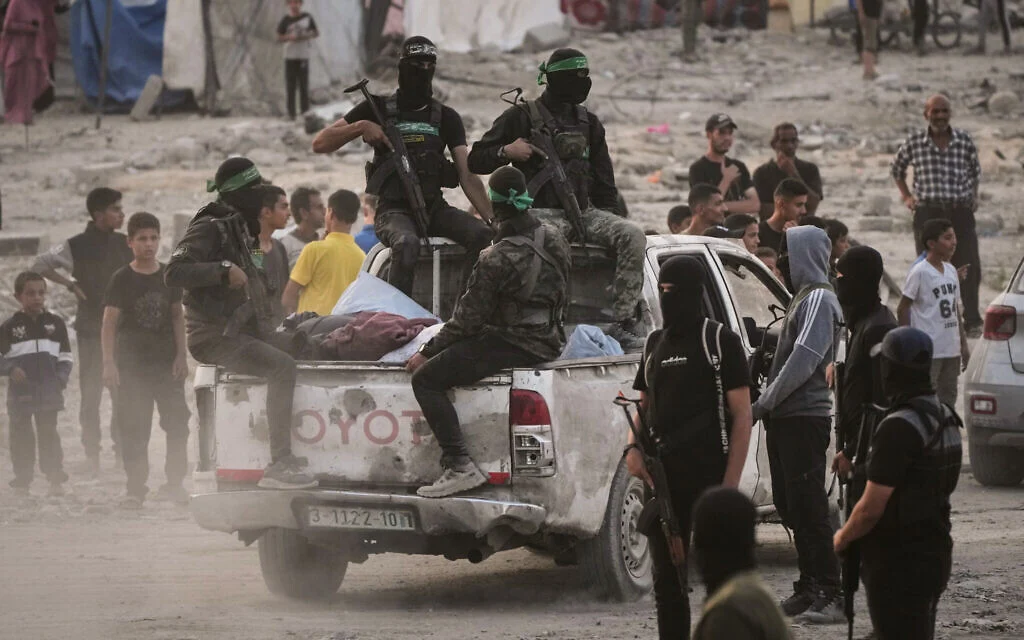
Hamas has managed to reassert its dominance in the near-half of the Strip from which the IDF has withdrawn since the Trump plan’s phase one truce and hostage release deal was inked on October 9.
The group agreed in that October deal to return, in one batch, all 20 remaining living hostages, giving up what had been seen as its remaining leverage over Israel despite having insisted for more than two years that the release would only be carried out in exchange for the full IDF withdrawal from Gaza. It also agreed to return the 28 bodies of deceased hostages still being held in the Strip. Twenty-seven of the bodies have been returned in a protracted process.
The phase one deal that Hamas accepted allows Israel to remain in control of 53 percent of the Strip. The Trump plan envisions an International Stabilization Force (ISF) gradually phasing out the Israeli army’s presence in the Strip, and the administration hopes to begin deploying the ISF at the beginning of January.
However, countries have yet to formally get on board, as the issue of Hamas’s disarmament remains unresolved.
Why Hamas agreed to the deal
Asked whether Hamas regrets agreeing to the October deal, especially as Israel has continued a daily pursuit of Gazan fighters that it says are violating the ceasefire, the source acknowledged that the terms of the US plan and its fallout have been far from ideal.
However, Hamas felt it offered the only way to end Israel’s bombardment of Gaza, the source said, briefing The Times of Israel at a hotel in Doha where much of the group’s abroad leadership is based.
The source claimed that there were no opportunities to reach an agreement earlier because Israel wasn’t prepared to end the war — a stance refuted by Trump officials as well as their predecessors from former US president Joe Biden’s administration, who argued that Hamas was the main obstacle to hostage deals, even if Prime Minister Benjamin Netanyahu at times took a combative approach in negotiations as well.
The source insisted that the group had been prepared to give up the hostages earlier and had offered to release the “civilian” hostages shortly after Hamas-led terrorists rampaged through southern Israel, murdering some 1,200 people and taking 251 captive into the Strip on October 7, 2023. Hamas refers to all Israeli adult men of army age as soldiers.
In the two years that followed, Hamas sought guarantees from the mediating countries that Israel would not resume fighting if it agreed to return the hostages, while Israel believed it would only release the hostages through military pressure and engaged in a crushing military campaign also aimed at destroying the group’s military and governing capabilities.
The IDF killed the vast majority of Hamas’s top leadership, along with what it says were 22,000 fighters. The Hamas-run health ministry’s war death toll is over three times that figure, though it doesn’t differentiate between civilians and combatants and has not been independently verified.
In the lead-up to the October ceasefire, the source said Hamas obtained assurances from the mediators, including the US, that they were committed to permanently ending the war.
Trump’s top aides Steve Witkoff and Jared Kushner even met with Hamas’s top negotiators on the eve of the ceasefire’s signing in Sharm el-Sheikh, Egypt, to offer the commitment in person.
In exchange, Witkoff said, Hamas had agreed to disarm. The Hamas source flatly denied this and said the sides didn’t even discuss such details, as the meeting mainly was used by the sides to build a personal rapport with one another. Witkoff said he managed to connect with head Hamas negotiator Khalil al-Hayya over their shared grief in losing a child — Witkoff’s to a drug overdose and Hayya’s to a September Israeli airstrike in Doha targeting the group’s leadership.
‘Mistakes’ were made while ‘restoring order’ post-ceasefire
While the group says it is prepared to give up governing authority over the Strip to an independent committee of Palestinian technocrats, it has worked to crack down on dissent in the two months since the ceasefire.
This has included summarily executing dozens of its rivals and other intimidation tactics.
While acknowledging that “mistakes” were made, the Hamas source said the group resorted to “hard tactics” to prevent “chaos” and “restore order.”
He took particular issue with those he accused of collaborating with Israel, including rival clan leader Yasser Abu Shabab, who was killed last week in a Rafah area under Israeli control.
The source didn’t claim Hamas was responsible, and reports have indicated Abu Shabab was killed in an internal dispute.
Eager for phase two
Regardless, the Hamas source said the group is keen to advance to phase two of the Trump plan, which envisions the installation of governing and security mechanisms responsible for managing Gaza during a postwar transitional phase.
Israel has pushed back on transitioning to phase two before Hamas has finished releasing all remaining deceased hostages. The body of Ran Gvili, a police officer killed during the October 7 onslaught, is still held in Gaza, but the Hamas source said the group has some idea about where his body may be located and is working to retrieve it.
“No one, including the US, imagined that Hamas would have been able to hand over 27 bodies already,” the source said. Trump has indeed appeared to credit the group for its efforts.
Phase two would also see a new Palestinian technocratic committee begin operating in Gaza with the oversight of a Trump-headed Board of Peace and an intermediate-level executive committee filled by Witkoff, Kushner, former UK prime minister Tony Blair, former UN envoy for the Mideast peace process Nikolay Mladenov and others, a US official told The Times of Israel.
Palestinian factions have held talks with Egypt to give their blessing on a list of politically independent Palestinians who will serve in the technocratic government that will be tasked with providing services and managing day-to-day affairs in Gaza. However, it is unclear if the US will accept those individuals or come up with an entirely different list.
Meanwhile, the ISF should be deployed “at the border” as a buffer between Israel and Gaza’s Palestinians, the Hamas source said, just weeks after his group condemned a UN Security Council resolution that provided the international mandate to establish the ISF.
Still, the source said that the ISF should not be involved in “taking weapons” from Hamas, as the resolution states.
While the US is hoping to announce a transition to the plan’s second phase already this month, Qatari Foreign Ministry spokesperson Majed al-Ansari indicated to reporters over the weekend that talks are still in initial stages regarding Hamas’s disarmament, with lots of questions on implementation still needing to be answered.
An Arab diplomat told The Times of Israel that Hamas has shown some indications that it would be prepared to accept a gradual disarmament process that begins with the handover or destruction of its heavy weapons, such as rockets and missiles.
Israel is unlikely to accept a drawn-out process, and the Hamas source did not comment on the idea, claiming that such specifics haven’t been discussed, even though his group is eager to do so.
The source said that in such negotiations, Hamas will demand the completion of Israel’s withdrawal from Gaza along with guarantees from mediators that Israel will not be allowed to resume military operations in the Strip.
Still, he took issue with the principle of the demand.
“You can’t tell your enemy that you will be polite and not use weapons. He will not respect this,” the Hamas source said, suggesting that Israel only responds to force.
Support for a two-state solution?
But beyond more immediate security concerns, the negotiations Hamas seeks would address longstanding political issues.
“The issue of the weapons is tied to a political issue, and therefore requires a political solution,” the Hamas source said, asserting Palestinians have a right to take up arms against “78 years of Israeli occupation.” That figure includes the period between 1948 and 1967, before Israel captured the West Bank, Gaza and East Jerusalem in the 1967 Six Day War.
The “political solution” Hamas is demanding in exchange for handing over its weapons is the establishment of a Palestinian state based on the pre-1967 lines, the source said.
The source didn’t seem to rule out the idea of a process that leads to the establishment of a state, as opposed to a more definite demand — both of which would almost certainly be rejected by Israel, whose public became more opposed to ceding control of territory following Hamas’s October 7 onslaught.
Asked whether the state Hamas pursues can exist alongside the State of Israel, the source responded: “We demand a state on the 1967 borders, which is just 21% of historic Palestine. That is our right. At the same time, don’t ask me to recognize Israel.”
He appeared to reject the notion that Hamas seeks control over the remaining territory between the Jordan River and the Mediterranean Sea, but chafed at a question on whether there could be coexistence after a Palestinian state is created on the pre-1967 borders.
Hamas’s founding charter calls for the “liberation” of all territories under Israeli control, but the group’s leadership adopted a follow-up document in 2017 that called for the establishment of a provisional Palestinian state on the pre-1967 lines, without recognizing Israel. The original charter has not been formally rescinded, however.
The source maintained that this is what differentiates Hamas from the Ramallah, West Bank-based Palestinian Authority, which also works for the establishment of a Palestinian state, but recognizes Israel.
And while Hamas is prepared to step aside from governance temporarily, it plans to be part of the future Palestinian state and have its weapons handed over to that government. PA President Mahmoud Abbas, however, has said he seeks a demilitarized Palestinian state.
Despite the very significant demands and the fact that disarmament talks do not appear very advanced, the source said Hamas is “prepared to be flexible” and that an agreement is possible.
No regrets over Oct. 7
The source was then asked whether Hamas’s launching of the October 7 attack had been a mistake, given the vast amount of death and destruction that has been wrought on Gaza since.
He responded by appearing to suggest that Hamas had little choice but to carry out the invasion, claiming that all other approaches had not succeeded in “liberating” the Palestinian people and that it could either “continue sitting in silence as slaves of the occupation or [it] could do something.”
That something included the mowing down of hundreds of Israeli civilians at a music festival, along with the use of widespread sexual violence, the kidnapping and murder of children and the elderly, the systematic killing of families in their homes, and other atrocities.
The source denied that such crimes had been committed and claimed that Hamas tries to avoid targeting civilians.
And while he recognized the massive price that Palestinians are continuing to pay for the war sparked by Hamas, the source argued that the fallout has also been the demonization of Israel in global public opinion, particularly among young people.
“We succeeded in changing history. The world has opened its eyes and sees what the Palestinians are going through and how criminal Israel is acting,” he said.