
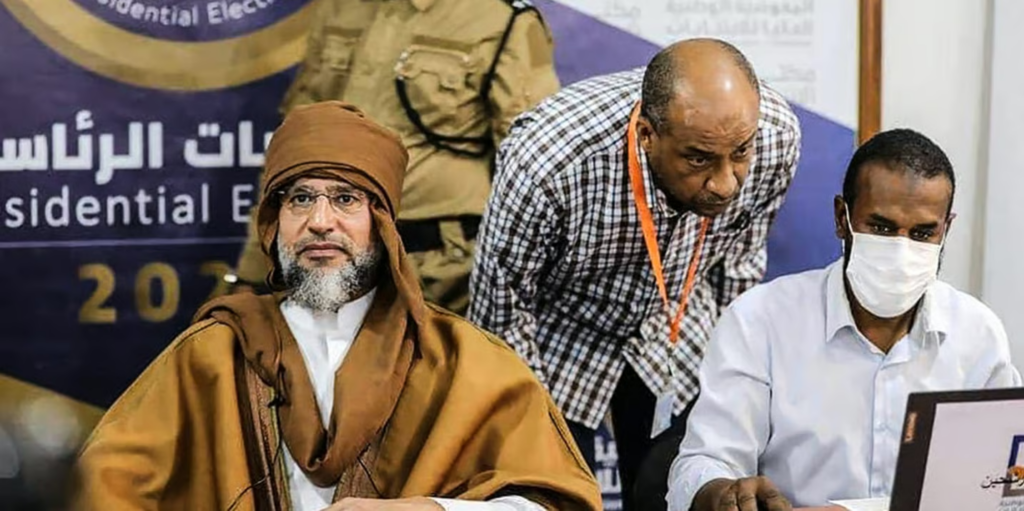
The death of the ICC-wanted heir removes a major obstacle to the country’s stalled elections, even as his supporters decry a ‘treacherous’ end for the man who once promised reform – and later, ‘rivers of blood’.
Saif al-Islam Gaddafi, the son of Libya’s late longtime ruler, Muammar Gaddafi, was killed Tuesday by gunmen who stormed his home in the western city of Zintan, his French lawyer Marcel Ceccaldi told AFP.
“He was killed [Tuesday] at 2:00 pm [1200 GMT] in Zintan in his home by a four-man commando,” Ceccaldi said.
Saif al-Islam, 53, had been seen by some as his father’s successor, despite being targeted by a warrant from the International Criminal Court (ICC) for alleged crimes against humanity.
In 2021, he announced he would run for president, but those elections were indefinitely postponed.
His adviser, Abdullah Othman Abdurrahim, told Libya’s Al-Ahrar television channel that the four unidentified men had stormed the home before “disabling surveillance cameras, then executed him”.
It remains unclear who is behind the killing.
Ceccaldi said a close associate of Saif al-Islam had told him days ago “that there were problems with his security”.
“So much so that the head of the [Gaddafi’s] tribe had called Saif and told him ‘I will send you people to ensure your security’. But Saif refused,” he said.
[Saif al-Islam’s death is] likely to cast him as a martyr for a significant segment of the population
While Saif al-Islam held no official position in Libya under his father’s rule, he had been described as the North African country’s de facto prime minister, cultivating the image of a moderate and reformer prior to the 2011 Arab Spring revolt.
But that reputation soon collapsed when he promised ‘rivers of blood’ in the face of the uprisings.
A divided country
Saif al-Islam was arrested in November 2011 in southern Libya following a warrant issued by the ICC in The Hague.
A Tripoli court later sentenced him to death in 2015 after a speedy trial, but he was granted amnesty.
His whereabouts had long been unknown. Ceccaldi said he “often moved around”.
Emadeddin Badi, a senior fellow with the Middle East Programs at the Atlantic Council, said Saif al-Islam’s death is “likely to cast him as a martyr for a significant segment of the population, while also shifting electoral dynamics by removing a major obstacle to presidential elections”.
“His candidacy and potential success had been a central point of contention,” Badi, who is a senior fellow at the Global Initiative Against Transnational Organized Crime (GI-TOC), said on X.
Muammar Gaddafi’s last spokesman, Moussa Ibrahim, also said on X: “They killed him treacherously. He wanted a united, sovereign Libya, safe for all its people.”
“I spoke with him two days ago. He spoke of nothing but a peaceful Libya and the safety of its people.”
Libya has struggled to recover from chaos that erupted after a NATO-backed uprising in 2011 overthrew longtime ruler Muammar Gaddafi.
Libya remains divided between a UN-backed government based in Tripoli and an eastern administration backed by Haftar.