
Key Takeaway: The Ethiopian federal government will likely launch an offensive against the Tigray People’s Liberation Front (TPLF) within the next month to neutralize the TPLF and its role in an emerging, loose anti-Ethiopian federal government coalition consisting of Eritrea, the TPLF, and other Amhara and Oromo ethno-nationalist militias. A conflict in Tigray would likely increase ongoing proxy competition between the Ethiopian federal government and the Sudanese Armed Forces (SAF) and heighten the risk of a broader Ethiopia-Eritrea conflict, which would likely draw in Egypt, the United Arab Emirates, Israel, and potentially Saudi Arabia.
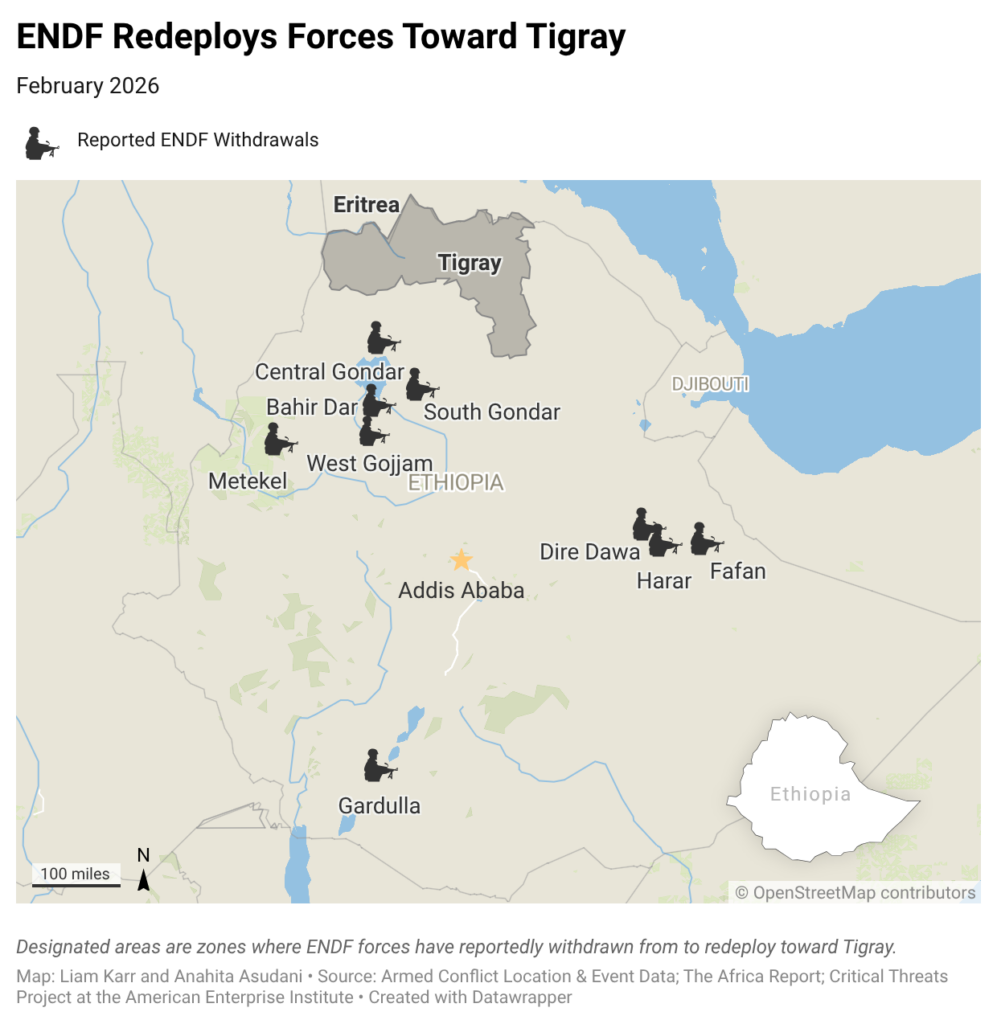
The Ethiopian federal government will likely launch an offensive against the Tigray People’s Liberation Front (TPLF) within the next month. The Ethiopian National Defense Force (ENDF) has massed forces and equipment at multiple locations along the Tigray regional border.[i] Videos on social media show convoys transporting heavy artillery, tanks, and troops toward Tigray.[ii] The ENDF has redeployed forces from across the country toward Tigray, including units stationed in Amhara and Oromia—two regions facing insurgencies from other armed groups.[iii] The ENDF has also declared a mobilization of former soldiers.[iv] TPLF head Debretsion Gebremichael said on February 17 that the ENDF is preparing to launch a war in Tigray, and the TPLF has since warned the international community of the risk of war.[v]
Figure 1. ENDF Redeploys Forces Toward Tigray
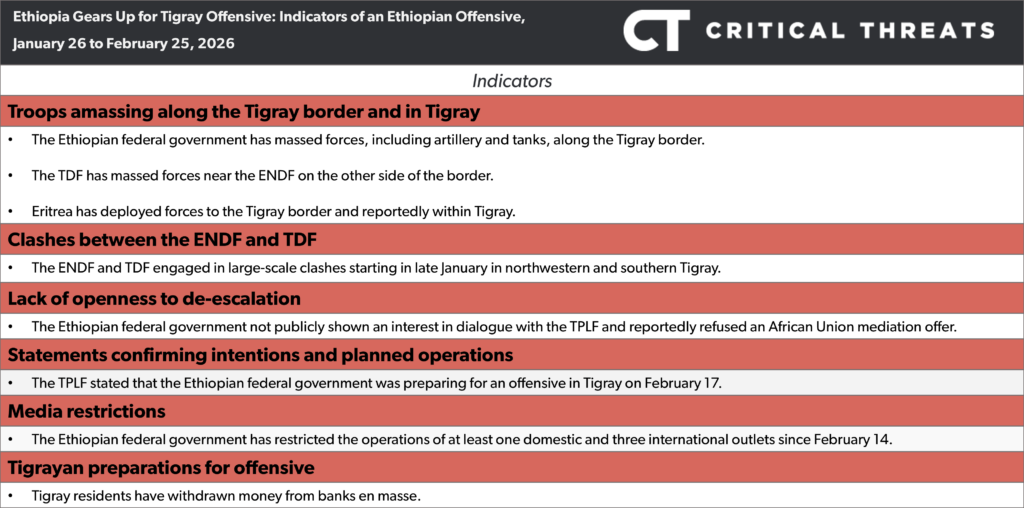
The federal government has additionally placed restrictions on journalists, which mirror restrictions immediately prior to and during the Tigray war from 2020 to 2022.[vi] The federal government prevented a credentialed Agence France-Presse journalist from traveling to Tigray on February 19 and revoked the Addis Standard’s certificate to operate online on February 24.[vii] The federal government previously refused to renew BBC journalists’ credentials and revoked Reuters journalists’ credentials on February 14 after Reuters published a story about Ethiopia’s involvement in the Sudanese civil war, which followed similar restrictions on Deutsche Welle and Wazema Radio.[viii]
The Tigray Defense Forces (TDF)—the TPLF’s military force—has responded to the buildup by massing forces across the border from where ENDF units are stationed.[ix] The TDF has also reportedly deployed heavy artillery and tanks.[x] TDF and Tigray Interim Administration (TIA) head Tadesse Worede stated on February 18 that only a “slim chance” for peace remains.[xi] Tigray residents have withdrawn money from bank accounts en masse, and there have been disruptions to daily market activity in Tigray.[xii]
Figure 2. Military Buildup in Northern Ethiopia
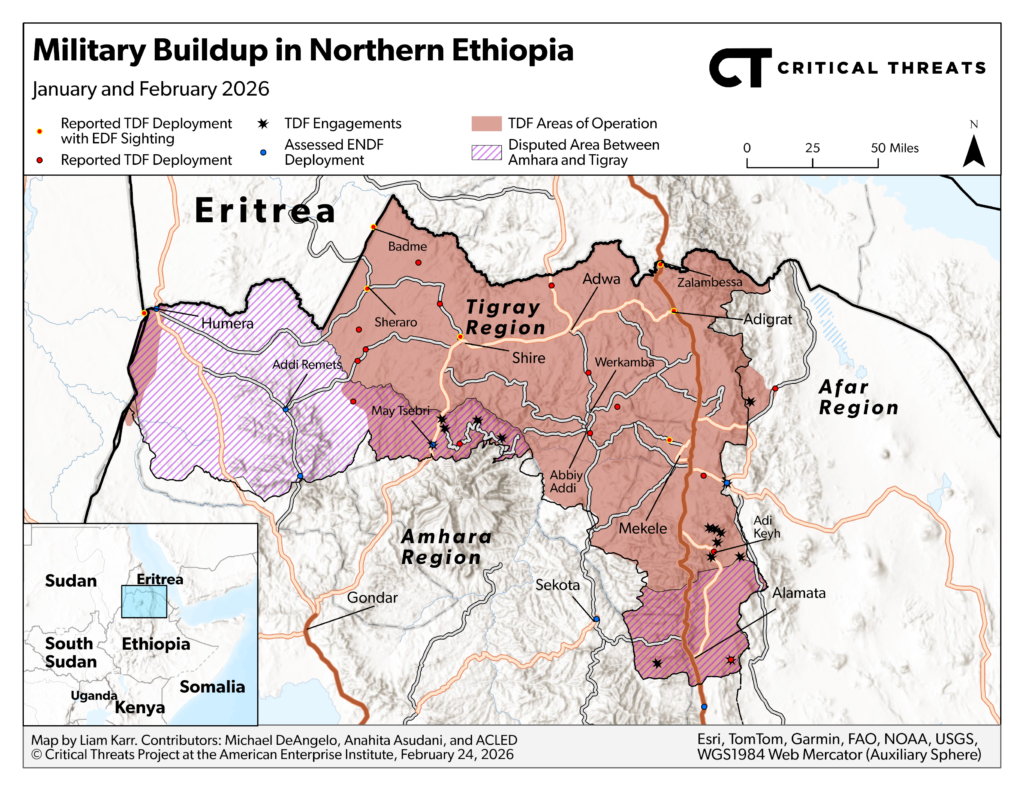
The buildups and statements follow recent clashes between the ENDF and TDF, which were the first large-scale hostilities between the two parties since the Tigray war ended. The TDF launched offensives to uproot the ENDF and Amhara ethno-nationalist forces from disputed areas of Tigray in late January.[xiii] The TDF first captured much of Tslemti district in North Western zone before withdrawing, then captured key towns in Alamata district in Southern zone.[xiv] The TPLF attempted to de-escalate and pursue dialogue after the offensive, but the federal government was unresponsive.[xv] The Economist reported that the federal government rejected an African Union mediation offer on January 30 and proceeded to begin the ongoing troop buildups the following week.[xvi] Ethiopia’s legislature then announced on February 23 that the federal government would assume responsibility for holding upcoming federal elections in certain disputed areas of Tigray, which the TIA denounced as a violation of Tigray’s borders and the federal constitution.[xvii]
Figures 3 and 4. Ethiopia Gears Up for Tigray Offensive: Indicators and Counter-Indicators of an Ethiopian Offensive
Relations between the federal government and TPLF have sharply deteriorated since early 2025, leaving the two sides at an impasse. Disputes between the federal government and TPLF over the continued presence of Amhara ethno-nationalist militias in disputed areas of Tigray, the return of displaced Tigrayans to these areas, and the TDF’s demobilization have undermined the implementation of the Pretoria peace agreement, which ended the Tigray war. The federal government has not enforced the withdrawal of the Amhara militias and secured all of Tigray’s de jure boundaries, which the Pretoria agreement mandates alongside the TPLF’s demobilization, disarmament, and reintegration.[xviii] The TPLF blames the continued displacement of more than one million Tigrayans on the presence of Amhara militias.[xix] The TDF has cited these shortcomings to justify its continued existence and substantially slowed its demobilization.[xx] Tadesse said that the recent clashes in Tselemti were a direct result of the federal government’s “failure to find a lasting solution” to the continued displacement of Tigrayans and presence of Amhara militias or to work with the TIA to solve the issues.[xxi]
The Pretoria agreement had already functionally collapsed in March 2025, when hardline TPLF factions affiliated with Debretsion launched a de facto coup against the federal government-backed TIA.[xxii] These factions disagreed with the Pretoria agreement and viewed the TIA as federal government-controlled.[xxiii] The TPLF’s coup allowed it to reassert political control over Tigray.[xxiv] The federal government eventually responded by revoking the TPLF’s legal standing as a political party, which prevents the TPLF from assuming formal federal or regional authority and effectively left TPLF-controlled Tigray outside of institutional control.[xxv]
The federal government and TPLF took increasingly belligerent stances throughout the rest of 2025 that pushed both sides toward open confrontation.[xxvi] The TPLF reinstated a central military command in June, which gives the TPLF formal control over the TDF.[xxvii] The TDF conducted raids in Afar, whose regional government is aligned with the federal government, in November to degrade the Tigray Peace Forces—an anti-TPLF Tigrayan faction that the TPLF accuses the federal government of backing.[xxviii] The ENDF responded with a drone strike on TDF positions, its first strike on Tigrayan forces since the end of the Tigray war.[xxix] The federal government then halted funding to Tigray in December, contributing to a limited TDF revolt against Tigray’s regional administration over unpaid salaries.[xxx] The TPLF has also accused the federal government of imposing a fuel blockade on Tigray.[xxxi]
The Ethiopian federal government likely seeks to neutralize the TPLF and its role in an emerging anti-Ethiopian federal government coalition consisting of Eritrea, the TPLF, Amhara ethno-nationalist Fano militias, and potentially the Oromo Liberation Army (OLA). The TPLF has opposed Ethiopian Prime Minister Abiy Ahmed’s plan to transition from a region-centric system of ethnic federalism to a more centralized and powerful federal government since he took office in 2018.[xxxii] These fundamental disputes sparked the Tigray war in 2020.[xxxiii] Abiy has since been unable to uproot the TPLF’s hold on military and political power in Tigray despite the Pretoria agreement mandating federal control of the region.[xxxiv] ENDF head Birhanu Jula stated in late 2025 that the TPLF’s violations of the Pretoria agreement justify war and that someone must depose the TPLF leadership.[xxxv] Tadesse has denied recent rumors that the ENDF deputy head said that the ENDF would seize all military bases in Tigray, but the TPLF has said that the Ethiopian federal government is preparing for war, with potential ENDF buildups on the Afar border near Mekele, the Tigray capital.[xxxvi]
Eritrea has partnered with the TPLF and other Ethiopian opposition factions to keep Ethiopia divided, preoccupied, and confined within its borders so that it poses less of a threat to Eritrea. Eritrea’s ties with the federal government collapsed after the Ethiopian federal government excluded Eritrea from the Pretoria peace process, even though Eritrea fought on the side of the Ethiopian federal government.[xxxvii] Ethiopian officials’ separate claims to sea access via Eritrea since have further increased tensions between Eritrea and Ethiopia, stoking Eritrean fears of an Ethiopian invasion.[xxxviii] Ethiopian officials have not fully ruled out the use of force to obtain sea access at Eritrea’s port of Assab.[xxxix]
The TPLF and Eritrea have bolstered ties amid their deteriorating relations with the federal government. Eritrean President Isaias Afwerki and TPLF officials reportedly met in January 2025 in one of several meetings between Eritrean and TPLF officials.[xl] Afwerki pledged to support the TPLF in case of a war with Ethiopia, according to French outlet Africa Intelligence.[xli] Eritrea and Tigray reopened a border crossing in June with TPLF head Debretsion in attendance, and Debretsion declared the TPLF’s intention to strengthen relations with Eritrea afterward.[xlii] Eritrea may have provided intelligence support for the TPLF’s de facto coup against the TIA in March and the TDF’s recent offensives in northwestern and southern Tigray, according to The Guardian and the Belgium-based, human rights-focused Europe External Programme with Africa think tank, respectively.[xliii] Eritrea has deployed forces to the Tigray border, with multiple sources reporting that Eritrea has deployed forces in Tigray itself.[xliv] An Ethiopian military official told French outlet The Africa Report on February 11 that Eritrean forces have established positions along key roads.[xlv] The TPLF denied ongoing military coordination with Eritrea but left open the possibility of an alliance in a conflict against Ethiopia.[xlvi]
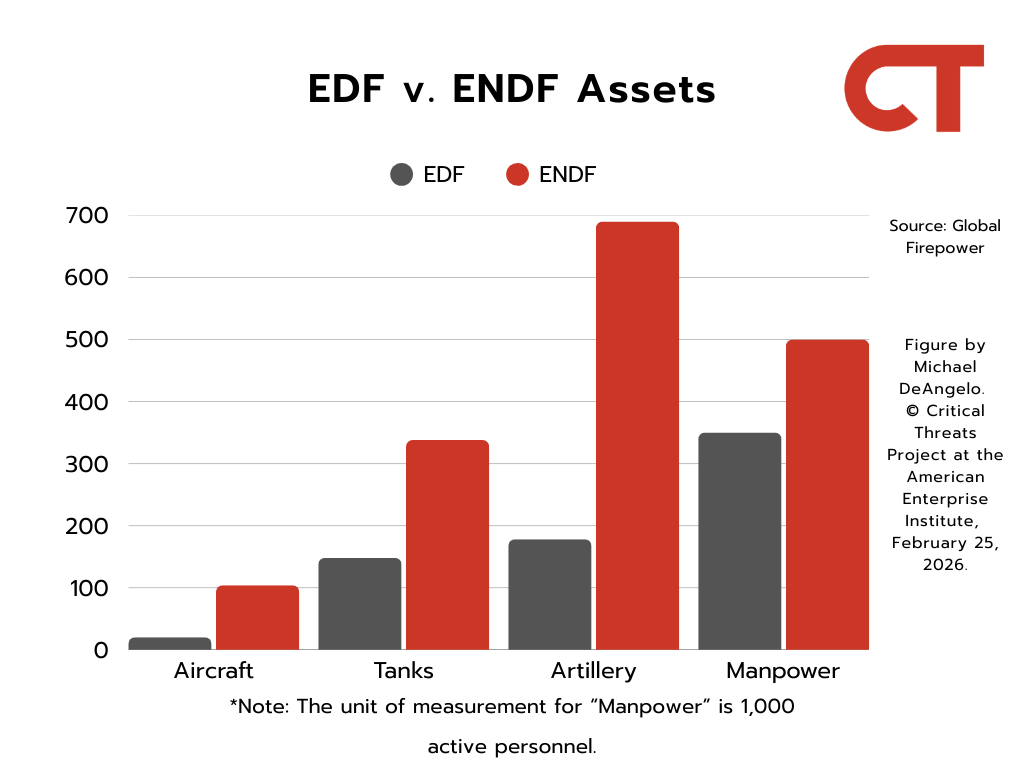
Eritrean support for the TPLF helps prevent Ethiopia from following through on its threats to annex Assab. The ENDF has limited options to launch offensives against Eritrea, as the TDF’s presence constrains the ENDF to the Afar-Eritrea border. The TDF is also a force augmenter for the Eritrean Defense Forces (EDF), as the TDF has over 250,000 fighters with heavy artillery and tanks.[xlvii] The EDF reportedly has 350,000 active personnel compared to the ENDF’s over 500,000, according to GlobalFirepower.[xlviii] The EDF also possesses significantly less air and land assets, including artillery, fighter aircraft, drones, and tanks.[xlix] The EDF relies heavily on Soviet-era equipment, while the ENDF has undertaken an extensive modernization.[l] Eritrea and Ethiopia have already come close to direct interstate conflict recently, with Eritrea launching a nationwide military mobilization in February 2025 and both countries massing forces at their shared border in March 2025 following the TPLF power grab.[li]
Figure 5. EDF v. ENDF Assets
Eritrea and the TPLF may also be collaborating with Fano and the OLA—an Oromo ethno-nationalist group—to pressure the Ethiopian federal government on multiple fronts. Ethiopia filed a complaint to the United Nations in early October accusing Eritrea and the TPLF of supporting a Fano offensive against the Ethiopian federal government in eastern Amhara.[lii] The Amhara regional government, which is aligned with the Ethiopian federal government, accused Eritrea of supplying Fano following an ammunition seizure in January.[liii] Eritrea has trained Fano forces for several years.[liv] The Economist separately detailed a meeting between Eritrean, Fano, OLA, and TPLF officials to discuss military collaboration in November, with unconfirmed reports alleging that the four parties agreed to cooperate.[lv] There are substantial preexisting divisions within this potential coalition, however, as many of its members have fought each other at various points in recent years and have drastically divergent aims, and their main point of unison is their opposition to the Ethiopian federal government.
The immediate aims of the impending federal government offensive are likely limited to Tigray and do not involve an imminent invasion of Eritrea, partially due to Fano already taking advantage of overstretched ENDF forces, which will challenge Ethiopia’s ability to sustain large operations in Tigray. The ENDF has reportedly concentrated forces near disputed areas of northwestern, southern, and western Tigray, especially where the TDF launched offensives in late January. (See Figure 2.)[lvi] Reports do not indicate that the ENDF has redeployed forces to northern Afar, which shares a border with Eritrea. Multiple anti-Ethiopian federal government sources have reported that the ENDF has transited through Afar to station troops on Tigray’s borders, potentially including the eastern border less than 50 miles southeast of Mekele.[lvii] Eritrean forces have also deployed forces to the Tigray border and reportedly in Tigray itself, indicating that Eritrea expects the fighting to be concentrated in Tigray.[lviii]
Figure 6. Fano Exploits ENDF Redeployments from Amhara to Tigray
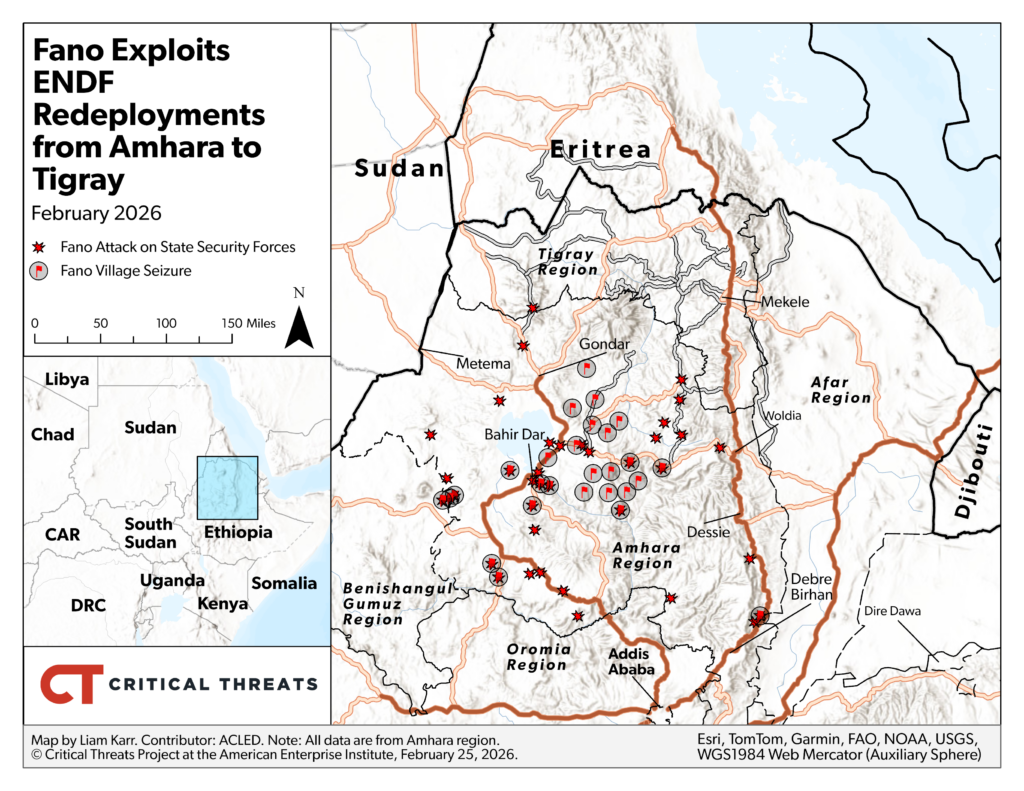
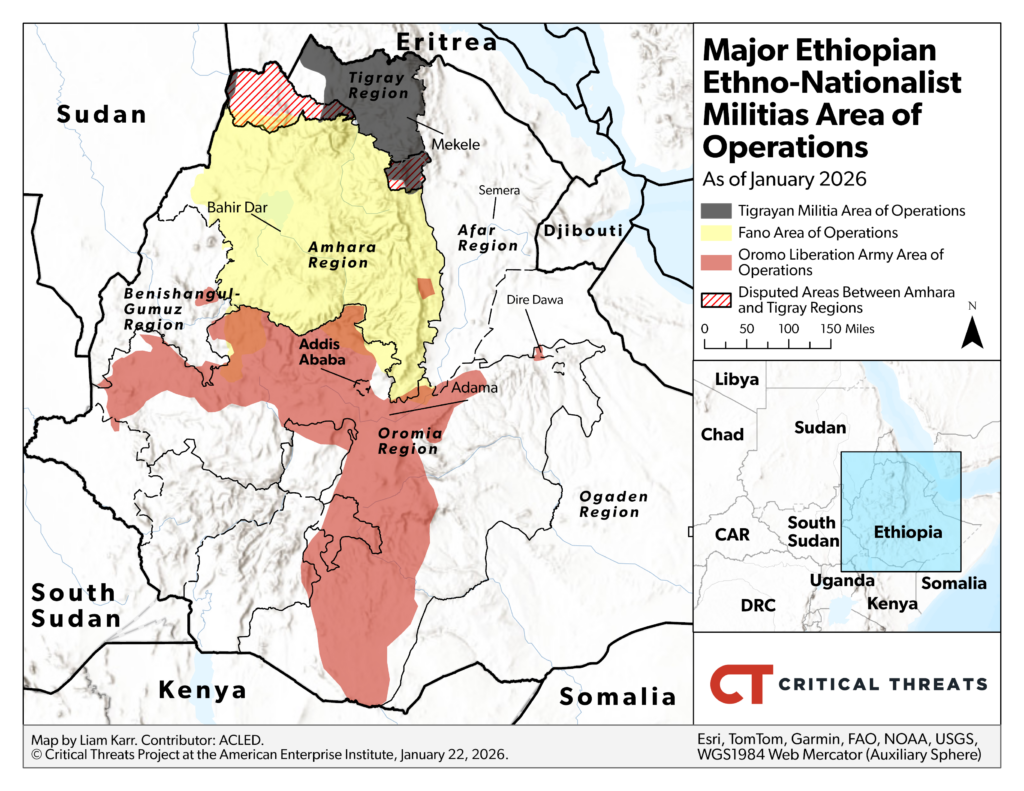
The ENDF’s redeployments from Amhara have left gaps for Fano and the OLA to exploit. Fano has launched offensives in central and western Amhara, capturing several towns along key roads.[lix] Fano captured Debre-Tabor—located on the main B22 highway connecting eastern and western Amhara—on February 8.[lx] Fano then captured Wereta—located on the A3 highway connecting Bahir Dar and Gondar, the two largest cities in Amhara—on February 15.[lxi] The ENDF has since conducted drone strikes and mounted ground operations to clear Fano positions, but clashes are ongoing.[lxii] Fano has briefly contested major cities in the past and had the most active three-month stretch of its insurgency ever from August to October 2025.[lxiii] The OLA may also exploit the ENDF’s redeployments from Oromia and surrounding regions, as it has reportedly captured territory in Beninshagul-Gumuz region since the redeployments.[lxiv] The OLA is active across central, southern, and western Ethiopia, including near Addis Ababa, the Ethiopian capital.[lxv]
Figure 7. Ethno-Nationalist Militia Area of Operation in Northern Ethiopia
A conflict in Tigray would heighten the risk of a broader Ethiopia-Eritrea conflict, however, due to Eritrea’s reported support for the TPLF and Ethiopia’s condition-setting for a future offensive against Eritrea. Afwerki’s alleged pledge to back the TPLF, reported Eritrean deployments in Tigray, and reported material support to the TPLF could lead to direct Eritrean participation in the fighting.[lxvi] Ethiopian Foreign Minister Gedion Timothewos already demanded that Eritrea to withdraw forces from Tigray on February 7 and halt any support for the TPLF and other armed groups, allegations that Eritrea rejected.[lxvii] Direct clashes between the EDF and ENDF would create a spillover risk, further escalate diplomatic tensions, and push the two adversaries toward open war.
A neutralized TPLF would also enable the ENDF to mass forces at multiple points along the Eritrean border and pursue its sea access ambitions. The ENDF would be able to amass forces along the entirety of the Ethiopia-Eritrea border—not just Afar—should it neutralize the TPLF. Gedion’s letter to his Eritrean counterpart on February 7 mentioned Ethiopia’s interest in gaining sea access via Assab.[lxviii] The ENDF displayed a banner implying that Ethiopia should annex Assab and assert a naval presence on the Red Sea during a military parade on February 22.[lxix] Abiy stated at the parade that the ENDF has the capability to “eliminate threats from the tip of Moyale to the tip of Massawa,” which is another Eritrean port city. Abiy and Jula also emphasized the ENDF’s naval training and intention to assert a naval presence.[lxx]
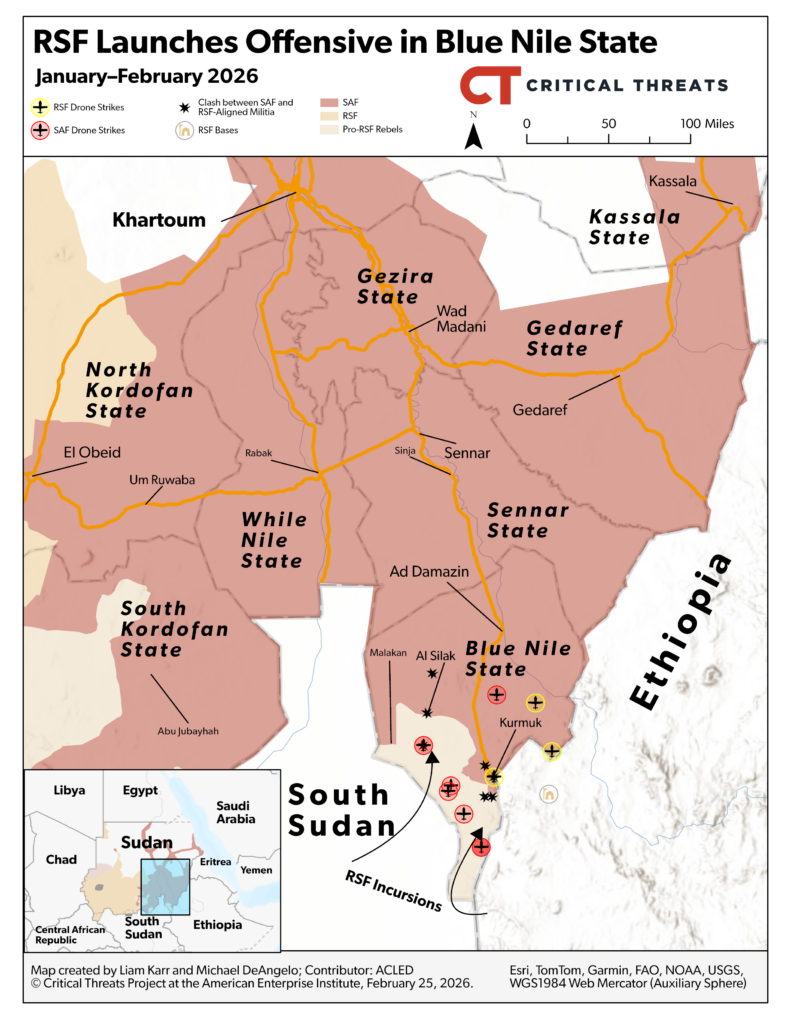
A conflict in Tigray would likely increase ongoing proxy competition between the Ethiopian federal government and the Sudanese Armed Forces (SAF). The Ethiopian federal government recently began directly supporting the Rapid Support Forces (RSF) in Sudan’s civil war, enabling the RSF to recently open a second front on the SAF’s eastern flank from western Ethiopia. Reuters confirmed SAF allegations from late 2025 that the ENDF helped establish an RSF training camp near the Sudanese border in Benishangul-Gumuz.[lxxi] The RSF and allied Sudan People’s Liberation Movement–North (SPLM-N) al Hilu militia have since launched an offensive in southeastern Sudan’s Blue Nile state, with SAF officials stating that fighters have transited through Ethiopia.[lxxii] Disruptions to RSF supply lines through Libya and Somalia have also made Ethiopia a key transit point for Emirati weapons shipments to the RSF.[lxxiii] Emirati-linked weapons shipments to Ethiopia have substantially increased since November 2025.[lxxiv]
Figure 8. RSF Launches Offensive in Blue Nile State
The SAF would likely leverage its long-standing relationship with the TPLF to counter and retaliate against Ethiopia. The SAF has allowed the TPLF to use Sudan as a safe haven historically and provided logistic support.[lxxv] The TPLF has established training bases in eastern Sudan, and the alleged Eritrea-TPLF-Fano-OLA meeting in November took place in SAF-controlled Sudan.[lxxvi] TDF advances into western Tigray would directly link the TPLF-controlled territory in Tigray with these rear bases in Sudan. TPLF-affiliated fighters have also reportedly fought alongside the SAF against the RSF.[lxxvii]
A broader war involving Eritrea would likely draw in Egypt, the United Arab Emirates, Israel, and potentially Saudi Arabia, most of which are already active in the neighboring Sudanese civil war. Egypt has increased ties with Eritrea as both of their relations with Ethiopia have worsened. Egypt views Ethiopia as a threat to its interests in the Red Sea and the Nile River Basin due to Ethiopia’s unilateral operationalization of the Grand Ethiopian Renaissance Dam and naval ambitions.[lxxviii] Egypt and Eritrea have advanced a high-level security dialogue and agreed to a deal in which Egypt will reportedly invest in Eritrea’s port of Assab in exchange for naval access.[lxxix]
Gulf rivals Saudi Arabia and the United Arab Emirates (UAE) have important partnerships with Eritrea and Ethiopia, respectively. The UAE has been one of Ethiopia’s primary backers during Abiy’s tenure, and has invested billions of dollars across key economic sectors.[lxxx] The UAE has also facilitated deals to support Ethiopia’s quest for sea access, which would provide economic and security benefits for the UAE in the Red Sea.[lxxxi] The UAE crucially provided drones to and a supply air bridge for the Ethiopian federal government during the Tigray war, helping the Ethiopian federal government regain the initiative and giving it the upper hand in the Pretoria peace process.[lxxxii] The UAE has increased weapons shipments to Amhara since November 2025, but not nearly at the scale seen to support the RSF’s offensive via western Ethiopia.
Saudi Arabia has increased diplomatic ties with Eritrea over the last several years and considered investing in Assab as part of efforts to counter Emirati influence in the region.[lxxxiii] Egypt has sought to facilitate even closer ties between its Eritrean and Saudi allies in 2026.[lxxxiv] Saudi Arabia also has strong economic ties with Ethiopia, however, and Saudi officials have met with the Eritrean and Ethiopian foreign ministers separately in February 2026, presumably to mediate between the two countries.[lxxxv]
Israel has cultivated a growing partnership with Ethiopia in recent years, strengthening its alignment with the UAE across the Red Sea region. The Ethiopian and Israeli intelligence services strengthened counterterrorism and intelligence coordination in 2020.[lxxxvi] This partnership helped Emirati intelligence services foil an Iranian attack plot on the Emirati embassies in Ethiopia and Sudan.[lxxxvii] The Ethiopian and Israeli foreign ministers visited each other’s capitals in 2025, discussing collaboration against shared threats al Shabaab and the Houthis, which have expanded financial and arms smuggling ties and joint training since 2024.[lxxxviii] Israeli President Isaac Herzog traveled to Addis Ababa on February 25, meeting with Abiy, Gedion, and Ethiopian President Taye Atske Selassie.[lxxxix]
Figure 9. Emerging Coalitions in the Red Sea Arena
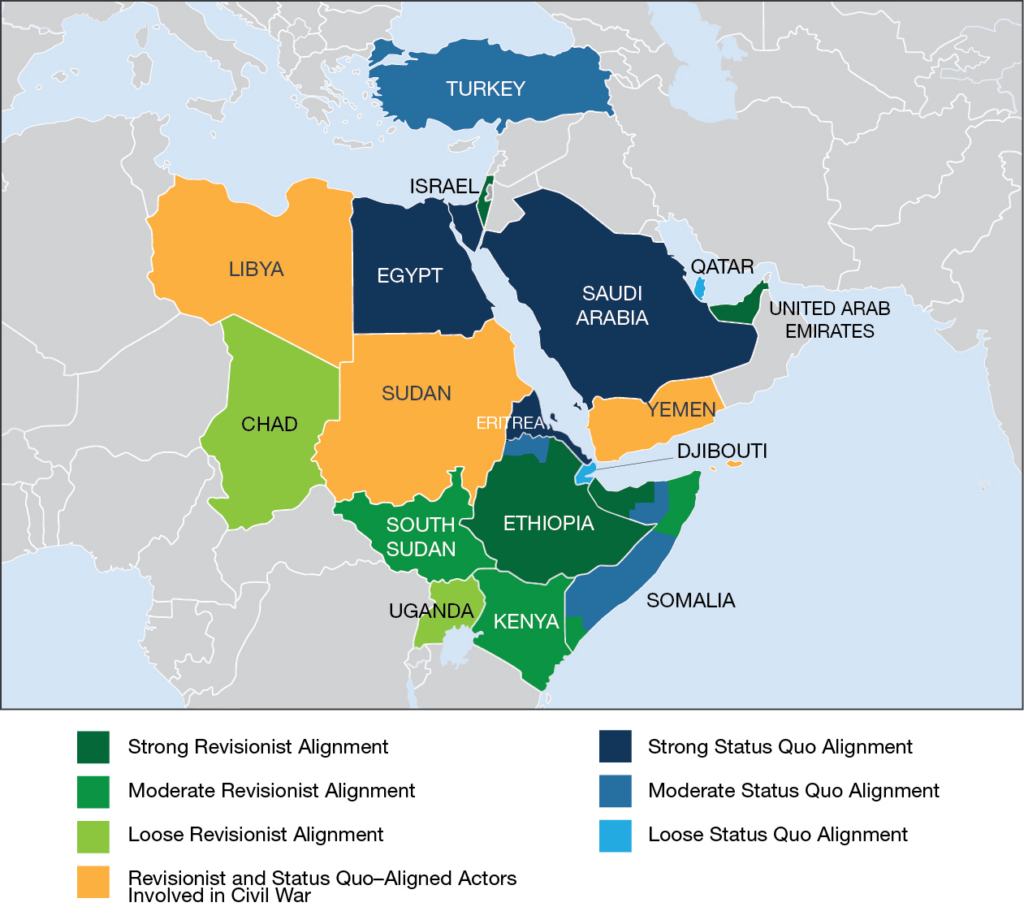
The Egypt–Saudi Arabia coalition and the UAE are already supporting opposite sides in Sudan’s civil war. Egypt has established joint command centers with the SAF and is conducting drone operations against the RSF from a base in southern Egypt.[xc] Saudi Arabia has provided mainly political support to the SAF in the US-led Quad peace forum that also includes Egypt and the UAE but is reportedly on the verge of a deal with Pakistan to supply the SAF with drones, air defense systems, and potentially fighter jets.[xci] The UAE is the RSF’s indispensable backer, supplying drones, air defense systems, and other equipment that were vital to the RSF consolidating control of western Sudan in the latter half of 2025, enforcing a de facto partition of Sudan.[xcii] The UAE uses air supply routes through Sudan’s neighboring countries, which Egypt and Saudi Arabia have recently disrupted by denying the UAE overflight permission.[xciii] This regional rivalry has hindered Quad peace talks, which have failed to achieve lasting ceasefires or sufficient provision of humanitarian aid.[xciv]
The regional competition has also come to a head in Somalia and Yemen, with the Egypt–Saudi Arabia coalition acting to supplant the UAE and Israel. Israel recognized the de facto independent breakaway Somaliland region, which the UAE is closely partnered with, in December 2025.[xcv] Israeli officials anonymously claimed that the UAE helped broker the recognition between its two allies.[xcvi] Egypt is working with Saudi Arabia and Somalia to finalize a trilateral military pact in response to the recognition after upgrading its ties with Somalia to a “comprehensive strategic partnership” in January 2025.[xcvii] Saudi Arabia has pressured Somalia to reduce ties with the UAE, and Somalia canceled bilateral agreements with the UAE in January 2026.[xcviii] Saudi Arabia then signed a military cooperation deal with Somalia on February 9.[xcix] Saudi Arabia separately halted an Emirati proxy offensive in Yemen in January 2026, leading to the UAE’s withdrawal from Yemen.[c]