
More than a week of protests in Iran reflects not only worsening economic conditions, but longstanding anger at government repression and regime policies that have led to Iran’s global isolation.
Regime security forces have thus far failed to quell the unrest with limited use of violence, but leaders have signaled they will again use massive armed force if necessary against protesters.
Regional leaders assess that a collapse of the regime, although unlikely, would usher in a long period of instability in Iran, but also lessen the threat posed by Tehran to other regional and global actors.
President Trump has threatened to intervene directly to support the protests, an unprecedented U.S. stance which might embolden demonstrators or, alternatively, discredit them as U.S. puppets.
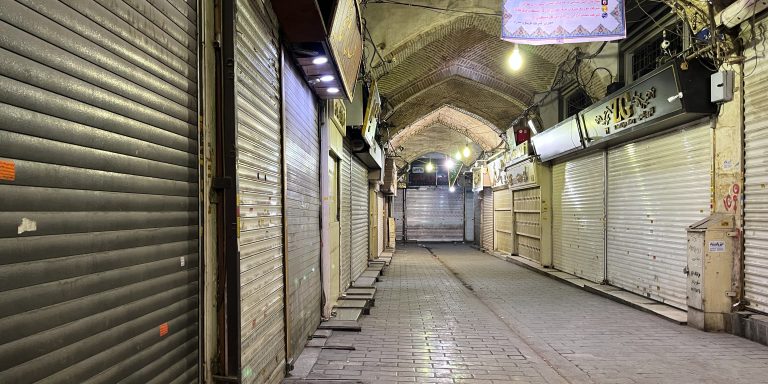
In late December, the most serious widespread unrest in Iran since the 2022 “Women, Life, Freedom” movement erupted in response to the recent sharp deterioration in economic conditions. The merchants of the large and powerful Tehran bazaar closed their shops and demonstrated in response to the declining value of Iran’s currency, the rial, which fell to a new low. The currency collapse virtually eliminated the merchant class’s ability to earn a profit from its core business — the sale of imported goods. The merchants’ defiance immediately sparked significant demonstrations in Tehran and elsewhere, amid a recent admission by Iran’s President Masoud Pezeshkian that his government is unable to reverse Iran’s economic decline. For Iranian consumers, prices rose by an average of 52 percent year-on-year in 2025, according to the Statistical Centre of Iran, making many necessities out of reach for non-affluent Iranians. Within hours, the protests evolved into a call for the outright replacement of the regime — a longstanding goal of many groups in Iran who resent the decades of government repression, corruption, and mismanagement. The demonstrations in most locations appeared to be dominated by Iran’s youths and women but included the merchants, industrial workers, and members of minority communities such as Kurds and Arabs. By Sunday, protests were reported by Iranian observers in more than 60 towns and cities across almost all of Iran’s 31 provinces. These protests have continued to ebb and flow throughout the country, including large anti-government protests in Abdanan, in the western part of the country.
Affirming that many Iranians link the regime’s regional policies to their economic hardships, one chant widely heard among protesters stated: “Not Gaza, not Lebanon, may my life be sacrificed for Iran.” The chant reflects a widespread perception that Iran’s support for its Axis of Resistance coalition — and its national security policy more broadly — has squandered the country’s resources and provoked the United States, Europe, and other major powers to impose crippling sanctions on Iran. These sanctions have essentially shut the country out of the global financial system and fueled the runaway inflation.
One unique feature of the current unrest, in contrast to past uprisings, has been a call by many protesters for a specific alternative — the return of the Pahlavi monarchy, exemplified now by Reza Pahlavi, the 65-year-old son of the ousted Shah of Iran. The Crown Prince has been in exile in the U.S. since the 1979 Islamic revolution, and critics say he lacks the leadership skills to confront a regime willing to use significant violence to suppress unrest. Many experts however, reject a return to monarchy, arguing Iran needs to move forward to form a Western-style democracy and not return to past authoritarian structures.
As the uprising intensified over the past week, regional and global officials are closely watching the regime’s response. Pezeshkian, while backing the blockage of the Internet — a tactic used by the regime in previous uprisings — has offered dialogue with protest leaders to address grievances. On Thursday, he stated the protesters have legitimate demands, adding: “if people are unhappy with us, we are the ones at fault.” Experts also note that security forces have, thus far, appeared to use force selectively in hopes of de-escalating the protests and avoiding a resort to massive coercive force. The Associated Press reports that at least 29 protesters had been killed thus far — a far smaller number than at a similar stage of prior major uprisings. Approximately 321 Iranians were killed by security forces during mass protests in November 2019, according to Amnesty International. A UN fact-finding mission found that authorities had carried out “unnecessary and disproportionate use of lethal force” in response to the 2022 Women, Life, Freedom protests. The number arrested ranges from several hundred to more than a thousand.
The regime’s response to date has not quelled the unrest, raising questions about whether the regime will escalate its assaults on protesters, particularly as some demonstrations have turned violent. The geopolitical setbacks suffered by Iran at the hands of Israel and the U.S. over the past year might have eroded the popular perception of regime strength, emboldening protesters to challenge security forces. In some cases, as portrayed on social media, protesters are combating security agents directly, including seizing or destroying their weaponry and vehicles. Several Islamic Revolutionary Guard Corps (IRGC) and Basij security force personnel have been killed by protesters. Oppositionists have also burned or toppled regime symbols such as statues and banners. In his first comments on the uprising since it began on December 28, Iranian Supreme Leader Ayatollah Ali Khamenei on Saturday foreshadowed a potential escalation of the use of suppressive force, insisting that “rioters (as distinct from peaceful protesters) must be put in their place.” Escalation succeeded in putting down past major uprisings, and most experts assess that the regime leadership and security apparatus remain, at least for now, sufficiently cohesive and committed to suppressing the latest unrest. However, even if the uprising subsides, large-scale protests are sure to flare again unless Iran’s leaders dramatically alter their policies to address the sources of unrest.
The duration, scope, and geopolitical context of the uprising have raised questions about whether Iran’s adversaries might intervene to help the protesters. The U.S., its European allies, and Israel have long hoped to replace the Islamic Republic with a more moderate political structure committed to regional integration — and to abandoning support for destabilizing actions throughout the region. Arab leaders also view Tehran as an adversary and potential aggressor, but they worry that a collapse of the current regime will yield unpredictable results for the region. Israel’s twelve days of strikes on Iran in June were intended to degrade Iran’s nuclear and missile programs and conventional arsenals but also included attacks on IRGC and regime security targets — signaling that regime change formed part of Israel’s battle plan. As the current uprising began to unfold, Israeli Prime Minister Benjamin Netanyahu was visiting Trump at his Mar-a-Lago compound in South Florida, in part seeking a U.S. “green light” to conduct additional strikes on Iran’s missile infrastructure. Some participants and supporters of the demonstrations intimated on social media that the uprising might receive help from Israel’s Mossad intelligence agency. However, no indications of Israeli involvement in the protest movement have emerged to date.
Experts and global leaders are more closely watching the U.S. reaction to the Iran protests. The U.S. has, in the past, intervened directly to bring about regime change, including by invading Afghanistan in 2001 to end the Taliban regime’s hosting of al-Qaeda; toppling Saddam Hussein in Iraq in 2003; and providing close air support to forces opposing Libyan dictator Muammar Gaddafi in 2011. In contrast to Israel, the United States has the capability to employ decisive force in support of anti-regime elements in Iran, if there were a decision to do so. However, U.S. leaders have historically hesitated to support past uprisings in Iran vocally, let alone intervene directly with military or covert action. U.S. officials have calculated that U.S. support or intervention would discredit Iranian opposition leaders as tools or puppets of the United States and potentially bog the United States down in a long-term nation-building project in Iran.
President Trump, although publicly opposing embroiling the U.S. in the internal affairs of Middle Eastern and other states, has signaled he might depart from the policies of his predecessors in the case of Iran. For most of 2025, he openly sought to engage Iranian leaders to try to forge a new nuclear pact to replace the 2015 multilateral agreement (JCPOA) he abrogated during his first term. In recent weeks, however, his statements have suggested frustration with the Iranian leadership’s rejection of his requirements for a new agreement. On Friday, Trump went beyond threatening further strikes on Iranian nuclear facilities to imply he might intervene to support any potential uprising. He warned on his Truth Social media account that if Iran “violently kills peaceful protesters, which is their custom, the United States of America will come to their rescue.” He offered no specifics on how the U.S. might intervene to protect protesters in the country but added: “We are locked and loaded and ready to go.”
The Trump post sparked broad debate among experts about whether the threat would embolden protesters to escalate their challenge to regime security forces, or, alternately, cause many Iranians to rally around the regime to deter U.S. intervention. In an effort to prevent any direct U.S. assistance to protesters, Ali Larijani, a former speaker of Iran’s Majles (parliament) and now secretary of the country’s National Security Council, posted Friday: “Trump should know that intervention by the U.S. in the domestic problem corresponds to chaos in the entire region and the destruction of the U.S. interests…They should take care of their own soldiers.” Larijani implied Iran would respond to U.S. support for the protests with attacks on U.S. military forces based across the Middle East. U.S. officials did not immediately respond to Larijani’s threats.